Threat Hunting vs Incident Response: Which Security Function Do You Need
Incident response reacts to known alerts while threat hunting proactively searches for hidden adversaries, requiring distinct skills and data sources.
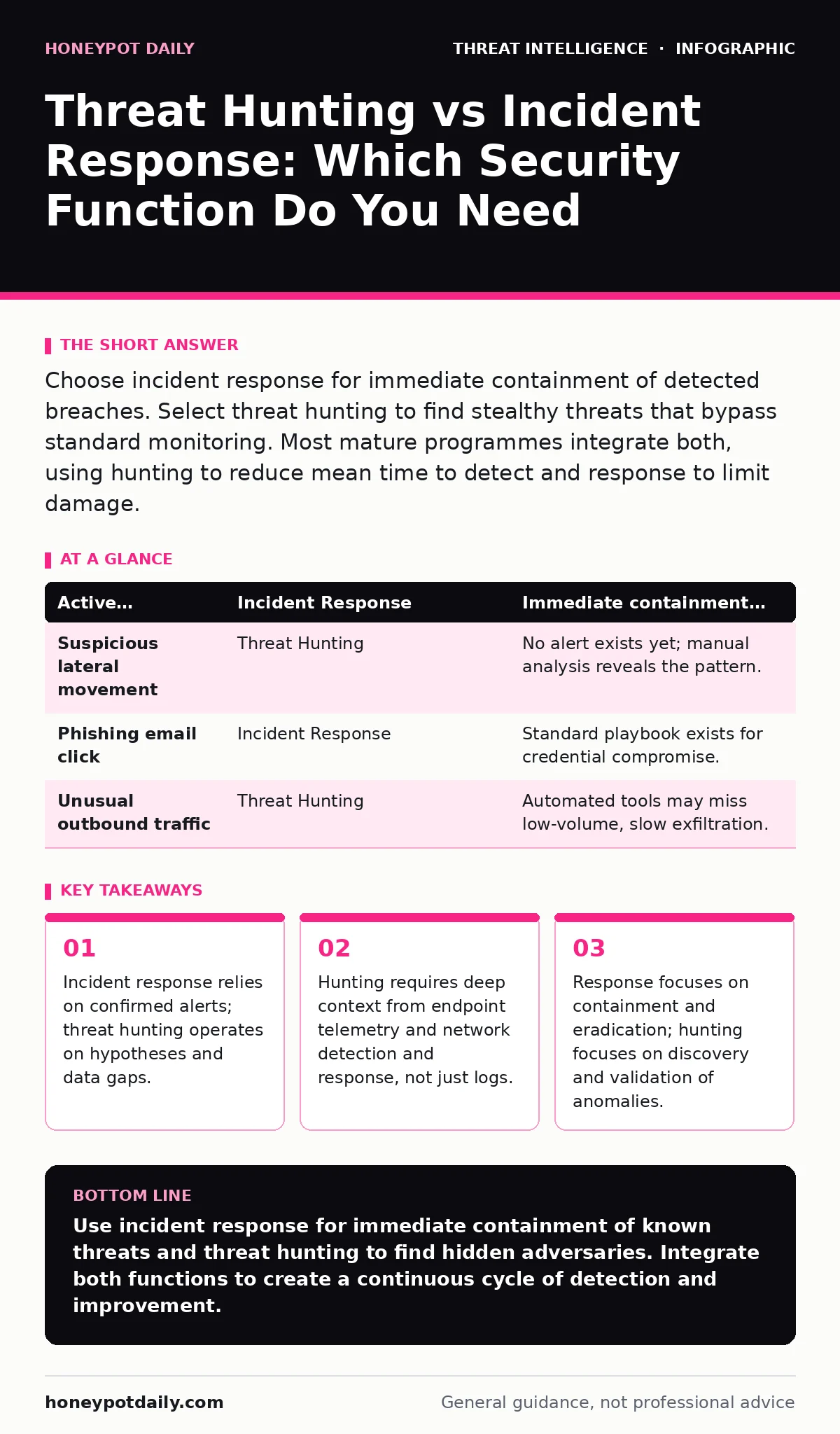
Choose incident response for immediate containment of detected breaches. Select threat hunting to find stealthy threats that bypass standard monitoring. Most mature programmes integrate both, using hunting to reduce mean time to detect and response to limit damage.
Does an alert trigger your action?
Incident response begins when a detection system signals a potential compromise. You react to a specific event, such as a firewall block or an antivirus quarantine. The goal is to contain the threat, eradicate it, and restore normal operations. This process is reactive by design. You cannot start incident response without a trigger.
Threat hunting starts with a hypothesis, not an alert. You suspect an adversary is present and search for evidence that supports or refutes that suspicion. This proactive approach finds threats that evade standard detection rules. It requires a different mindset, one that questions the integrity of the environment rather than trusting the monitoring tools.
What is your primary objective?
The objective of incident response is damage limitation. You aim to isolate affected systems, preserve forensic evidence, and communicate with stakeholders. Speed is paramount because every minute of delay increases the scope of the breach. The process follows a structured playbook to ensure consistency and legal defensibility.
The objective of threat hunting is discovery. You aim to identify malicious activity that has not yet been flagged by automated tools. This might involve looking for unusual process injection techniques or anomalous data transfers. The goal is to find the adversary before they achieve their objective, such as data exfiltration or ransomware deployment.
How do you validate your findings?
In incident response, validation is binary. Either the alert is a true positive requiring action, or it is a false positive that can be dismissed. You rely on established indicators of compromise, such as known malicious IP addresses or file hashes. The validation process is quick to allow rapid containment.
In threat hunting, validation is iterative. You gather data from multiple sources, such as endpoint telemetry and threat intelligence feeds, to build a picture of behaviour. You may find an anomaly that turns out to be a legitimate administrative task. The validation process is slower but more thorough, reducing the risk of disrupting business operations.
Which skills are required?
Incident response requires procedural discipline and forensic expertise. Analysts must follow playbooks precisely and document every step. They need strong communication skills to coordinate with legal, HR, and management teams. Technical skills focus on containment tools and forensic analysis.
Threat hunting requires creative thinking and deep technical knowledge. Hunters must understand how adversaries operate and how to manipulate data to reveal hidden patterns. They need proficiency in data analysis, scripting, and understanding system internals. The role is more investigative and less procedural.
Situation | Better fit | Why
| Active ransomware encryption | Incident Response | Immediate containment stops the spread and preserves data. |
|---|---|---|
| Suspicious lateral movement | Threat Hunting | No alert exists yet; manual analysis reveals the pattern. |
| Phishing email click | Incident Response | Standard playbook exists for credential compromise. |
| Unusual outbound traffic | Threat Hunting | Automated tools may miss low-volume, slow exfiltration. |
See also: Sandbox Escape Response: Containment, Recovery and Prevention Steps · How Digital Forensics Works: The Chain of Evidence Explained
When to use both together
Relying solely on incident response leaves blind spots. Adversaries who evade initial detection remain in the network until they cause significant damage. Relying solely on threat hunting is inefficient. Hunters cannot manually inspect every event in a large environment. You need incident response to handle the volume of confirmed alerts.
Integrating both functions creates a feedback loop. Incident response provides real-world examples of adversary behaviour. Threat hunting uses these examples to create new detection rules. This continuous improvement reduces mean time to detect and strengthens overall security posture. Blue team operations benefit from this synergy by having both reactive and proactive capabilities.
Consider how bulletproof hosting services allow adversaries to hide infrastructure. Hunting helps identify traffic to these hidden services before they are added to blocklists. Response handles the immediate threat once identified. Using both ensures you catch the early signs and deal with the confirmed threat.
Making the decision
Ask yourself if you have confirmed evidence of a breach. If yes, engage incident response. If no, but you have a strong suspicion or hypothesis, engage threat hunting. Do not try to do both simultaneously for the same event. It creates confusion and delays critical actions.
Define clear boundaries between the two functions. Incident response handles alerts and confirmed incidents. Threat hunting investigates anomalies and hypotheses. Ensure both teams share data and insights regularly. This collaboration prevents silos and ensures a holistic defence strategy.
Key takeaways
- Incident response relies on confirmed alerts; threat hunting operates on hypotheses and data gaps.
- Hunting requires deep context from endpoint telemetry and network detection and response, not just logs.
- Response focuses on containment and eradication; hunting focuses on discovery and validation of anomalies.
Use incident response for immediate containment of known threats and threat hunting to find hidden adversaries. Integrate both functions to create a continuous cycle of detection and improvement.
Frequently asked questions
Can the same person do both threat hunting and incident response?
It is possible in small teams, but the mindsets differ significantly. Combining them often leads to burnout and reduced effectiveness in both areas.
How do I measure the success of threat hunting?
Measure by the number of new detection rules created and the reduction in mean time to detect for specific threat types.
Is threat hunting only for large enterprises?
No, but the scope differs. Small teams can hunt using open-source tools and focused hypotheses on critical assets.
What data sources are best for threat hunting?
Endpoint telemetry and network detection and response provide the most comprehensive view of system behaviour and traffic patterns.
How this guide was produced: written by the Honeypot Daily editorial team with AI assistance, checked against the public references listed below, and reviewed when the facts change. See our editorial policy or report an error.