
Stop Process Injection: Practical Prevention for Modern Defences
Most injection attacks bypass perimeter controls by hiding inside legitimate processes, making internal integrity checks the only reliable defence.
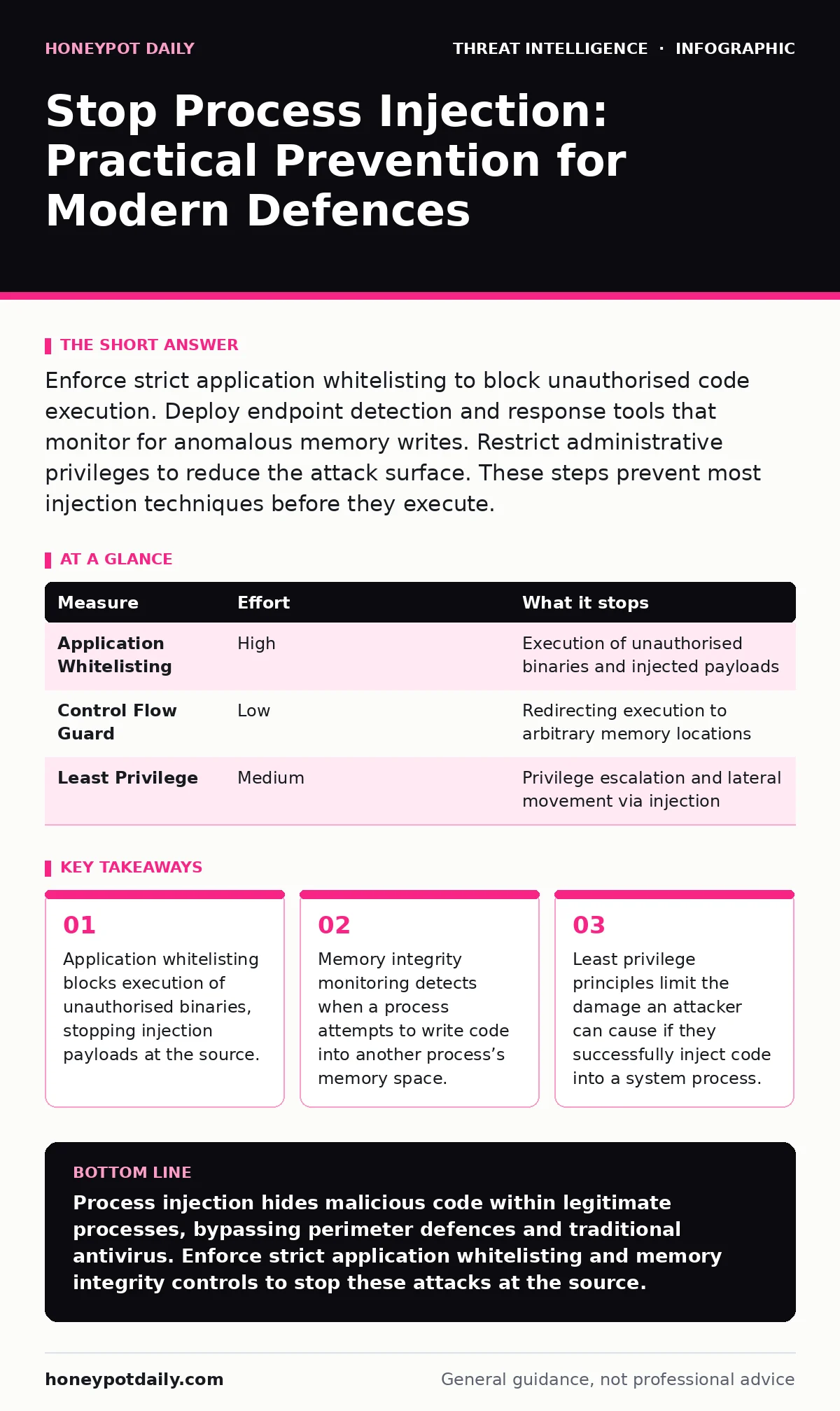
Enforce strict application whitelisting to block unauthorised code execution. Deploy endpoint detection and response tools that monitor for anomalous memory writes. Restrict administrative privileges to reduce the attack surface. These steps prevent most injection techniques before they execute.
The Mechanics of Process Injection
Process injection is a technique where an attacker forces a running process to execute malicious code. Instead of launching a new, suspicious program, the attacker piggybacks on a trusted application. This method hides the malicious activity within the normal behaviour of legitimate software. Security tools often trust these well-known applications, making the injected code invisible to basic monitoring.
The most common form involves writing shellcode into the memory space of a target process. The attacker then forces the target to jump to this new memory location. This allows the malicious code to run with the privileges of the host process. If the host is a high-privilege system service, the attacker gains elevated access immediately.
Imagine a scenario where an attacker targets a web server. They inject code into the server’s worker process. To an external observer, the server is simply handling requests. Internally, however, the injected code is exfiltrating data or establishing a backdoor. This stealth is why traditional signature-based antivirus often fails against injection attacks.
Why Perimeter Defences Fail
Firewalls and network intrusion detection systems focus on traffic entering or leaving the network. They are largely blind to activity that occurs entirely within a single host. Once an attacker has initial access, they can use process injection to move laterally. The traffic generated by the injected code often looks like normal application behaviour.
This is why relying solely on network segmentation is insufficient. An attacker who compromises one machine can inject code into processes that communicate with other systems. The injected code uses the legitimate credentials and network permissions of the host process. This bypasses many identity-based access controls.
For teams focused on blue team operations, this highlights a critical gap. Monitoring network flows alone will not reveal the internal manipulation of process memory. You must look at the host itself to see these attacks. Understanding the limitations of perimeter tools is the first step in building effective internal defences.
The Priority of Application Whitelisting
The most effective way to prevent process injection is to stop unauthorised code from running in the first place. Application whitelisting achieves this by allowing only approved executables to run on a system. Any binary not on the list is blocked, regardless of its signature or reputation.
This measure removes the risk of executing injected payloads from unknown sources. It also prevents attackers from dropping new tools onto the system. Whitelisting is stricter than blacklisting, which attempts to block known bad files. New or modified malware often evades blacklists, but it cannot bypass a whitelist.
Implementing whitelisting requires careful configuration. You must identify all legitimate applications and scripts that need to run. This initial effort is significant, but it pays off by reducing the attack surface. It forces attackers to use the approved binaries, which are easier to monitor and restrict.
Memory Integrity and Control Flow Guard
Modern operating systems include features to protect memory from corruption. Control Flow Guard is one such mechanism. It ensures that function calls only go to valid targets within the application’s code. This prevents an attacker from redirecting execution to injected shellcode.
When Control Flow Guard is enabled, the operating system validates the destination of indirect calls. If the target address is not a valid function entry point, the application crashes. This stops the injected code from running. It adds a layer of defence even if an attacker manages to write code into memory.
This feature is particularly effective against return-oriented programming attacks. These attacks chain together small pieces of existing code to perform malicious actions. Control Flow Guard breaks these chains by validating the flow of execution. It is a built-in defence that requires minimal configuration to enable.
| Measure | Effort | What it stops |
|---|---|---|
| Application Whitelisting | High | Execution of unauthorised binaries and injected payloads |
| Control Flow Guard | Low | Redirecting execution to arbitrary memory locations |
| Least Privilege | Medium | Privilege escalation and lateral movement via injection |
Restricting Administrative Privileges
The impact of a successful injection attack depends on the privileges of the host process. If an attacker injects code into a standard user process, their access is limited. If they inject into a system service running as administrator, they gain full control.
Enforcing the principle of least privilege limits this risk. Users and services should only have the permissions necessary for their tasks. This means regular users do not have administrative rights. Services run under dedicated accounts with minimal access.
This measure does not prevent injection, but it contains the damage. An attacker who injects code into a low-privilege process cannot modify system files or install persistent malware. It forces them to escalate privileges, which is a separate and often detectable action. Combining least privilege with other controls creates a layered defence.
See also: Endpoint telemetry checklist: capture what attackers hide · Next-Gen Antivirus Mistakes: 7 Errors Blocking Your Detections
Monitoring for Anomalous Behaviour
Endpoint detection and response tools can identify process injection by monitoring for specific indicators. These include unusual memory writes, process hollowing, and thread creation. Endpoint telemetry provides the data needed to detect these anomalies.
You should configure alerts for processes that attempt to modify the memory of other processes. Legitimate applications rarely do this. Exceptions include debuggers and certain security tools, which should be whitelisted. Any other instance is suspicious and warrants investigation.
Look for processes that create threads in other processes. This is a common technique for executing injected code. Also monitor for processes that allocate executable memory. While some applications do this legitimately, it is a high-risk activity. Correlating these events with other telemetry data helps distinguish attacks from normal behaviour.
What Does Not Work
Many organisations rely on antivirus software to detect process injection. Traditional antivirus scans files on disk for known signatures. It is ineffective against code that exists only in memory. The injected payload is never written to disk, so the antivirus never sees it.
Another common mistake is disabling all scripts. While this reduces risk, it is often impractical. Many legitimate applications use scripts for configuration and automation. Disabling them breaks functionality and hinders operations. Instead, restrict script execution to approved locations and signed scripts.
Closing Checklist for Immediate Action
Start by auditing your current application execution policies. Identify any systems that allow arbitrary code execution. Move these systems to a whitelisting model as soon as possible. This is the single most impactful change you can make.
Next, verify that Control Flow Guard is enabled on all supported systems. This is a built-in feature that requires no additional software. It provides immediate protection against many injection techniques. Check your system settings to ensure it is active.
Finally, review your administrative privilege assignments. Remove unnecessary administrative rights from user accounts. Ensure services run under dedicated, low-privilege accounts. This limits the potential impact of any successful injection attack.
- Audit and enforce application whitelisting on critical systems.
- Enable Control Flow Guard on all supported operating systems.
- Review and restrict administrative privileges for users and services.
Key takeaways
- Application whitelisting blocks execution of unauthorised binaries, stopping injection payloads at the source.
- Memory integrity monitoring detects when a process attempts to write code into another process’s memory space.
- Least privilege principles limit the damage an attacker can cause if they successfully inject code into a system process.
Process injection hides malicious code within legitimate processes, bypassing perimeter defences and traditional antivirus. Enforce strict application whitelisting and memory integrity controls to stop these attacks at the source.
Frequently asked questions
Can process injection be detected by network monitoring?
No, because the injected code runs within an existing process and uses its legitimate network permissions. The traffic often appears normal, making it invisible to standard network monitoring.
Is application whitelisting difficult to maintain?
Initial setup requires identifying all legitimate applications, which can be labour-intensive. However, once established, it reduces the need for constant updates to block new threats, as only approved binaries can run.
What is the difference between process injection and process hollowing?
Process injection writes code into an existing process’s memory. Process hollowing creates a suspended process, replaces its memory with malicious code, and then resumes execution. Both aim to hide malicious activity within a legitimate process.
Do virtual machines protect against process injection?
Virtual machines isolate the guest operating system from the host, but they do not prevent injection within the guest. If an attacker compromises the guest OS, they can still use process injection to escalate privileges or move laterally within the virtual environment.
How this guide was produced: written by the Honeypot Daily editorial team with AI assistance, checked against the public references listed below, and reviewed when the facts change. See our editorial policy or report an error.