Threat Intelligence Feeds: Mechanics, Noise and Practical Usage
Raw feeds rarely improve security directly; they require rigorous filtering and contextual mapping before they can reduce your mean time to detect actual threats within your environment.
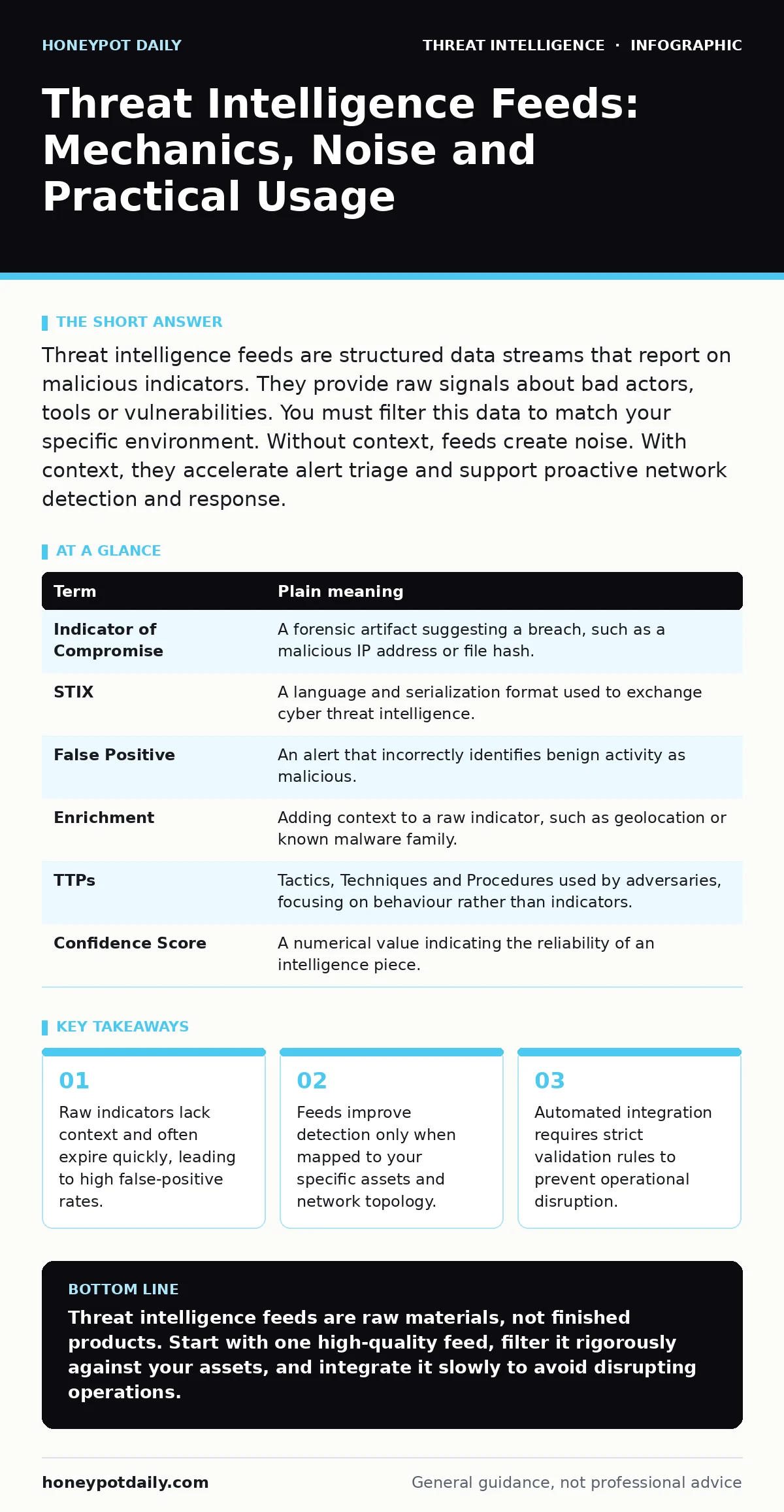
Threat intelligence feeds are structured data streams that report on malicious indicators. They provide raw signals about bad actors, tools or vulnerabilities. You must filter this data to match your specific environment. Without context, feeds create noise. With context, they accelerate alert triage and support proactive network detection and response.
The Radio Broadcast Analogy
Imagine you live in a large city. You own a radio that picks up every broadcast signal transmitted in the area. Most of these signals are local weather updates, traffic reports or music from distant stations. Only a tiny fraction contains emergency warnings relevant to your street.
If you listen to every signal, you will hear constant noise. You will miss the one warning about a gas leak on your corner because it is buried under advertisements for cars three towns away.
Threat intelligence feeds operate on this exact principle. They broadcast global observations of malicious activity. Most of this data is irrelevant to your specific infrastructure. You need a way to filter the global broadcast down to local emergencies.
Anatomy of the Signal
A feed is a structured data stream that delivers machine-readable information about threats. These threats include domain names, IP addresses or file hashes. The content varies by provider and scope.
Some feeds focus on phishing domains. Others track command-and-control servers used by malware. Each feed has a different update frequency and data format. Common formats include STIX 2.0, which standardises how cyber threat information is shared, or simple CSV lists.
| Term | Plain meaning |
|---|---|
| Indicator of Compromise | A forensic artifact suggesting a breach, such as a malicious IP address or file hash. |
| STIX | A language and serialization format used to exchange cyber threat intelligence. |
| False Positive | An alert that incorrectly identifies benign activity as malicious. |
| Enrichment | Adding context to a raw indicator, such as geolocation or known malware family. |
| TTPs | Tactics, Techniques and Procedures used by adversaries, focusing on behaviour rather than indicators. |
| Confidence Score | A numerical value indicating the reliability of an intelligence piece. |
The Context Deficit
The biggest challenge with feeds is the lack of context. An IP address might be flagged as malicious because it hosted malware once. That same IP might now be a legitimate cloud provider or a mobile carrier gateway.
If you block every flagged IP, you will disrupt legitimate traffic. This is the hidden cost of naive consumption. You trade security for availability.
You must assess the confidence score. Low-confidence indicators require manual review. High-confidence indicators can be automated, but even they need validation. A single wrong block can take down a critical service.
Integrating with Existing Operations
Feeds do not work in isolation. They feed into your security tools. You integrate them into your firewall, intrusion prevention system or SIEM.
The integration method matters. Pull-based integration fetches data on a schedule. Push-based integration receives data in real-time. Real-time is faster but puts more strain on your systems.
Imagine your SIEM receives a feed of new phishing domains. It automatically updates your email gateway. When an email arrives from a new domain, the gateway checks the list. If it matches, the email is quarantined. This happens before a human ever sees the message.
This process supports efficient alert triage. Analysts spend less time investigating false positives and more time on genuine incidents. It also aids OSINT investigations by providing a baseline of known bad actors.
Filtering for Relevance
You cannot use all feeds equally. Some are high-volume and low-quality. Others are low-volume and high-context. You must curate your sources.
Start by mapping your assets. What domains do you use? What IP ranges are yours? Create a whitelist of your own infrastructure. Exclude these from any feed consumption.
Next, apply temporal filters. Indicators decay. A malicious domain used last month may be clean today. Use feeds that provide expiration dates or age indicators.
Finally, consider the source. Open-source feeds are free but noisy. Commercial feeds often provide better context and support. The choice depends on your resources and risk appetite.
See also: Block OSINT Tool Reconnaissance Across Your Surface · Cybercrime Forums: What Small Businesses Need to Know About Threat Exposure
Practical Implementation Steps
- Select one reputable feed that aligns with your primary threat model. Do not start with five feeds. Start with one.
- Implement a local cache. Store the feed data locally to reduce latency and allow for custom filtering.
- Configure your detection engine to query the cache. Set a threshold for action. For example, quarantine but do not delete.
This approach reduces noise. It ensures that only consistent, high-confidence threats trigger automated responses.
The Human Element
Automated feeds are not a silver bullet. They miss novel attacks. They do not understand intent. They cannot detect process injection if the technique is new.
Analysts must review anomalies. If a feed flags a legitimate site as malicious, you must investigate. Is it a mistake? Is the site compromised?
This review process builds your internal knowledge. It helps you refine your filters. It turns raw data into actionable intelligence.
Beyond Simple Indicators
Indicators are the lowest level of intelligence. They tell you what happened. TTPs tell you how it happened.
Advanced teams move beyond IPs and domains. They look for patterns of behaviour. This requires YARA rules and behavioural analytics.
Feeds that provide TTP data are more valuable long-term. They help you detect new variants of old attacks. They support a deeper understanding of adversary behaviour.
Key takeaways
- Raw indicators lack context and often expire quickly, leading to high false-positive rates.
- Feeds improve detection only when mapped to your specific assets and network topology.
- Automated integration requires strict validation rules to prevent operational disruption.
Threat intelligence feeds are raw materials, not finished products. Start with one high-quality feed, filter it rigorously against your assets, and integrate it slowly to avoid disrupting operations.
Frequently asked questions
How many feeds should I use?
Start with one or two high-quality feeds. Adding more increases complexity and noise faster than it adds value.
Are free feeds useless?
No, but they require more processing. Free feeds often lack context and confidence scores, so you must build that logic yourself.
How often should I update my local cache?
Match the update frequency to your risk tolerance. Hourly updates are common for high-risk environments. Daily updates may suffice for others.
Can feeds detect insider threats?
Generally no. Feeds focus on external indicators. Insider threats often use legitimate credentials and internal tools, which feeds do not track.
How this guide was produced: written by the Honeypot Daily editorial team with AI assistance, checked against the public references listed below, and reviewed when the facts change. See our editorial policy or report an error.