
Sandbox Escape Response: Containment, Recovery and Prevention Steps
Sandboxes isolate code but rarely isolate network state, meaning an escape often grants lateral movement before the initial breach is even detected by monitoring systems.
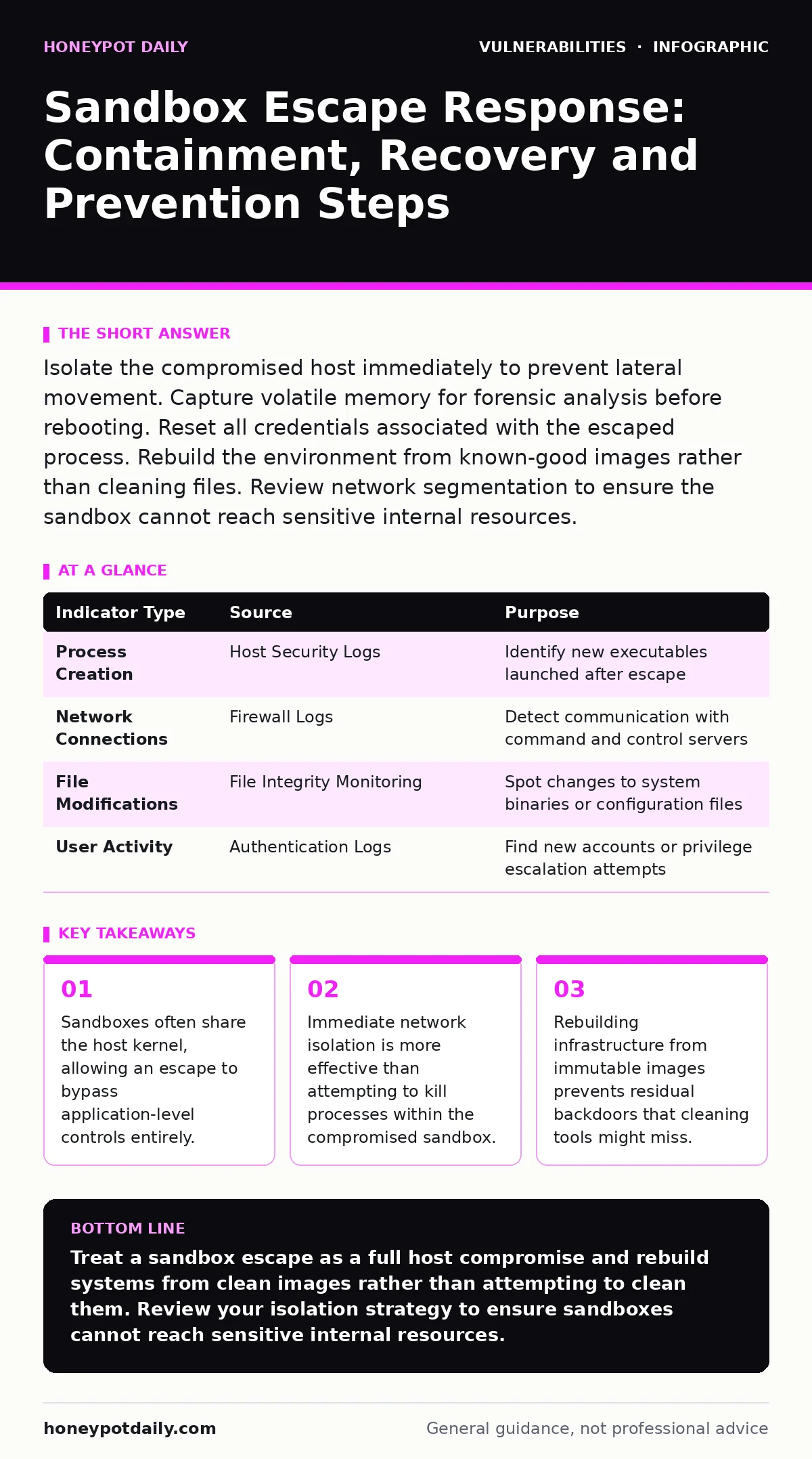
Isolate the compromised host immediately to prevent lateral movement. Capture volatile memory for forensic analysis before rebooting. Reset all credentials associated with the escaped process. Rebuild the environment from known-good images rather than cleaning files. Review network segmentation to ensure the sandbox cannot reach sensitive internal resources.
First hour
A sandbox escape vulnerability allows malicious code to break out of its restricted environment and interact with the host system or other applications. This breach of boundary means the attacker now has access to resources the sandbox was designed to protect. You must assume the host operating system is compromised. The immediate priority is containment, not investigation. Investigation preserves evidence, but containment stops the spread.
- Isolate the affected host from the network using switch port disabling or firewall rules.
- Capture a full memory dump of the host system using forensic tools.
- Record the current time and date on the system for timeline correlation.
- Identify the specific sandbox technology and version involved.
- Check for unusual outbound network connections from the host.
Isolation prevents the attacker from moving laterally. If the sandbox was running in a virtualised environment, the hypervisor may also be at risk if the escape traversed the virtualisation layer. You must treat the entire host as untrusted. Do not attempt to clean the system in place. Files can be modified to look legitimate while retaining malicious functionality. Rebuilding is safer and more reliable than cleaning.
First day
Once containment is achieved, focus shifts to understanding the scope of the breach. You need to determine what the attacker accessed and what data was exfiltrated. Review logs from the sandbox, the host and the network. Look for commands executed after the escape point. Check for new user accounts, modified system files or scheduled tasks. These indicators reveal the attacker’s intent and capabilities.
| Indicator Type | Source | Purpose |
|---|---|---|
| Process Creation | Host Security Logs | Identify new executables launched after escape |
| Network Connections | Firewall Logs | Detect communication with command and control servers |
| File Modifications | File Integrity Monitoring | Spot changes to system binaries or configuration files |
| User Activity | Authentication Logs | Find new accounts or privilege escalation attempts |
Analyze the memory dump captured in the first hour. Look for injected code, hidden processes or decrypted data. This analysis helps reconstruct the attack chain. Determine if the escape used a known vulnerability or a zero-day exploit. This distinction affects your long-term mitigation strategy. If it was a known vulnerability, check if other systems are running the same vulnerable version.
You must also assess the impact on data integrity. If the sandbox processed sensitive data, assume that data is compromised. Notify relevant stakeholders about the potential breach. Do not share technical details externally yet. Keep communication internal and focused on operational impact. Prepare a preliminary report for management outlining the incident and initial response actions.
First week
Recovery involves rebuilding the affected systems and restoring normal operations. Do not reuse the compromised images or backups. Create new instances from known-good sources. Apply all security patches and updates before connecting them to the network. Verify that the new configurations are secure. This step ensures that any hidden backdoors or persistence mechanisms are removed.
Consider the trade-offs of your sandboxing strategy. Sandboxes provide isolation but can create a false sense of security. If an attacker escapes, they often have more privileges than expected. You need to evaluate whether your current sandboxing approach is sufficient. Look into more robust isolation techniques, such as hardware-enforced virtualisation or micro-segmentation. These methods add layers of defence that are harder to bypass.
Review your monitoring and detection capabilities. Did the escape trigger any alerts? If not, why? Adjust your security information and event management rules to catch similar behaviour in the future. Look for anomalies in resource usage, network traffic or system calls. Early detection reduces the damage caused by a breach.
Who to tell
Communication is critical during an incident. You must inform internal teams first. The security operations team needs detailed technical information. The incident response team requires a timeline and impact assessment. Management needs a high-level summary of business impact and recovery plans. Legal and compliance teams must be notified if regulatory requirements are triggered.
External communication depends on the severity of the breach. If customer data was accessed, you may need to notify affected individuals. Check local laws and regulations for specific requirements. Do not speculate in external communications. Stick to confirmed facts. Provide clear instructions on what actions users should take, such as changing passwords or monitoring accounts.
Coordinate with your insurance provider if you have cyber insurance. They may have specific reporting requirements and can assist with forensic analysis and legal support. Keep records of all communications and actions taken. This documentation is essential for post-incident review and potential legal proceedings.
How to stop a repeat
Preventing future sandbox escapes requires a layered defence strategy. Relying on a single control is insufficient. Combine sandboxing with other security measures such as application whitelisting, least privilege access and network segmentation. These controls reduce the attack surface and limit the damage if an escape occurs.
Regularly update sandbox software and host operating systems. Vulnerabilities are discovered constantly. Delaying updates increases the risk of exploitation. Implement a structured process for change management for security patches to ensure updates are applied consistently and without disrupting operations. Test patches in a staging environment before deploying to production.
Monitor for unusual behaviour within sandboxes. Look for attempts to access restricted resources or execute privileged commands. Use behavioural analysis to detect anomalies that rule-based systems might miss. This proactive approach helps identify escapes before they cause significant damage.
See also: Whaling Attack Response: Containment, Recovery and Prevention Steps · What Is Threat Actors: Definitions, Tactics and Detection Strategies
Reviewing related controls
Sandbox escapes often exploit weaknesses in broader security configurations. Review your HTTP security headers to ensure they are configured correctly. Misconfigured headers can allow attackers to inject malicious scripts or bypass restrictions. Proper header configuration adds an extra layer of defence against web-based attacks.
If you use container orchestration, check for Kubernetes misconfigurations. Containers are a form of sandboxing, and misconfigurations can lead to privilege escalation and host access. Ensure that pods run with minimal privileges and that network policies restrict communication between containers. This reduces the risk of lateral movement after an escape.
Consider your exposure management practices. Regularly scan for exposed services and vulnerabilities. Identify and remediate risks before attackers can exploit them. This continuous assessment helps maintain a strong security posture.
Final steps
Document the entire incident from start to finish. Include timelines, actions taken, findings and lessons learned. This documentation is valuable for future incident response and for improving security processes. Share the findings with the wider organisation to raise awareness and prevent similar incidents.
Conduct a post-incident review. Evaluate the effectiveness of the response. Identify areas for improvement. Update incident response plans and procedures based on the findings. This continuous improvement cycle strengthens your security posture over time.
Ensure that all temporary controls implemented during the incident are reviewed. Remove any unnecessary restrictions or changes that are no longer needed. Restore normal operations while maintaining enhanced security measures where appropriate. This balance ensures business continuity without compromising security.
Key takeaways
- Sandboxes often share the host kernel, allowing an escape to bypass application-level controls entirely.
- Immediate network isolation is more effective than attempting to kill processes within the compromised sandbox.
- Rebuilding infrastructure from immutable images prevents residual backdoors that cleaning tools might miss.
Treat a sandbox escape as a full host compromise and rebuild systems from clean images rather than attempting to clean them. Review your isolation strategy to ensure sandboxes cannot reach sensitive internal resources.
Frequently asked questions
Can a sandbox escape spread to other virtual machines on the same host?
Yes, if the escape grants access to the hypervisor or host kernel, the attacker can potentially move to other virtual machines sharing the same physical hardware.
How do I know if my sandbox has been escaped?
Look for unexpected network connections, new processes, or file modifications on the host system that originated from the sandboxed application.
Is rebooting the host enough to remove the attacker?
No, rebooting may erase volatile evidence and some malware, but persistent threats can survive in firmware, boot sectors or external storage. Rebuilding is safer.
Should I disable sandboxing after an escape?
No, sandboxing provides valuable isolation. Instead, improve your detection, harden the host configuration and ensure proper network segmentation to mitigate risk.
How this guide was produced: written by the Honeypot Daily editorial team with AI assistance, checked against the public references listed below, and reviewed when the facts change. See our editorial policy or report an error.