How Digital Forensics Works: The Chain of Evidence Explained
Forensic analysis fails when the initial imaging process alters the original data, rendering legal evidence inadmissible regardless of the findings.
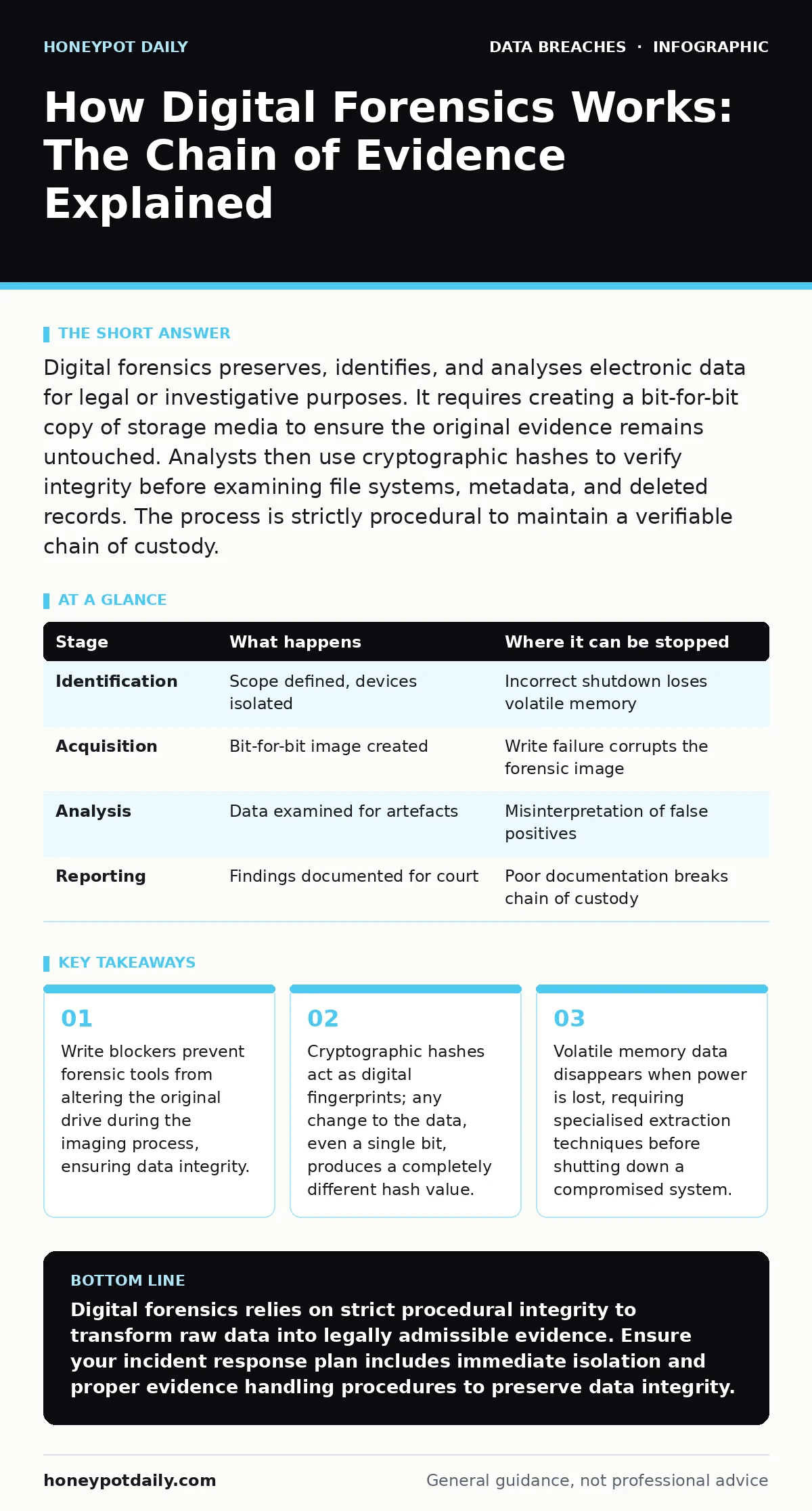
Digital forensics preserves, identifies, and analyses electronic data for legal or investigative purposes. It requires creating a bit-for-bit copy of storage media to ensure the original evidence remains untouched. Analysts then use cryptographic hashes to verify integrity before examining file systems, metadata, and deleted records. The process is strictly procedural to maintain a verifiable chain of custody.
The Forensic Imperative
Digital forensics is the application of investigation and analysis techniques to gather and preserve evidence from a digital device in a way that is suitable for presentation in a court of law. Unlike routine security monitoring, which focuses on real-time detection, forensics looks backward to reconstruct events with high fidelity. The primary goal is not just to find what happened, but to prove it happened without doubt.
Imagine a server is compromised. You need to know how the attacker entered, what data they exfiltrated, and whether they installed persistence mechanisms. Standard logs might be deleted or altered. Forensic analysis digs deeper, examining unallocated space on hard drives, memory dumps, and network packet captures. This process relies on strict adherence to procedure. If the chain of custody is broken, the evidence is worthless.
Stage 1: Identification and Preservation
The first step involves identifying the scope of the incident and preserving the evidence. This is often the most critical phase. If you shut down a powered-on computer incorrectly, you lose volatile data stored in the RAM. This memory contains active processes, encryption keys, and network connections that exist only while the system is running.
Analysts must decide whether to power down the device or keep it running. If the device is part of an active attack, powering it down might prevent further damage but destroys the memory state. If the device is a server hosting critical services, shutting it down might be impossible. The decision depends on the risk assessment.
Preservation also means isolating the device from the network. This prevents remote wiping commands or further data exfiltration. Physical security is paramount. The device must be placed in a secure location with access logs. Every person who handles the evidence must be recorded. This creates the chain of custody, a documented history of the evidence handling.
Stage 2: Acquisition and Imaging
Acquisition involves creating a forensic image of the storage media. This is not a simple copy-paste operation. A forensic image is a bit-for-bit copy of the entire drive, including deleted files, slack space, and unallocated sectors. Standard file copying tools only retrieve active files and ignore the hidden data where attackers often hide.
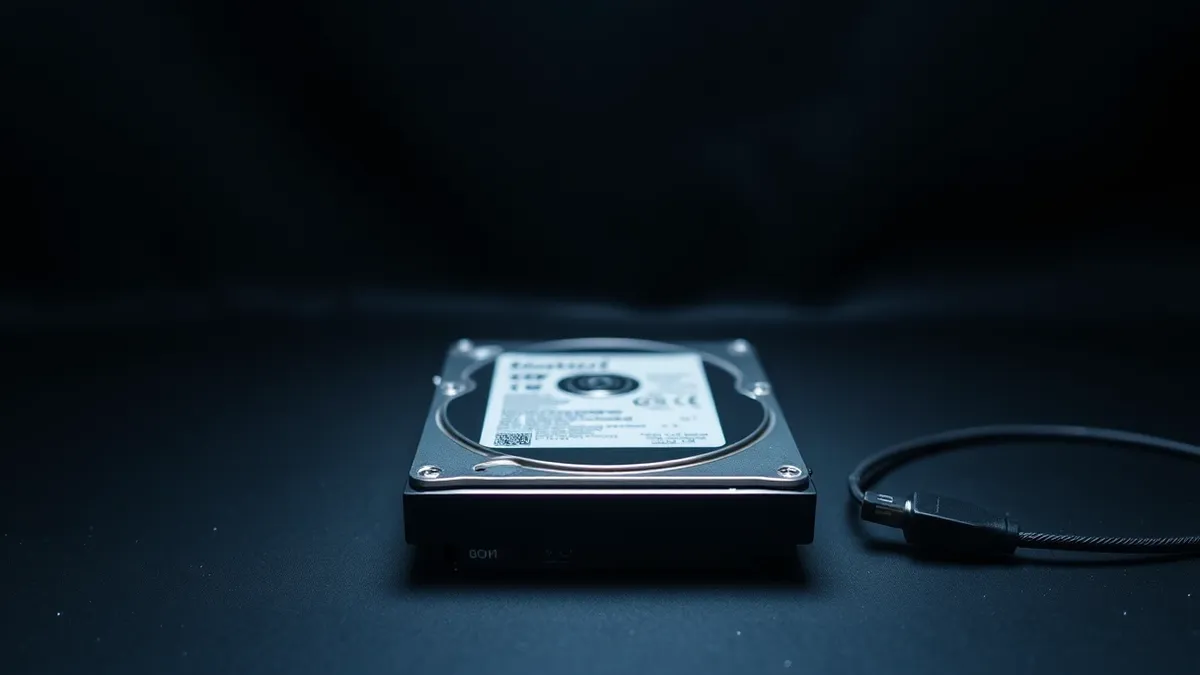
To ensure the original drive is not modified during this process, analysts use a hardware write blocker. This device sits between the suspect drive and the forensic workstation. It allows the workstation to read data from the drive but physically prevents any write commands from reaching it. This guarantees the original evidence remains in its exact state at the time of seizure.
After the image is created, analysts generate a cryptographic hash of both the original drive and the forensic image. Common algorithms include SHA-256. These hashes serve as digital fingerprints. If the hash of the image matches the hash of the original drive, you have mathematical proof that the image is an exact replica. Any alteration, no matter how small, will result in a different hash value.
| Stage | What happens | Where it can be stopped |
|---|---|---|
| Identification | Scope defined, devices isolated | Incorrect shutdown loses volatile memory |
| Acquisition | Bit-for-bit image created | Write failure corrupts the forensic image |
| Analysis | Data examined for artefacts | Misinterpretation of false positives |
| Reporting | Findings documented for court | Poor documentation breaks chain of custody |
Stage 3: Analysis and Examination
Analysis is the investigative phase where analysts examine the forensic image. They use specialised software to parse file systems, recover deleted files, and reconstruct timelines. The goal is to answer specific questions: Who did what, when, and how?
Analysts look for artefacts. These are traces of user activity left behind by the operating system and applications. Examples include registry keys, prefetch files, browser history, and email caches. They also examine metadata, which is data about the data. Metadata can reveal when a document was created, modified, or last accessed. This information often contradicts the file name or content, revealing attempts to cover tracks.
Analysts also correlate data from different sources. They might compare network logs with local system logs to build a complete picture. This cross-referencing helps identify anomalies. For instance, a login from an unusual location at an odd time might indicate a compromised account. Understanding the baseline normal activity is crucial for spotting deviations.
Stage 4: Documentation and Reporting
The final stage is documenting the findings in a clear, concise report. This report must be understandable to non-technical readers, such as judges or juries. It should explain the methodology, the tools used, and the conclusions drawn. Every finding must be supported by evidence.
The report must also address limitations. Digital forensics is not infallible. Data might be corrupted, incomplete, or ambiguous. Analysts must be transparent about these gaps. They should not speculate or make assumptions without evidence. The report becomes part of the legal record. It may be challenged in court during cross-examination.
The chain of custody documentation is appended to the report. This proves that the evidence was handled correctly from seizure to analysis. Any break in this chain can lead to the evidence being excluded from legal proceedings. The integrity of the entire investigation rests on this documentation.
See also: How security operations centers detect and respond to threats · Whaling Attack Response: Containment, Recovery and Prevention Steps
Limits of Digital Forensics
Digital forensics has inherent limitations. It cannot recover data that has been securely overwritten. If an attacker uses a tool that overwrites deleted files with random data, that information is gone forever. Encryption also poses a significant challenge. If the drive is encrypted and the key is lost, the data is inaccessible, regardless of forensic skill.
Volatility is another constraint. Data in RAM is lost when power is cut. If analysts do not capture the memory state immediately, they lose critical context. Network traffic is also transient. Unless packet capture was active at the time of the incident, reconstructing network activity is often impossible.
Forensic analysis is also subjective. Interpreting artefacts requires expertise. Two analysts might draw different conclusions from the same data. This is why peer review and validation of methods are important. The field relies on established best practices, but there is no single automated solution that guarantees truth.
Integration with Security Operations
Forensics is not a standalone activity. It integrates with broader security operations. For instance, understanding data inventory and mapping helps analysts know where sensitive information resides, allowing them to prioritise the investigation of those systems. Knowing what personally identifiable information is stored on a device helps determine the severity of a breach.
When investigating credential theft, knowledge of password hashing and salting helps analysts understand how credentials are stored and whether they can be reversed. If an attacker steals database hashes, the presence of salt makes brute-force attacks significantly harder. Forensic analysis can reveal if the attacker successfully cracked these hashes.
Forensics also informs incident response. Findings from one investigation can help detect similar attacks in the future. By analysing the tactics, techniques, and procedures used by attackers, security teams can improve their detection rules. This feedback loop strengthens the overall security posture. However, forensics is reactive. It tells you what happened after the fact. Prevention and detection remain the primary goals of security operations.
Conclusion of the Process
The forensic process is rigorous and methodical. It transforms raw data into admissible evidence. Each stage, from identification to reporting, must be executed with precision. Errors at any point can compromise the entire investigation. The goal is not just to find the truth, but to prove it beyond reasonable doubt.
Analysts must remain objective. They should let the evidence speak for itself. Bias can lead to misinterpretation. The report must reflect the findings accurately, without embellishment or omission. Digital forensics is a powerful tool, but it is only as strong as the procedures that govern it. Adherence to standards ensures that the results are reliable and defensible.
Key takeaways
- Write blockers prevent forensic tools from altering the original drive during the imaging process, ensuring data integrity.
- Cryptographic hashes act as digital fingerprints; any change to the data, even a single bit, produces a completely different hash value.
- Volatile memory data disappears when power is lost, requiring specialised extraction techniques before shutting down a compromised system.
Digital forensics relies on strict procedural integrity to transform raw data into legally admissible evidence. Ensure your incident response plan includes immediate isolation and proper evidence handling procedures to preserve data integrity.
Frequently asked questions
Can deleted files always be recovered?
No, deleted files can only be recovered if the data has not been overwritten by new information. Secure deletion tools overwrite data, making recovery impossible.
How long does a forensic investigation take?
The duration varies widely depending on the size of the data, the complexity of the incident, and the resources available. Simple cases may take days, while complex investigations can take months.
Is forensic analysis legal?
Forensic analysis is legal when conducted with proper authority and following established legal procedures. Unauthorized analysis of devices you do not own or have permission to examine is illegal.
What is a write blocker?
A write blocker is a hardware or software tool that prevents any data from being written to a storage device during forensic imaging, ensuring the original evidence remains unchanged.
How this guide was produced: written by the Honeypot Daily editorial team with AI assistance, checked against the public references listed below, and reviewed when the facts change. See our editorial policy or report an error.