YARA Rules: How Pattern Matching Catches What Signatures Miss
YARA rules detect malware families by structural patterns rather than hashes, allowing them to identify new variants that traditional signature systems overlook entirely.
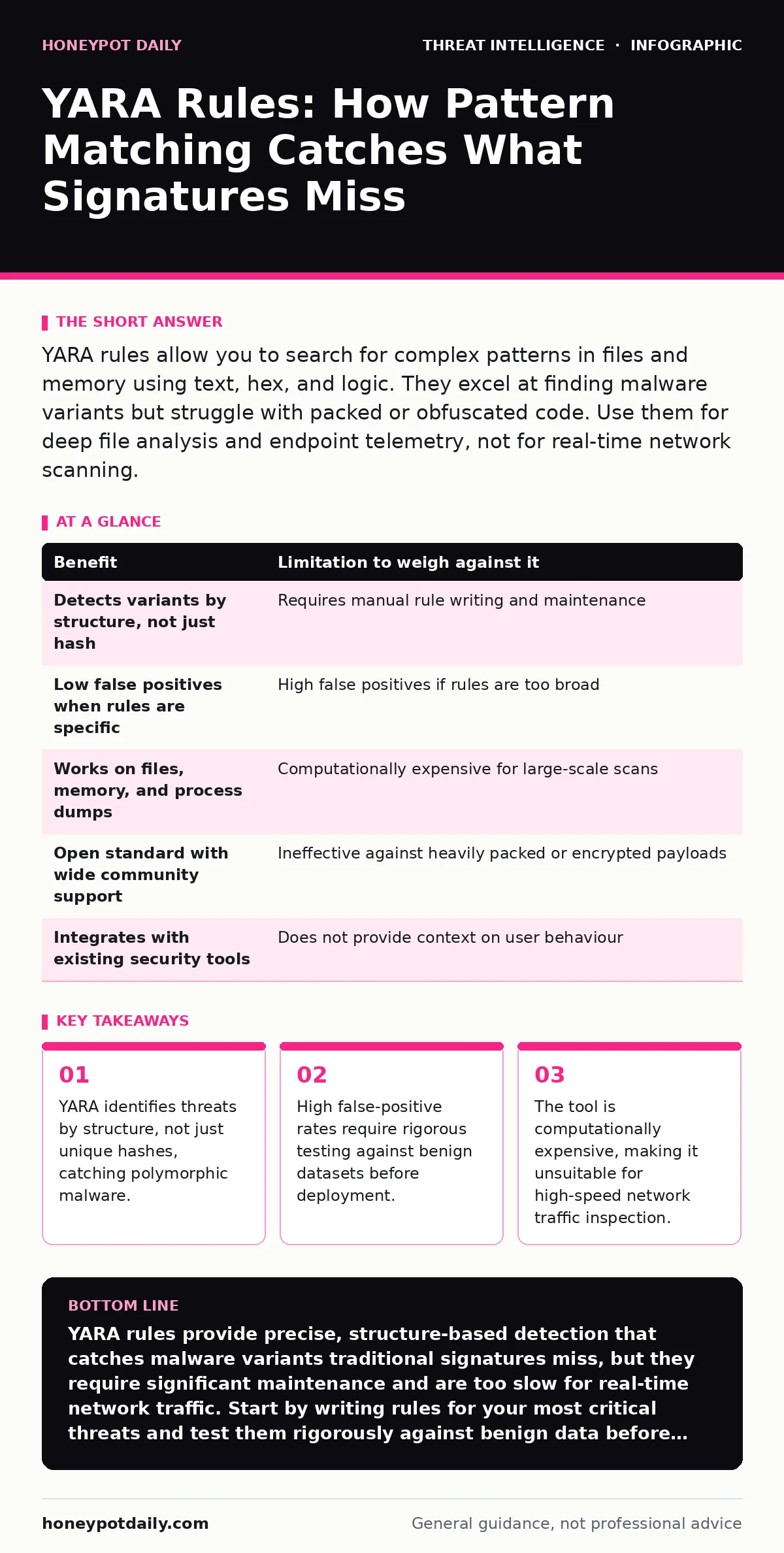
YARA rules allow you to search for complex patterns in files and memory using text, hex, and logic. They excel at finding malware variants but struggle with packed or obfuscated code. Use them for deep file analysis and endpoint telemetry, not for real-time network scanning.
The Mechanics of Pattern Matching
YARA is a tool that helps malware researchers identify and classify malware samples. It allows you to create rules that describe patterns found in malicious files. Unlike antivirus software that relies on a database of known hashes, YARA lets you define the logic yourself. You specify what a file must contain to match your rule.
This approach shifts the focus from "what is this file" to "what does this file do". You can look for specific strings, hexadecimal sequences, or structural elements. The engine then scans your target to see if these conditions are met. This flexibility is the core strength of the system. It turns static analysis into a targeted search.
Concrete Benefits of Custom Rules
The primary benefit is the ability to detect unknown variants. If a threat actor changes a few bytes in a malicious executable, its hash changes. A hash-based system will miss it. YARA rules, however, can look for the underlying logic or specific code segments that remain constant. This means you can catch a new version of a known threat.
You can also combine multiple conditions using logical operators. A rule can require the presence of two specific strings and a certain file size. This reduces noise by ensuring that only files meeting all criteria are flagged. It allows for precise targeting of specific malware families or configuration files.
Furthermore, YARA operates on raw data. It can scan memory dumps, disk images, and network captures. This versatility means it fits into various parts of your detection stack. It complements endpoint telemetry by providing a deeper layer of inspection. You are not limited to what the endpoint agent reports.
Honest Limitations and Hidden Costs
YARA rules are not magic. They require significant effort to write and maintain. Crafting a rule that is specific enough to avoid false positives but broad enough to catch variants is difficult. You must understand the malware’s structure to write an effective rule. This demands skilled analysts who can reverse engineer samples.
The computational cost is another major limitation. Scanning every file on a system with complex rules slows down operations. It is not designed for high-throughput environments. Using YARA for real-time network detection and response is generally inefficient. The engine is better suited for offline analysis or scheduled scans of specific directories.
Obfuscation and packing defeat standard YARA rules. If a malware author encrypts their payload or uses a packer, the strings you are looking for will not exist in the static file. You would need to unpack the file first, which adds complexity. This creates a cat-and-mouse game where attackers constantly adapt their packing methods.
Weighing Benefits Against Limitations
| Benefit | Limitation to weigh against it |
|---|---|
| Detects variants by structure, not just hash | Requires manual rule writing and maintenance |
| Low false positives when rules are specific | High false positives if rules are too broad |
| Works on files, memory, and process dumps | Computationally expensive for large-scale scans |
| Open standard with wide community support | Ineffective against heavily packed or encrypted payloads |
| Integrates with existing security tools | Does not provide context on user behaviour |
When It Is Worth It
YARA is worth the investment when you need to find specific threats across a large dataset. Suppose you have a collection of suspicious files from an incident. YARA can quickly identify which ones belong to a known family. It accelerates the triage process by grouping similar samples.
It is also valuable for threat hunting. You can create rules based on intelligence from OSINT investigations. If a new indicator of compromise emerges, you can write a rule to search your environment for it. This proactive approach helps you find hidden threats before they cause damage.
For endpoint telemetry, YARA adds depth. It can inspect processes and memory for signs of injection or obfuscation. This is particularly useful when investigating PowerShell abuse or other script-based attacks. It provides a layer of detection that behavioural analytics might miss.
See also: Threat Hunting vs Incident Response: Which Security Function Do You Need · Dark web threat intelligence explained: separating myth from reality
When It Is Not Worth It
Do not use YARA for real-time network scanning. The overhead is too high, and it will degrade performance. Network traffic is too voluminous and ephemeral for this type of deep inspection. Use protocol-aware tools for that purpose instead.
It is not a replacement for behavioural detection. YARA looks for static patterns. It cannot detect if a user is performing a risky action, such as copying sensitive data. It tells you what a file is, not what it is doing in real time. Relying solely on YARA leaves gaps in your security posture.
Avoid using YARA if you lack the resources to maintain rules. Rules become outdated as malware evolves. Without regular updates, they provide a false sense of security. The effort required to keep them accurate often outweighs the benefits for smaller teams.
Integrating with Your Detection Stack
YARA works best when integrated with other tools. Use it to enrich alerts from your SIEM or endpoint detection platform. When an alert fires, run YARA rules on the associated files to confirm the threat. This reduces the mean time to detect by providing immediate context.
It also supports alert triage. Analysts can use YARA to quickly categorise suspicious files. This speeds up the investigation process. By automating the identification of known malware families, you free up analysts to focus on novel threats.
Consider using YARA in conjunction with sandboxing. Sandboxes execute files in a controlled environment. YARA can scan the files before and after execution. This combination provides both static and dynamic analysis capabilities. It gives you a more complete picture of the threat.
Common Pitfalls to Avoid
One common mistake is writing rules that are too generic. Looking for common strings like "Windows" or "System" will result in massive false-positive rates. Be specific in your conditions. Use multiple strings and structural checks to narrow down matches.
Another pitfall is ignoring rule performance. Complex rules with many conditions can slow down scanning. Test your rules for performance before deploying them. Optimise them to ensure they run efficiently.
Finally, do not assume YARA catches everything. It is a tool, not a solution. It needs to be part of a broader security strategy. Combine it with other detection methods to ensure comprehensive coverage.
Key takeaways
- YARA identifies threats by structure, not just unique hashes, catching polymorphic malware.
- High false-positive rates require rigorous testing against benign datasets before deployment.
- The tool is computationally expensive, making it unsuitable for high-speed network traffic inspection.
YARA rules provide precise, structure-based detection that catches malware variants traditional signatures miss, but they require significant maintenance and are too slow for real-time network traffic. Start by writing rules for your most critical threats and test them rigorously against benign data before deployment.
Frequently asked questions
Can YARA detect zero-day malware?
YARA can detect zero-day malware if you have written rules that match its structural patterns, but it cannot detect threats for which no patterns have been defined yet.
How do I reduce false positives in YARA rules?
Reduce false positives by adding more specific conditions, such as requiring multiple strings or specific file characteristics, and by testing rules against a large set of benign files.
Is YARA suitable for cloud environments?
YARA can be used in cloud environments, but you must consider the computational cost and ensure your scanning infrastructure can handle the load without impacting performance.
Can YARA scan memory for malware?
Yes, YARA can scan memory dumps and process memory, making it useful for detecting fileless malware and other threats that do not exist on disk.
How this guide was produced: written by the Honeypot Daily editorial team with AI assistance, checked against the public references listed below, and reviewed when the facts change. See our editorial policy or report an error.