Detecting Bulletproof Hosting: Signals, Blind Spots and Verification
Bulletproof hosting hides malicious infrastructure behind legal obfuscation and shared resources, making traditional reputation checks insufficient for accurate attribution.
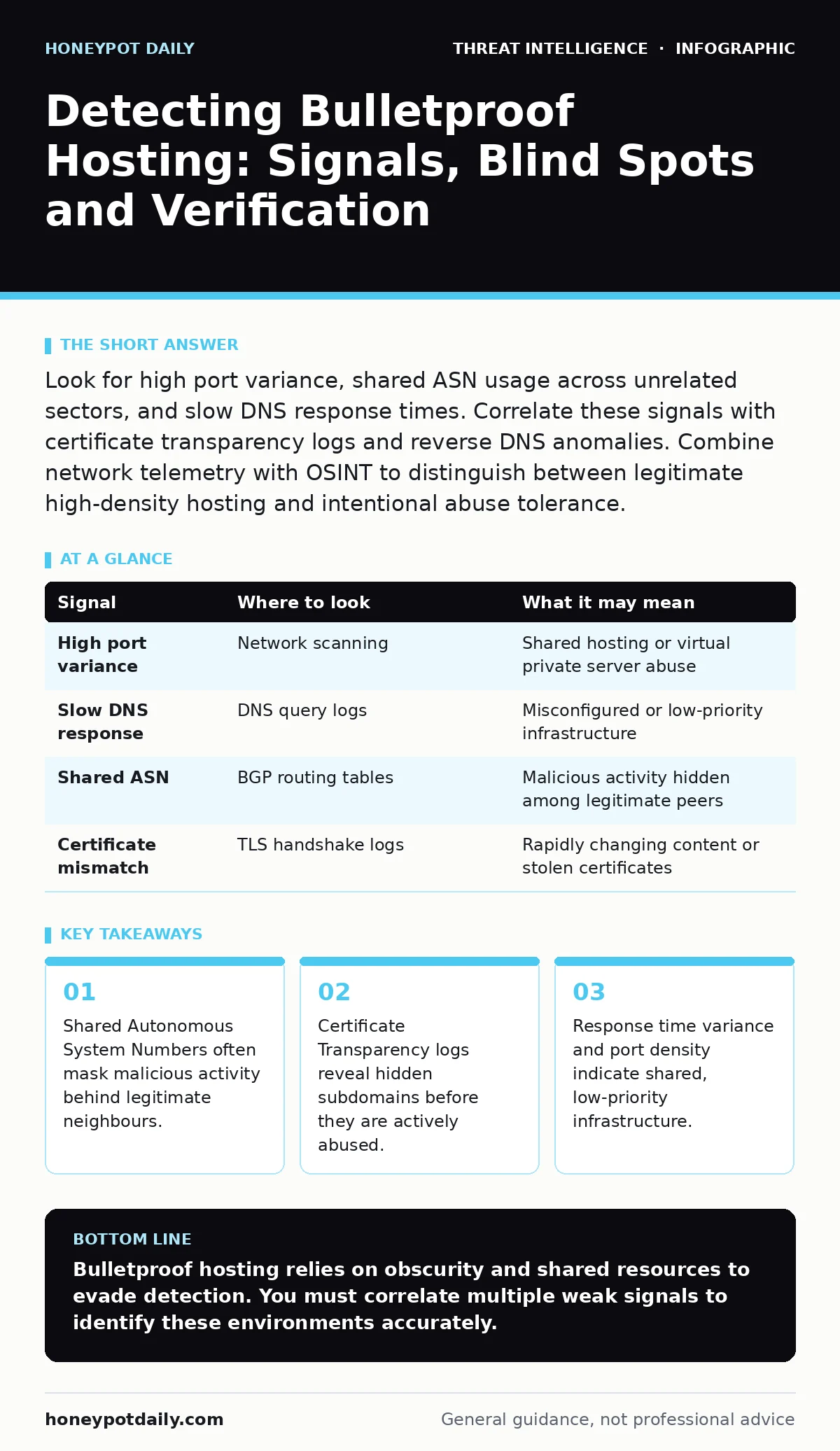
Look for high port variance, shared ASN usage across unrelated sectors, and slow DNS response times. Correlate these signals with certificate transparency logs and reverse DNS anomalies. Combine network telemetry with OSINT to distinguish between legitimate high-density hosting and intentional abuse tolerance.
The Architecture of Plausible Deniability
Bulletproof hosting is not a single technology. It is a business model that prioritises client privacy and abuse tolerance over security hygiene. Providers in this sector often operate in jurisdictions with weak enforcement or complex legal structures. They use technical obfuscation to make attribution difficult.
You cannot rely on static IP blacklists. These providers rotate infrastructure rapidly and use legitimate cloud resources as proxies. The signal lies in the behaviour of the infrastructure, not just the address itself. You must look for patterns that indicate a lack of operational security discipline.
Imagine a server that hosts a legitimate forum on one port and a command-and-control channel on another. The provider ignores the abuse reports for the malicious port. This tolerance is the defining feature. Your detection strategy must focus on identifying this tolerance.
Network Layer Anomalies
The network layer provides the first layer of evidence. Bulletproof hosts often exhibit unusual port usage patterns. You will see a wide variety of open ports on a single IP address. Legitimate servers usually run specific services on standard ports.
Look for high port variance. If a single IP has hundreds of open ports, it is likely a shared hosting environment. These environments are attractive to bad actors because they blend in with noise. The traffic volume may be low, but the diversity of protocols is high.
| Signal | Where to look | What it may mean |
|---|---|---|
| High port variance | Network scanning | Shared hosting or virtual private server abuse |
| Slow DNS response | DNS query logs | Misconfigured or low-priority infrastructure |
| Shared ASN | BGP routing tables | Malicious activity hidden among legitimate peers |
| Certificate mismatch | TLS handshake logs | Rapidly changing content or stolen certificates |
Check the Autonomous System Number (ASN) associated with the IP. Bulletproof hosts often use ASNs that contain thousands of IPs. This makes it hard to isolate the specific provider. You need to cross-reference the ASN with known abuse reports.
DNS and Certificate Indicators
Domain Name System (DNS) behaviour reveals infrastructure age and stability. Bulletproof hosting often uses newly registered domains. These domains may have short lifespans. They are created, used for a brief campaign, and then abandoned.
Look for DNS response times. Legitimate providers optimise for speed. Bulletproof hosts often have slower response times. This indicates lower priority in the provider’s network stack. They do not invest in optimisation for malicious clients.
Examine the TLS certificates. Bad actors often use self-signed certificates or those with mismatched subject names. They may also use certificates issued to unrelated entities. This is a sign of certificate theft or misuse.
You should monitor for certificate reuse. If the same certificate appears on multiple unrelated domains, it is a strong indicator of shared infrastructure. This pattern is common in bulletproof hosting environments.
Traffic Pattern Recognition
Traffic patterns differ from standard web hosting. You will see irregular burst patterns. Legitimate sites have predictable traffic cycles. Malicious infrastructure often sends data in small, frequent bursts. This mimics normal background traffic to avoid detection.
Look for encrypted traffic to non-standard ports. While HTTPS is standard, bulletproof hosts may use encryption on ports like 8080 or 443. This is not inherently malicious, but combined with other signals, it raises suspicion.
The payload size can also be a clue. Command-and-control traffic often has small, consistent packet sizes. This is different from the variable sizes of normal web browsing. You need deep packet inspection to see this, but metadata analysis can also reveal anomalies.
Endpoint and Log Correlation
Your internal logs provide context for external signals. Endpoint telemetry can show connections to suspicious IPs. Look for processes that initiate outbound connections to unknown destinations. These connections may bypass standard web proxies.
Windows event log monitoring can reveal scheduled tasks that persist even after system reboots. These tasks may connect to bulletproof hosted servers. You need to correlate these events with network detection and response data.
Check for unusual user-agent strings. Bad actors often use generic or missing user-agents. Legitimate browsers send detailed information. This mismatch can help you filter out false positives.
You should also look for DNS queries that fail to resolve. This may indicate an attempt to reach a domain that has been taken down or is being rotated. These failed queries are a signal of active evasion.
See also: Block OSINT Tool Reconnaissance Across Your Surface · Cybercrime Forums: What Small Businesses Need to Know About Threat Exposure
Common Blind Spots
One major blind spot is the reliance on reputation scores. These scores are often outdated. Bulletproof hosts can clean their reputation by moving to new IPs. You must use real-time data sources.
Another blind spot is ignoring the legitimate neighbours. Bad actors intentionally place their servers next to legitimate ones. This makes it hard to block the malicious IP without affecting the good one. You need granular detection rules.
Many teams focus only on inbound traffic. Bulletproof hosting is often used for outbound command-and-control. You must monitor outbound connections as well. This requires a holistic view of your network.
Tooling and Integration
You need tools that can correlate multiple data sources. Threat intelligence feeds provide context for IPs and domains. However, you must verify this data with your own observations.
YARA rules can help identify known malicious payloads. Integrate these with your endpoint detection systems. This allows you to catch known threats quickly.
OSINT investigations are crucial for attribution. Use public data to map the infrastructure. This helps you understand the scope of the threat.
Network scanning can reveal open ports and services. Use this data to build a baseline of normal behaviour. Deviations from this baseline are potential indicators of compromise.
Verification and Attribution
Attribution is difficult. You must verify your findings with multiple sources. Do not rely on a single indicator. Correlate network, DNS, and endpoint data.
Use mean time to detect metrics to improve your processes. The faster you detect, the less damage is done. Continuous improvement is key.
Remember that bulletproof hosting is a moving target. Your detection methods must adapt. Stay updated with the latest tactics and techniques.
Key takeaways
- Shared Autonomous System Numbers often mask malicious activity behind legitimate neighbours.
- Certificate Transparency logs reveal hidden subdomains before they are actively abused.
- Response time variance and port density indicate shared, low-priority infrastructure.
Bulletproof hosting relies on obscurity and shared resources to evade detection. You must correlate multiple weak signals to identify these environments accurately.
Frequently asked questions
How do I distinguish bulletproof hosting from standard cloud providers?
Look for high port variance, slow DNS responses, and shared ASNs with mixed legitimate and malicious traffic.
Can I use public IP blacklists to detect bulletproof hosting?
No, these lists are often outdated. You need real-time correlation of multiple indicators.
What is the role of certificate transparency logs?
They reveal hidden subdomains and certificate reuse, which are common in bulletproof hosting environments.
How do I avoid false positives when monitoring shared ASNs?
Focus on specific IPs and domains that exhibit multiple suspicious indicators, not the entire ASN.
How this guide was produced: written by the Honeypot Daily editorial team with AI assistance, checked against the public references listed below, and reviewed when the facts change. See our editorial policy or report an error.