Blue Team Operations: Definition, Purpose and Core Mechanics
Blue team operations transform raw noise into actionable context, shifting defence from passive logging to active hypothesis testing and adversary modelling.
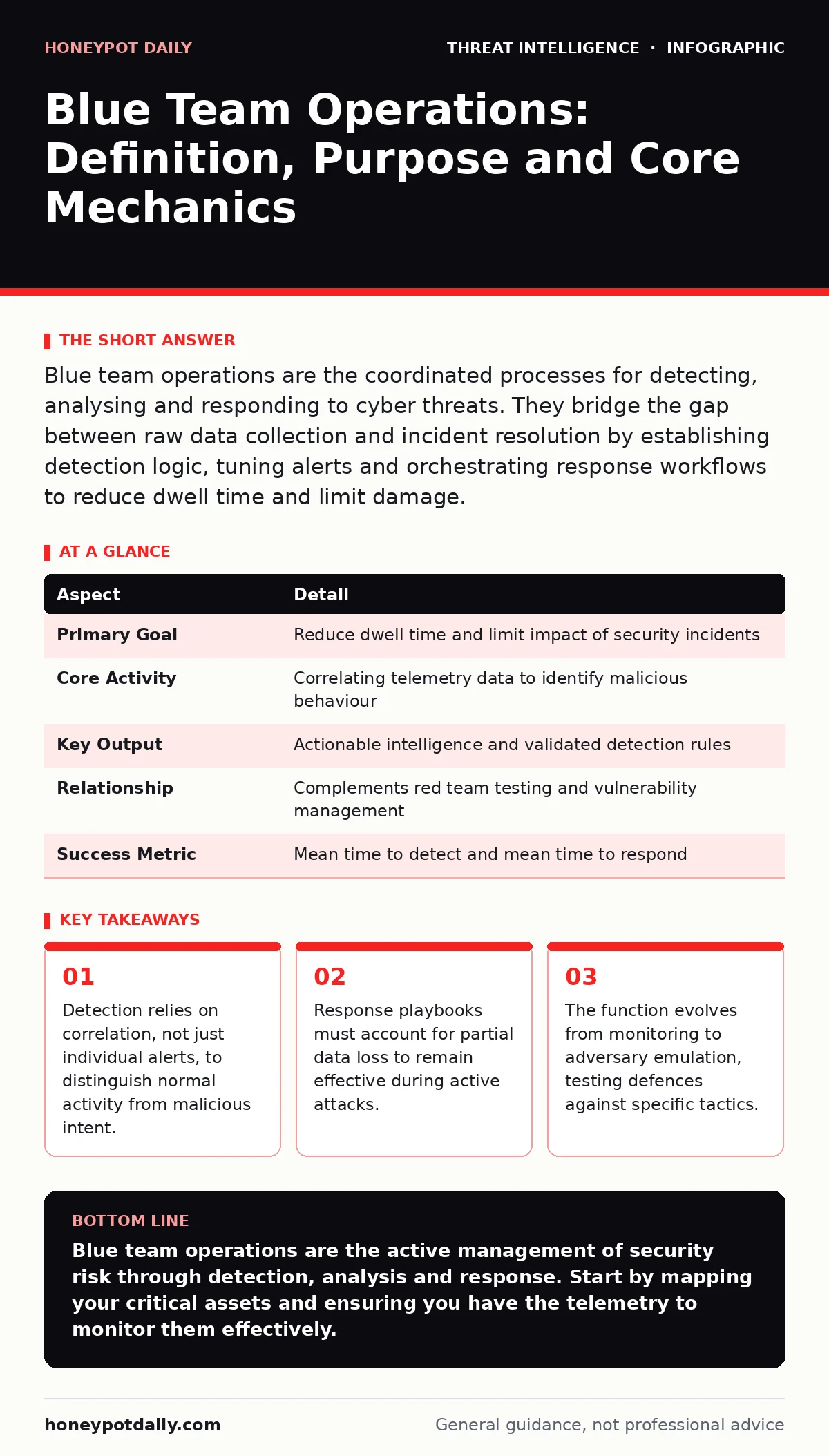
Blue team operations are the coordinated processes for detecting, analysing and responding to cyber threats. They bridge the gap between raw data collection and incident resolution by establishing detection logic, tuning alerts and orchestrating response workflows to reduce dwell time and limit damage.
The Air Traffic Control Analogy
Imagine air traffic control. Thousands of aircraft fly through shared airspace daily. Most movements are routine and benign. If controllers reacted to every radar blip with an emergency landing, the system would collapse under the weight of false alarms. Instead, they monitor patterns, predict conflicts and intervene only when deviation occurs. Blue team operations function similarly. They monitor the digital airspace of your infrastructure, filtering routine traffic to identify genuine threats before they cause structural damage.
The core challenge is signal-to-noise ratio. Modern systems generate vast amounts of data. Without structured operations, this data becomes a liability rather than an asset. The blue team’s primary task is to impose order on chaos, creating a reliable signal that indicates actual compromise. This requires more than just installing sensors; it demands a continuous cycle of tuning, validation and refinement.
Defining the Operational Scope
Blue team operations encompass the people, processes and technologies dedicated to defending an organisation’s IT assets. The term "blue team" originates from military exercises where one side defends a network while the "red team" attacks it. In commercial environments, the blue team is not a single role but a function. It includes security analysts, incident responders and detection engineers.
The purpose is not to prevent all attacks, as that is technically impossible. The purpose is to reduce the window of opportunity for an attacker. By shortening the time between compromise and containment, the blue team limits the impact of a breach. This shift in mindset moves security from a binary state of "secure" or "breached" to a managed risk model.
| Aspect | Detail |
|---|---|
| Primary Goal | Reduce dwell time and limit impact of security incidents |
| Core Activity | Correlating telemetry data to identify malicious behaviour |
| Key Output | Actionable intelligence and validated detection rules |
| Relationship | Complements red team testing and vulnerability management |
| Success Metric | Mean time to detect and mean time to respond |
The Three Pillars of Defence
Effective blue team operations rest on three interconnected pillars: detection, analysis and response. Detection involves the collection and initial filtering of data. This is where endpoint telemetry plays a significant role, providing visibility into actions taken on individual devices. Without comprehensive logging, the blue team operates blind. However, raw logs are useless without context.
Analysis is the intellectual heavy lifting. Analysts examine alerts to determine if they represent a threat or a false positive. This stage often requires cross-referencing multiple data sources. For instance, a login failure might be benign in isolation. When combined with Windows event log monitoring from a privileged account and unusual network egress, it becomes suspicious. This correlation is what separates automated alerting from genuine security operations.
Response is the action phase. It involves containment, eradication and recovery. This is not merely blocking an IP address. It requires understanding the scope of the compromise. If an attacker has established persistence, blocking one entry point is insufficient. The response must address the root cause and remove all backdoors. This pillar relies heavily on predefined playbooks that guide analysts through complex scenarios under pressure.
Where It Fits in the Ecosystem
Blue team operations do not exist in a vacuum. They interact with several other security functions. Vulnerability management identifies weaknesses, but the blue team monitors for exploitation of those weaknesses. Threat intelligence feeds provide context about external actors, helping the blue team prioritise which threats to hunt for. Without this external context, internal alerts lack urgency and direction.
The relationship with offensive security is also critical. Red teams simulate attacks to test the blue team’s detection capabilities. This feedback loop is vital for improvement. If a red team can move laterally without triggering an alert, the blue team must adjust its detection logic. This adversarial dynamic ensures that defences remain adaptive rather than static. OSINT investigations may also support the blue team by identifying exposed credentials or infrastructure that attackers could exploit.
The Hidden Cost of Alert Fatigue
One non-obvious consequence of blue team operations is alert fatigue. When detection rules are poorly tuned, analysts receive hundreds of irrelevant notifications daily. This leads to desensitisation. Important signals get buried under noise. The cost is not just operational inefficiency; it is a direct increase in risk. An ignored alert may represent a genuine compromise.
To combat this, the blue team must continuously refine detection logic. This involves suppressing known benign activities and increasing the fidelity of alerts. It requires a deep understanding of normal business operations. What looks like process injection in a test environment might be standard behaviour for a specific application. The blue team must distinguish between the two. This tuning is an ongoing process, not a one-time setup.
Another hidden cost is the reliance on tooling. Tools provide data, but they do not make decisions. Over-reliance on automation can lead to missed nuances. Human judgement remains critical for interpreting ambiguous data. The best blue teams combine automated triage with expert human analysis. This hybrid approach balances speed with accuracy.
See also: Watering hole attack example: how the trap works and how to escape · Alert Triage Mechanics: How Security Teams Filter Noise
Common Misconceptions
Many organisations misunderstand the scope of blue team operations. A common error is equating the blue team with the IT helpdesk. While both deal with system issues, the blue team focuses on security-specific threats. Another misconception is that blue team operations are purely reactive. In reality, proactive hunting is a core component. The blue team actively searches for indicators of compromise that bypass automated detection.
There is also a belief that technology alone can solve security problems. This is false. Technology provides the data, but people provide the context. PowerShell abuse is a prime example. Scripts can be used for legitimate administration or malicious activity. Detecting the difference requires understanding the intent behind the code, which technology alone cannot determine. The blue team must interpret the behaviour, not just the syntax.
Furthermore, organisations often neglect the response phase. They invest heavily in detection but lack clear procedures for containment. This leaves them vulnerable when an incident occurs. A detection without a response plan is merely a warning light that no one knows how to fix. The blue team must ensure that every detection rule has a corresponding response action.
The Evolution of the Role
The blue team role is evolving. Traditional monitoring is becoming automated. The new focus is on adversary emulation and threat hunting. Analysts are no longer just watching screens; they are actively testing hypotheses. This requires a deeper understanding of attack techniques. The blue team must think like an attacker to defend effectively.
This shift demands different skills. Technical expertise in networking and systems is still required, but so is analytical thinking. The ability to connect disparate pieces of information is key. Bulletproof hosting services may be used by attackers to hide their infrastructure. The blue team must recognise the patterns associated with such services, even if the specific IPs change. This requires a focus on behaviour rather than static indicators.
The future of blue team operations lies in integration. Security tools must share data seamlessly. Siloed information hinders detection and response. The blue team must champion this integration, ensuring that data flows freely between systems. This creates a unified view of the security posture, enabling faster and more accurate decisions.
Practical Implementation Steps
Implementing effective blue team operations requires a structured approach. Start by defining what you need to detect. Identify your critical assets and the threats that matter most. Then, ensure you have the necessary data sources. Endpoint telemetry and network logs are foundational. Without this data, detection is impossible.
Next, establish baseline behaviour. Understand what normal activity looks like in your environment. This baseline allows you to identify anomalies. Tune your detection rules to reduce false positives. Involve analysts in this process to ensure rules are practical and actionable. Finally, test your defences regularly. Use red team exercises to validate your detection and response capabilities.
- Define critical assets and associated threats
- Implement comprehensive logging and telemetry
- Establish baseline behaviour for key systems
- Tune detection rules to reduce noise
- Develop and test response playbooks
- Conduct regular red team exercises
Key takeaways
- Detection relies on correlation, not just individual alerts, to distinguish normal activity from malicious intent.
- Response playbooks must account for partial data loss to remain effective during active attacks.
- The function evolves from monitoring to adversary emulation, testing defences against specific tactics.
Blue team operations are the active management of security risk through detection, analysis and response. Start by mapping your critical assets and ensuring you have the telemetry to monitor them effectively.
Frequently asked questions
What is the difference between a blue team and a SOC?
A Security Operations Centre (SOC) is a facility or function that may include blue team activities. The blue team refers specifically to the defensive personnel and processes. A SOC might also handle IT support or compliance monitoring.
How do I measure the effectiveness of my blue team?
Focus on metrics like mean time to detect and mean time to respond. These measure how quickly the team identifies and contains threats. Also track the reduction in false positives over time.
Can blue team operations be fully automated?
No. Automation can handle routine tasks and initial triage. However, complex analysis and decision-making require human judgement. Advanced attacks often evade automated rules, requiring manual investigation.
What skills are needed for a blue team member?
Skills include knowledge of networking, operating systems and security tools. Analytical thinking and problem-solving are crucial. Understanding attacker tactics and techniques is also essential for effective detection.
How this guide was produced: written by the Honeypot Daily editorial team with AI assistance, checked against the public references listed below, and reviewed when the facts change. See our editorial policy or report an error.