OSINT investigations mistakes and how to avoid false leads
Treating public data as verified truth creates blind spots that compromise every security assessment you run.
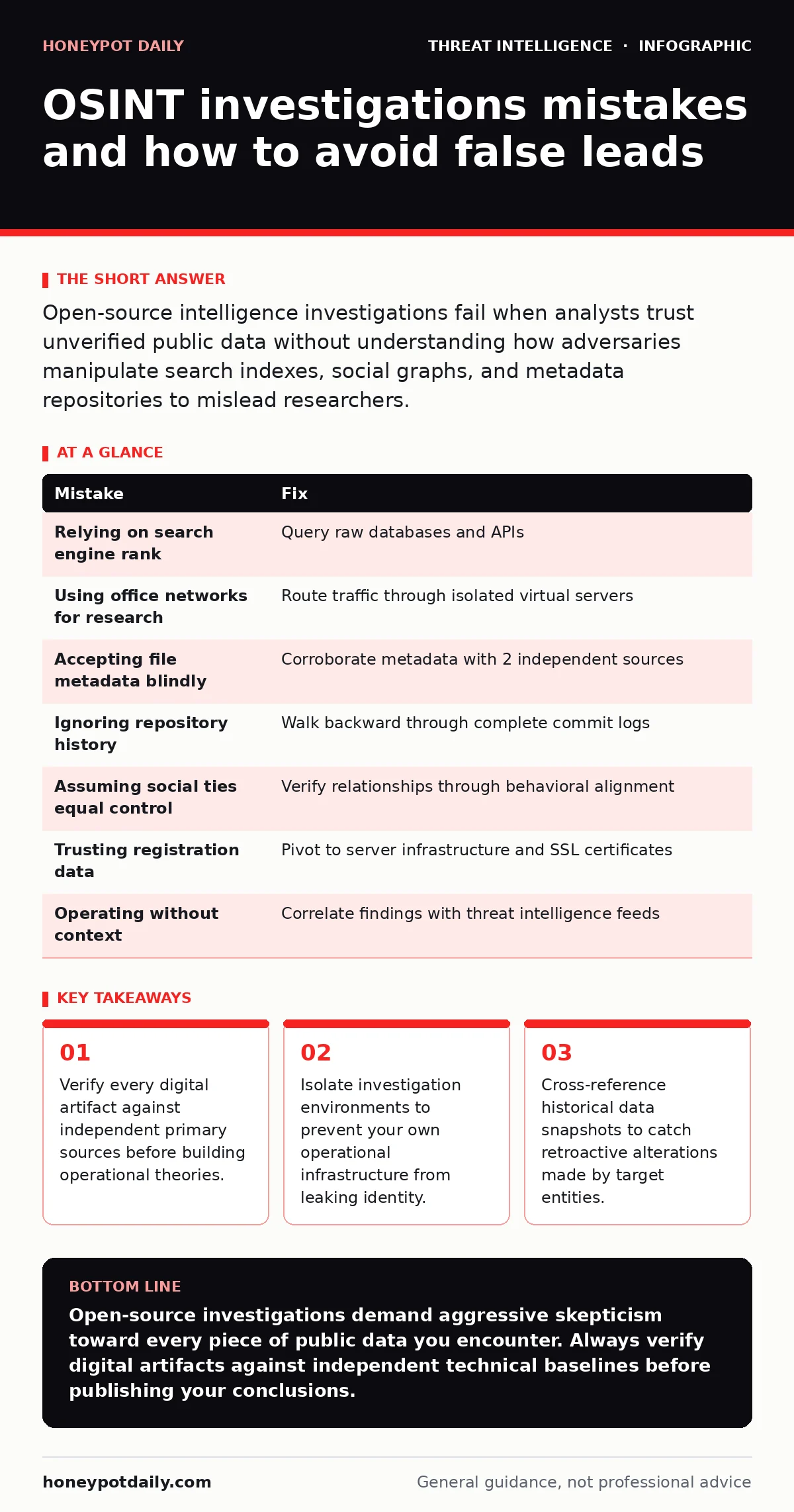
Open-source intelligence investigations fail when analysts trust unverified public data without understanding how adversaries manipulate search indexes, social graphs, and metadata repositories to mislead researchers.
Mistake 1: Relying solely on default search engine result pages
Analysts often treat top search engine results as comprehensive reflections of public digital footprints. Commercial search algorithms rank pages based on commercial relevance, search engine optimisation tactics, and paid placement rather than factual accuracy or security relevance. Adversaries actively manipulate these ranking algorithms to bury damaging disclosures or elevate synthetic content designed to waste investigator time.
Why it hurts: Relying on surface-rankings exposes your investigation to targeted misinformation campaigns engineered specifically to misdirect security teams. You end up wasting precious hours chasing ghosts while the real infrastructure operates quietly in unindexed directory structures or alternative data repositories.
The fix: Bypass standard web interfaces entirely by querying raw database dumps, specialized document archives, and direct API endpoints. Combine your queries with programmatic extraction routines to surface deeply buried files that standard search engines ignore or suppress.
Mistake 2: Failing to isolate the analyst research environment
Investigators frequently use personal or primary office networks to query target domains, social profiles, and public code repositories. Your local IP address, browser fingerprint, and logged-in account sessions transmit a wealth of telemetry directly to the servers you are attempting to quietly observe. Target entities monitor incoming web traffic precisely to catalogue incoming interest from security researchers.
Why it hurts: Blending your personal operational footprint with investigative traffic alerts the target immediately to your presence. Once alerted, the adversary can alter their infrastructure configurations, feed you poisoned telemetry, or launch retaliatory probes against your corporate network.
The fix: Route all traffic through dedicated virtual private servers configured with rotated IP addresses and hardened browser profiles that mimic standard consumer devices. Never log into personal social accounts or corporate identity providers from the machine executing the investigation.
Mistake 3: Accepting metadata at face value without validation
Digital files such as photographs, documents, and spreadsheets frequently retain hidden author names, software versions, and internal network paths. Investigators often pull these embedded properties directly into reports as definitive proof of ownership or geographical origin. Software tools designed for OSINT tools for investigators make extracting these attributes effortless, creating a false sense of security regarding their authenticity.
Why it hurts: File metadata is trivially forged, stripped, or spoofed using basic command-line utilities available to anyone on the internet. Building an attribution case upon unverified author tags or internal file paths leaves your entire conclusion vulnerable to simple counter-forgery tricks.
The fix: Cross-reference extracted properties with independent physical markers, linguistic patterns, and external timeline events. Treat metadata merely as a starting hypothesis that requires corroboration from at least 2 distinct, unrelated technical artifacts.
Mistake 4: Ignoring historical repository version control changes
Researchers often examine a public code repository or website in its current state and assume it reflects long-term operational history. Codebases and public documents evolve through dozens of intermediate commits, drafts, and edits that developers frequently forget to purge completely. Relying on current snapshots means missing the initial configuration files or credentials that were accidentally published and subsequently deleted.
Why it hurts: Stopping your review at the current version misses valuable historical artifacts that reveal previous infrastructure partners, developer real names, and legacy staging environments. Adversaries frequently scrub active repositories while leaving historical commit logs fully exposed.
The fix: Walk backward through the complete commit history of every repository and document version control system you encounter. Look specifically for deleted configuration files, hardcoded credentials, and initial author commits made before accounts were pseudonymised.
Mistake 5: Treating social graph connections as direct association
Investigators regularly map professional networks and friendship ties on public platforms to establish organizational hierarchies and operational command structures. Social media links reflect mutual follows, shared educational backgrounds, or casual interactions rather than operational complicity or command authority.
Why it hurts: Assuming social connectivity equals operational collaboration leads to false accusations against innocent third parties while missing the actual decision-makers who maintain strict operational security separation from public profiles.
The fix: Validate social ties by tracking concurrent activity, shared communication channels, and synchronized timing of operational events. Real operational relationships manifest through behavioral alignment rather than public declarations of friendship.
See also: Cybercrime Forums: What Small Businesses Need to Know About Threat Exposure · Port Scanning Mistakes: 7 Errors That Leave Your Network Exposed
Mistake 6: Neglecting domain registration anonymity trade-offs
Security teams often rely blindly on historical registration records and ownership databases to identify individuals behind malicious web infrastructure. Privacy protection services and registrar-level redactions obscure real ownership details behind generic proxy identities designed to comply with legal frameworks while protecting user privacy.
Why it hurts: Trusting raw registration data leads investigators to believe they have unmasked a threat actor when they are merely looking at proxy contact details managed by third-party hosting providers or bulletproof hosting networks.
The fix: Pivot your investigation away from registration contact fields and toward hosting provider metadata, SSL certificate serial numbers, and underlying server architecture footprints. Infrastructure reuse provides much stronger attribution signals than rented registration names.
Mistake 7: Failing to correlate findings with threat intelligence feeds
Investigators often treat an open-source finding as an isolated island of truth without matching the discovered indicators against broader historical campaigns. Information gathered from public forums, paste sites, and social networks lacks context regarding frequency, actor sophistication, and known attack patterns.
Why it hurts: Operating without broader context turns normal administrative behavior into perceived malicious activity, causing false alarms and misdirected operational focus during active incident response scenarios.
The fix: Feed all discovered indicators, file hashes, and network addresses directly into your threat intelligence feeds to verify whether the artifacts belong to known, documented adversary campaigns or benign commercial operations.
| Mistake | Fix |
|---|---|
| Relying on search engine rank | Query raw databases and APIs |
| Using office networks for research | Route traffic through isolated virtual servers |
| Accepting file metadata blindly | Corroborate metadata with 2 independent sources |
| Ignoring repository history | Walk backward through complete commit logs |
| Assuming social ties equal control | Verify relationships through behavioral alignment |
| Trusting registration data | Pivot to server infrastructure and SSL certificates |
| Operating without context | Correlate findings with threat intelligence feeds |
Key takeaways
- Verify every digital artifact against independent primary sources before building operational theories.
- Isolate investigation environments to prevent your own operational infrastructure from leaking identity.
- Cross-reference historical data snapshots to catch retroactive alterations made by target entities.
Open-source investigations demand aggressive skepticism toward every piece of public data you encounter. Always verify digital artifacts against independent technical baselines before publishing your conclusions.
Frequently asked questions
Can search engines be manipulated to hide malicious domains from investigators?
Adversaries manipulate search indexes by flooding platforms with synthetic positive content and optimizing text to bury warning reports.
Why do virtual private servers protect analyst identities during investigations?
Virtual servers hide your local network IP address and prevent target servers from profiling your browser and office telemetry.
How can investigators spot forged file metadata during an assessment?
Investigators spot forgeries by cross-referencing embedded author tags with linguistic patterns, physical markers, and independent timeline events.
What is the risk of using personal social accounts for open-source research?
Personal accounts transmit persistent tracking cookies and telemetry that immediately alert target entities to your surveillance efforts.
How this guide was produced: written by the Honeypot Daily editorial team with AI assistance, checked against the public references listed below, and reviewed when the facts change. See our editorial policy or report an error.