
Network Detection and Response: How It Works and Why You Need It
Network detection and response spots threats that endpoint agents miss by analysing the silent traffic between systems, closing the visibility gap in your infrastructure.
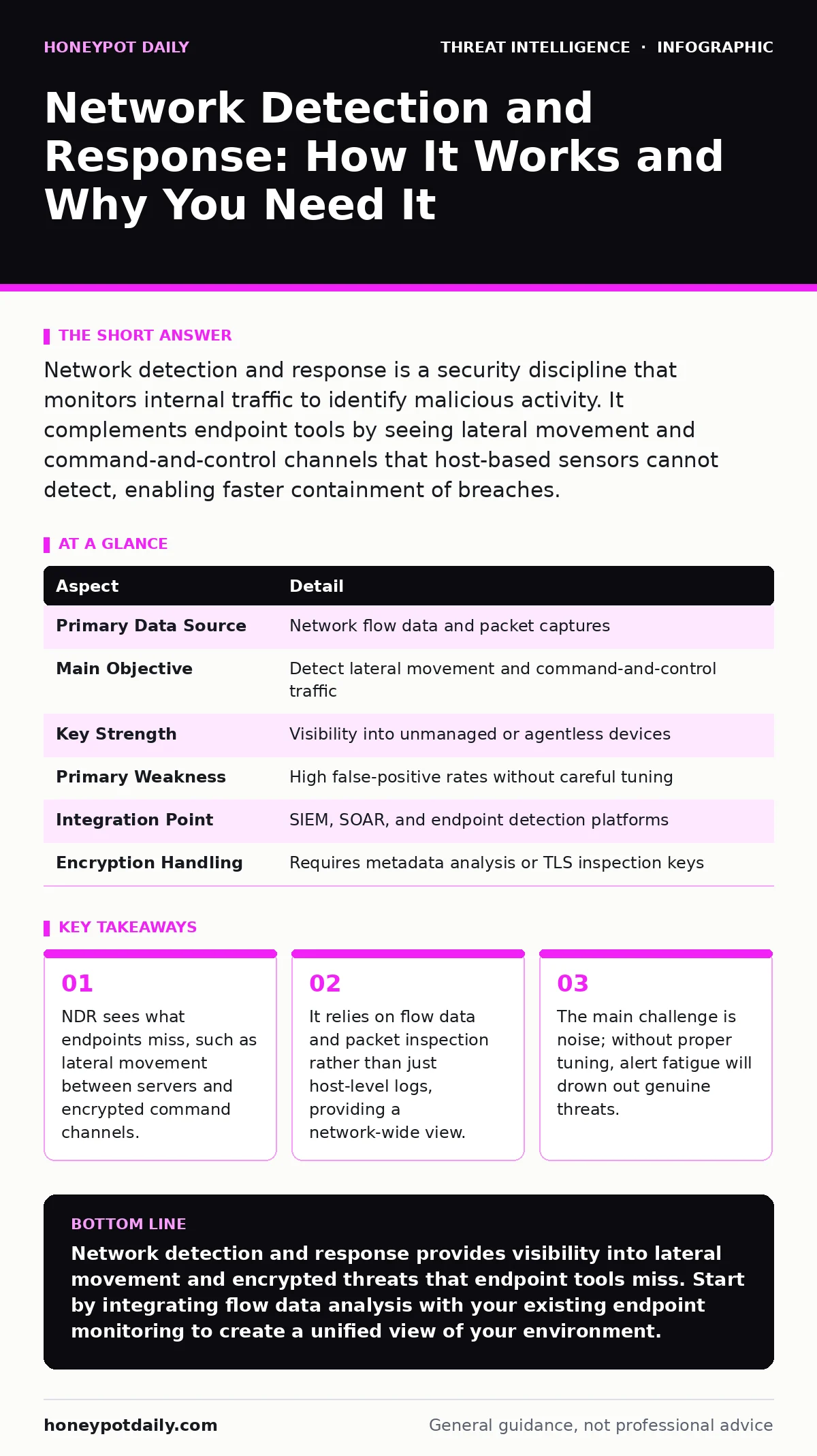
Network detection and response is a security discipline that monitors internal traffic to identify malicious activity. It complements endpoint tools by seeing lateral movement and command-and-control channels that host-based sensors cannot detect, enabling faster containment of breaches.
The Radio Tower Analogy
Imagine a city where every building has a security guard inside. These guards check IDs at the door and watch who enters. This is your endpoint security. Now imagine a radio operator listening to the airwaves. They do not see who is inside the buildings, but they hear the secret codes being exchanged between them. If two buildings start speaking in a strange, encrypted dialect at 3 a.m., the radio operator knows something is wrong, even if the guards inside see nothing suspicious.
Network detection and response acts as that radio operator. It does not care about the files on a hard drive or the processes running in memory. It cares about the conversation between machines. When an attacker compromises one system, they must communicate with others to steal data or spread malware. That communication creates a pattern in the network traffic. NDR tools are designed to spot those patterns.
The Blind Spot in Host-Based Security
Traditional security tools focus on the endpoint. They look for known malware signatures, suspicious process injection, or unusual registry changes. This approach is necessary but insufficient. Modern attackers often use legitimate tools to move around. They might use PowerShell or SSH to jump from a compromised workstation to a database server. These tools are signed, trusted, and expected. The endpoint agent on the database server sees a valid administrator connecting. It logs nothing suspicious.
The network, however, sees the truth. It sees a workstation that never talks to the database suddenly initiating a large data transfer. It sees the timing, the volume, and the protocol. This is the blind spot that NDR fills. By observing the flow of data, you can detect lateral movement that host-based tools ignore. This is particularly useful when you cannot install agents on every device, such as with legacy industrial control systems or third-party appliances.
Core Components of NDR
A functional NDR setup requires three distinct elements working in tandem. First is the data collection layer. This involves sensors or taps that capture network traffic. They extract metadata, such as source and destination IPs, ports, and packet sizes. Some also capture full packet payloads for deeper inspection.
Second is the analysis engine. This component processes the raw data. It applies baseline behaviour models to determine what is normal for your environment. If a server usually sends 10 megabytes of data per hour but suddenly sends 10 gigabytes, the engine flags this anomaly. It may also use YARA rules to scan packet contents for known malicious signatures or patterns.
Third is the response capability. Detection is useless without action. The system must integrate with your security orchestration platform. When a high-confidence threat is identified, it can automatically isolate the affected host, block the malicious IP, or trigger an alert for alert triage. This automation reduces the time between detection and containment.
| Aspect | Detail |
|---|---|
| Primary Data Source | Network flow data and packet captures |
| Main Objective | Detect lateral movement and command-and-control traffic |
| Key Strength | Visibility into unmanaged or agentless devices |
| Primary Weakness | High false-positive rates without careful tuning |
| Integration Point | SIEM, SOAR, and endpoint detection platforms |
| Encryption Handling | Requires metadata analysis or TLS inspection keys |
Where NDR Fits in Your Defence
Network detection and response is not a replacement for other security tools. It is a complementary layer. Think of your security stack as a series of filters. Endpoint protection stops known malware at the entry point. Firewall rules block obvious external attacks. NDR sits behind these layers, watching for what slips through.
It works closely with threat intelligence feeds. When an external feed identifies a new command-and-control server, your NDR can instantly search its historical data to see if any internal hosts have already communicated with it. This retrospective analysis is powerful. It allows you to find infections that occurred weeks ago but went undetected.
It also enhances blue team operations. Analysts can use NDR data to map the attack path. Instead of guessing how an attacker moved from a email server to a file share, they can see the exact network connections. This clarity speeds up incident response and helps in understanding the scope of a breach.
The Encryption Challenge
Most modern traffic is encrypted using TLS. This protects user privacy but hides the content from security tools. NDR tools cannot simply read the payload to find malware. They must rely on metadata. This includes the size and timing of packets, the TLS handshake details, and the certificate information.
Advanced NDR solutions use machine learning to analyse this metadata. They learn the normal behaviour of applications. If a web browser suddenly starts behaving like a botnet client in terms of packet structure, the system raises an alarm. However, this is less precise than inspecting the actual content.
Some organisations implement TLS inspection, where a proxy decrypts traffic for analysis. This provides deeper visibility but introduces significant performance overhead and privacy concerns. You must weigh the security benefit against the operational cost and legal implications. For most environments, metadata analysis combined with endpoint data provides a sufficient balance.
See also: Port Scanning Mistakes: 7 Errors That Leave Your Network Exposed · Network Scanning: How Defenders Spot and Stop Port Probes
Common Misconceptions
Many teams believe that NDR will solve all their detection problems. This is a mistake. NDR is excellent at seeing movement and communication, but it is poor at seeing what happens inside a single host. It cannot tell you if a file was deleted or if a user account was created locally. You still need Windows event log monitoring and endpoint telemetry for that.
Another misconception is that NDR requires full packet capture for everything. This is a storage nightmare. Most NDR tools work effectively with flow data, such as NetFlow or IPFIX. Full packet capture is only needed for deep inspection of specific suspicious flows.
Finally, do not confuse NDR with a firewall. A firewall enforces policy. It blocks traffic based on rules. NDR observes traffic and identifies threats. It does not block traffic by default. It needs to be integrated with a firewall or switch to take action. Without that integration, it is merely a monitoring tool.
Getting Started with NDR
Begin by defining what you want to protect. Identify your critical assets and the traffic flows around them. Place sensors at strategic points, such as at the edge of your data centre or between network segments. Ensure you are capturing flow data from all relevant switches and routers.
Integrate your NDR with your existing security information and event management system. This allows you to correlate network alerts with endpoint logs. A network alert combined with a suspicious process creation on the endpoint provides high-confidence evidence.
Tune your detection rules carefully. Start with known indicators of compromise. Gradually introduce behavioural anomalies. Review alerts daily to reduce noise. Involve your network engineers in this process. They understand the normal traffic patterns and can help distinguish between a threat and a legitimate change.
Remember that NDR is a tool for visibility. It gives you the sight to see the unseen. Use it to close the gaps in your defence, not to replace the foundation.
Key takeaways
- NDR sees what endpoints miss, such as lateral movement between servers and encrypted command channels.
- It relies on flow data and packet inspection rather than just host-level logs, providing a network-wide view.
- The main challenge is noise; without proper tuning, alert fatigue will drown out genuine threats.
- It fits into a layered defence strategy, sitting alongside endpoint detection and threat intelligence feeds.
Network detection and response provides visibility into lateral movement and encrypted threats that endpoint tools miss. Start by integrating flow data analysis with your existing endpoint monitoring to create a unified view of your environment.
Frequently asked questions
Does network detection and response replace antivirus software?
No, it complements it. Antivirus protects individual hosts from known malware, while NDR detects suspicious network behaviour and lateral movement that host-based tools may miss.
Can NDR detect attacks on encrypted traffic?
Yes, but with limitations. It analyses metadata like packet size and timing rather than content. For deep inspection, you need TLS decryption, which adds complexity and privacy risks.
What is the difference between NDR and a firewall?
A firewall blocks traffic based on predefined rules. NDR observes traffic to identify anomalies and threats, often requiring integration with a firewall to take blocking actions.
Do I need to install agents on every device for NDR?
No, one of its main benefits is agentless monitoring. It works by analysing network traffic flows, allowing you to see activity on devices that cannot run security software.
How this guide was produced: written by the Honeypot Daily editorial team with AI assistance, checked against the public references listed below, and reviewed when the facts change. See our editorial policy or report an error.