Dark web threat intelligence explained: separating myth from reality
Hidden forum monitoring reveals actor intent long before infrastructure deployment occurs.
Dark web threat intelligence involves collecting and analysing data from underground forums and marketplaces to anticipate cyber attacks. This practice turns raw chatter about vulnerabilities and stolen credentials into actionable warnings, helping defenders prepare for specific threats before they materialize.
What is dark web threat intelligence?
Dark web threat intelligence is the systematic collection and analysis of data from hidden online forums, marketplaces, and messaging channels to anticipate cyber attacks. You can picture this discipline as running a surveillance post outside a sprawling, clandestine night market where criminals trade stolen goods and discuss illicit blueprints. Instead of waiting for a break-in at your front door, you listen to the planning conversations happening across town.
Underground markets rely on specialised anonymity networks that mask the physical location of servers and the identities of users. Forums require cryptographic invitations or vetting fees to keep outsiders away, mimicking exclusive members-only clubs. These digital bazaars operate outside standard search engine indexes, creating an environment where malicious actors feel secure enough to trade credentials, zero-day exploits, and corporate access.
Gathering intelligence from these hidden spaces helps you understand who might target your sector and what methods they prefer. Open-source intelligence investigations often overlap with this work by harvesting public artefacts that point toward hidden forums. Intelligence feeds do not stop attacks automatically; they only provide early warnings about shifting adversary tactics and newly minted hazards.
How underground bazaars mimic legitimate commerce
Underground bazaars operate with commercial efficiency, featuring reputation systems, escrow services, and dispute resolution channels for buyers and sellers. Imagine a high-end bazaar where merchants display their stolen credentials, corporate network access, and malicious software tools on polished digital storefronts. Vendors maintain ratings based on successful transactions, and disgruntled buyers leave public feedback when an exploit fails to function as advertised.
Reputation scores dictate pricing dynamics, allowing established threat actors to command higher fees for verified administrative access to corporate networks. Newer participants must offer discounts or free samples to build credibility within the community. This market logic means that financial motivations heavily influence which vulnerabilities receive public attention and which exploits remain closely guarded secrets.
Transaction escrow ensures that funds are held by a neutral third party until the buyer verifies that the stolen database or access credential works. Dispute forums handle disagreements over invalid passwords or patched vulnerabilities, mirroring consumer protection boards in mainstream retail. Understanding this commercial structure helps analysts determine whether a posted threat represents a credible vendor or a scammer attempting to offload recycled data.
The glossary of hidden forum operations
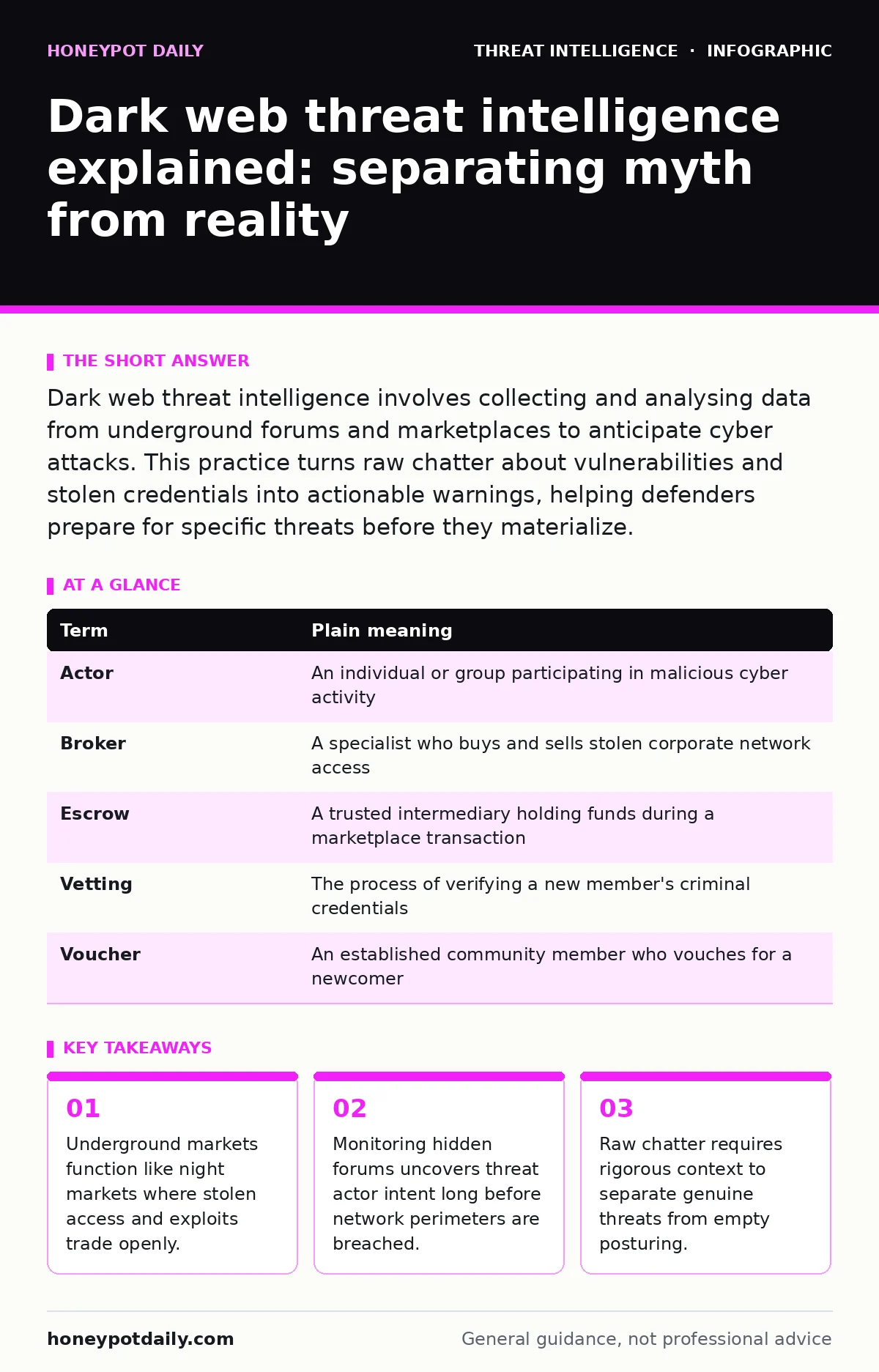
Underground ecosystems use specific terminology to describe transactions, actors, and operational security measures.
| Term | Plain meaning |
|---|---|
| Actor | An individual or group participating in malicious cyber activity |
| Broker | A specialist who buys and sells stolen corporate network access |
| Escrow | A trusted intermediary holding funds during a marketplace transaction |
| Vetting | The process of verifying a new member's criminal credentials |
| Voucher | An established community member who vouches for a newcomer |
Mastering these definitions allows your defensive teams to parse raw chatter accurately during shift handovers and alert triage. Analysts must look past aggressive posturing to identify verifiable proof of stolen assets. Without a clear grasp of marketplace mechanics, security teams often chase phantom threats while ignoring genuine access brokers operating quietly in the background.
Why raw chatter requires deep context
Raw chatter on hidden forums often consists of exaggerated claims, recycled data dumps, and outright scams designed to part novice criminals from their cryptocurrency. Suppose a vendor claims to sell administrative access to a Fortune corporation for a remarkably low price. An experienced analyst knows that high-value network access rarely appears on public auction boards without prior private negotiation among trusted peers.
Filtering out the noise demands deep familiarity with threat actor personas and historical trading patterns across multiple forums. You must correlate marketplace claims with security telemetry from your own network to determine if a stated vulnerability actually exists in your environment. Relying solely on forum posts without technical verification leads to wasted effort chasing nonexistent hazards.
Hidden costs and operational friction
Monitoring underground spaces consumes significant analyst time, mental energy, and technical resources that could otherwise defend internal infrastructure. Maintaining undercover personas requires careful isolation to prevent threat actors from discovering your surveillance operation and burning your intelligence sources. Analysts must rotate operational infrastructure constantly to avoid detection by forum administrators who actively hunt for law enforcement and security researchers.
Burnout remains a persistent hidden cost when staff spend hours reading toxic forums and monitoring accounts of data theft. The psychological weight of processing constant threats can degrade decision-making quality over long shifts. Organisations must rotate analysts regularly and provide adequate support structures to maintain analytical accuracy.
See also: Cybercrime Forums: What Small Businesses Need to Know About Threat Exposure · Port Scanning Mistakes: 7 Errors That Leave Your Network Exposed
The limits of predictive visibility
Predictive visibility derived from underground forums has distinct boundaries and frequently fails to capture sophisticated state-sponsored operations. Highly targeted campaigns often bypass public marketplaces entirely, relying on closed communication channels and bespoke tools that never touch commercial dark web forums. You cannot rely on forum monitoring as a complete defense, because many silent intrusions begin without any prior public boasting or marketplace auction.
Adversaries frequently shift their communication methods when law enforcement actions disrupt popular forums, scattering communities across encrypted messaging applications. This migration breaks established collection pipelines and leaves defenders temporarily blind while they build new tracking mechanisms. Intelligence gathering provides a useful strategic window, but it remains just one component of a balanced defensive posture.
How to begin monitoring underground chatter
Starting your intelligence collection requires a structured approach that avoids common pitfalls and legal hazards.
- Configure isolated research virtual machines with strict network controls and updated browser configurations to ensure safe navigation.
- Identify 3 trusted public repositories or threat intelligence feeds that aggregate verified forum summaries without requiring direct marketplace participation.
- Establish a baseline of normal chatter regarding your industry sector so you can quickly spot anomalous discussions concerning your brand or supply chain.
Bottom line
Dark web threat intelligence provides early warnings about shifting adversary tactics through the systematic observation of underground markets. You should begin your intelligence journey by auditing your current threat feeds to ensure they distinguish between genuine access brokers and empty forum posturing.
Key takeaways
- Underground markets function like night markets where stolen access and exploits trade openly.
- Monitoring hidden forums uncovers threat actor intent long before network perimeters are breached.
- Raw chatter requires rigorous context to separate genuine threats from empty posturing.
Frequently asked questions
Can automated tools completely replace human analysts on hidden forums?
Automated tools can scrape text and flag keywords, but human analysts remain essential for contextualizing ambiguous claims and evaluating threat credibility.
How do threat actors usually pay for services on hidden marketplaces?
Transactions typically rely on privacy-focused cryptocurrencies or escrow services that obscure the financial trail between buyer and seller.
What happens when law enforcement seizes a major underground forum?
Communities usually fracture and migrate to encrypted messaging apps or smaller niche boards, temporarily disrupting intelligence collection pipelines.
Are all discussions on hidden forums related to cyber attacks?
Many forums host discussions on financial fraud, physical security bypasses, and general tradecraft that have no direct bearing on corporate network security.
How this guide was produced: written by the Honeypot Daily editorial team with AI assistance, checked against the public references listed below, and reviewed when the facts change. See our editorial policy or report an error.