Block OSINT Tool Reconnaissance Across Your Surface
Public reconnaissance tools map your entire perimeter by querying shared third-party datasets long before any packets reach your boundary firewalls.
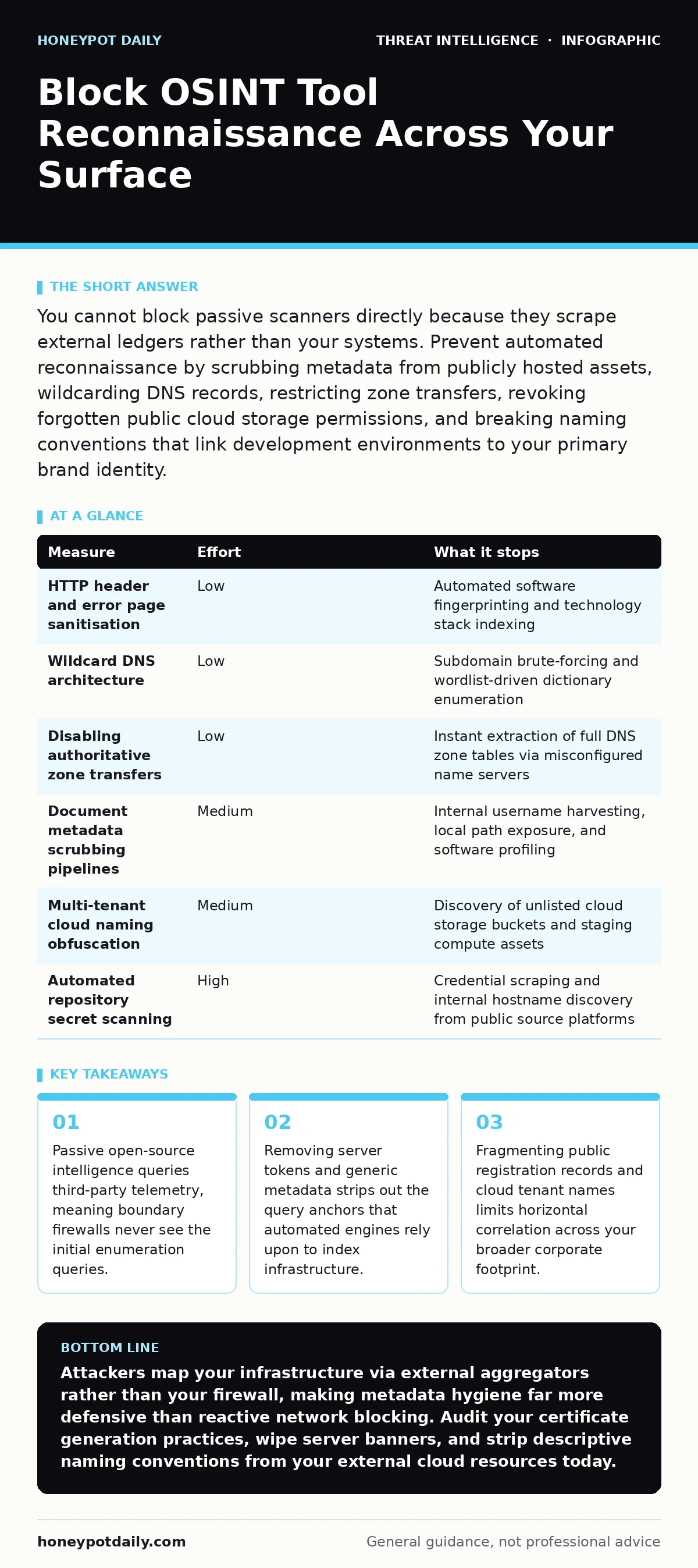
You cannot block passive scanners directly because they scrape external ledgers rather than your systems. Prevent automated reconnaissance by scrubbing metadata from publicly hosted assets, wildcarding DNS records, restricting zone transfers, revoking forgotten public cloud storage permissions, and breaking naming conventions that link development environments to your primary brand identity.
How Public Reconnaissance Engines Harvest Your Footprint
Reconnaissance scripts rarely hit your IP space directly during early discovery phases. Open-source intelligence (OSINT) engines harvest infrastructure information by querying third-party aggregators, passive Domain Name System (DNS) databases, Certificate Transparency logs, and public code repositories. Profiling these data streams allows external observers to map environments before initiating active probes such as port scanning.
Defenders face an asymmetrical problem because boundary devices cannot inspect queries sent to foreign databases. Every time an engineer requests an automated Transport Layer Security (TLS) certificate, that hostname appends to an immutable public append-only ledger. When developers commit configuration files containing development hostnames or staging credentials, scrapers extract those breadcrumbs within seconds. Limiting reconnaissance requires poison pills, stripping data at creation points, and aggressive footprint consolidation.
Immediate Wins to Starve Automated Sweepers
Quick remediation efforts yield outsized returns by dismantling the search queries adversary automation relies on. Begin by purging all unnecessary external records that reveal internal topography.
- Purge diagnostic DNS subdomains: Delete legacy hostnames such as
test,dev,vpn-old, orstagethat point to active public addresses. - Scrub HTTP banner headers: Modify server configuration profiles to strip out values from fields such as
Server,X-Powered-By, andX-AspNet-Version. - Enforce authenticated proxy gateways: Place exposed administrative interfaces behind zero-trust network access gateways so crawlers only receive blank authentication pages.
- Scrub document metadata: Strip user identities, software versions, and local path structures from all publicly downloadable PDF and office files via automated build pipelines.
Comparative Defense Measures Against Data Aggregation
Different anti-reconnaissance controls address distinct phases of information gathering. The following breakdown shows the resource commitment needed for each defensive countermeasure and the specific collection vectors it neutralises.
| Measure | Effort | What it stops |
|---|---|---|
| HTTP header and error page sanitisation | Low | Automated software fingerprinting and technology stack indexing |
| Wildcard DNS architecture | Low | Subdomain brute-forcing and wordlist-driven dictionary enumeration |
| Disabling authoritative zone transfers | Low | Instant extraction of full DNS zone tables via misconfigured name servers |
| Document metadata scrubbing pipelines | Medium | Internal username harvesting, local path exposure, and software profiling |
| Multi-tenant cloud naming obfuscation | Medium | Discovery of unlisted cloud storage buckets and staging compute assets |
| Automated repository secret scanning | High | Credential scraping and internal hostname discovery from public source platforms |
Restricting Public DNS and Name Registration Exposure
Authoritative name servers represent the most prolific data fountain for automated discovery engines. Standard network enumeration strategies rely on predictable subdomain structures to locate forgotten systems. You can halt wordlist enumeration by implementing wildcard DNS records (*.example.com) resolved to a synthetic dead-end address, which invalidates automated brute-forcing scripts by returning identical hits for non-existent names.
Authoritative DNS configurations must explicitly forbid full zone transfers (AXFR requests) to untrusted resolvers. When an external server permits an AXFR request, an investigator captures every mapped hostname across the domain in a single request. Enforce strict access control lists on all authoritative DNS software, ensuring only verified secondary name servers can synchronise these records.
Preventing Infrastructure Linkage via Certificate Transparency Logs
Certificate Transparency logs are mandatory, publicly auditable records of all issued TLS certificates. OSINT collection platforms continuously parse these logs to instantly detect new staging sites, subdomains, and branch infrastructure. Because these append-only logs cannot be bypassed or modified, standard concealment methods routinely fail here.
Mitigate this tracking vector by requesting wildcard certificates for internal service endpoints rather than unique certificates for each sub-tier service. Generating a single certificate for *.internal.example.com stops scanners from learning the distinct functional roles of hosts like auth.internal.example.com or billing.internal.example.com. Where distinct domains must exist, avoid embedding the core enterprise brand name into non-production testing hostnames.
See also: Cybercrime Forums: What Small Businesses Need to Know About Threat Exposure · Port Scanning Mistakes: 7 Errors That Leave Your Network Exposed
Mitigating Cloud Footprint and Repository Linkages
Unlinked public cloud environments present an easy target when naming schemes mirror standard brand conventions. Autonomous scrapers systematically permute company names with terms like backup, internal, logs, or database against public cloud storage naming conventions. Obfuscate your cloud tenant and storage container names with non-sequential, pseudorandom string prefixes rather than recognisable corporate identifiers.
Developers inadvertently hand investigators the keys to your operational infrastructure by pushing code with hardcoded uniform resource identifiers. Integrating automated inspection scanners directly into local version control hooks stops code containing sensitive IP networks, internal endpoints, and API credentials from ever reaching open repositories. Incorporating these scanning controls directly supports broader blue team operations by terminating internal resource disclosure at the commit stage.
Trapping Scanners and Poisoning Adversary Telemetry
Active deception diverts automated collection scripts by intentionally polluting the output with synthetic noise. Deploy high-interaction web traps that feed false endpoint data to anomalous client requests. When scanning engines harvest these falsified services, they log phantom systems that consume investigative time and trigger automated alerting inside network detection and response platforms.
Combine synthetic data generation with strict anti-scraping parameters on public documentation. Implement explicit access quotas on web resources to disrupt persistent scrapers without hindering ordinary visitor traffic. Configure firewall drop actions rather than reject actions on all closed ports, which denies enumeration scanners the clean TCP reset responses needed to calculate rapid state transitions during mapping.
Why Perimeter IP Obfuscation Fails on its Own
Hiding origin IP addresses behind reverse proxies gives a false sense of security when configuration sanitisation is neglected. Aggregator services actively crawl the raw public IPv4 space by transmitting direct HTTP requests using naked IP addresses. If an origin server answers direct requests with its production TLS certificate, the platform links the origin IP to the domain name immediately.
Origin web servers must reject all incoming connections that lack the specific hostname in the Server Name Indication (SNI) negotiation. Configure origin firewalls to restrict ingress traffic exclusively to the published IP address ranges of your proxy provider. Neglecting this configuration allows investigators to bypass content filtering layers entirely by sending packets directly to your origin infrastructure.
Tactical Reconnaissance Defence Checklist
Execute these 3 actions immediately to shrink your public profiling footprint:
- Audit authoritative DNS servers to confirm that incoming AXFR zone transfer requests from unlisted external clients are dropped immediately.
- Implement wildcard TLS certificates across all staging host configurations to deny certificate-logging scrapers advance notice of internal hostnames.
- Configure perimeter web servers to drop connections where the incoming request supplies a raw IP address or mismatched host header.
Key takeaways
- Passive open-source intelligence queries third-party telemetry, meaning boundary firewalls never see the initial enumeration queries.
- Removing server tokens and generic metadata strips out the query anchors that automated engines rely upon to index infrastructure.
- Fragmenting public registration records and cloud tenant names limits horizontal correlation across your broader corporate footprint.
Attackers map your infrastructure via external aggregators rather than your firewall, making metadata hygiene far more defensive than reactive network blocking. Audit your certificate generation practices, wipe server banners, and strip descriptive naming conventions from your external cloud resources today.
Frequently asked questions
Can you hide your organisation from Certificate Transparency logs entirely?
No, you cannot suppress Certificate Transparency logs because public Certificate Authorities must write to these public ledgers to issue valid browser-trusted certificates. You can only reduce the intelligence value of these logs by using wildcard certificates or hosting internal applications on completely separate domains.
How do OSINT investigators identify origin IPs behind reverse proxies?
Investigators scan the entire public address space with direct HTTPS requests to harvest the TLS certificates presented on port 443. If your origin server presents a certificate bearing your primary domain name instead of dropping non-proxy requests, your real IP is exposed.
Does placing fake contact details in WHOIS protect against infrastructure profiling?
WHOIS privacy protections only shield the human contact details associated with a domain. Automated reconnaissance scripts identify infrastructure through nameserver records, IP address block registrations, autonomous system numbers, and routing tables, none of which are concealed by domain privacy guards.
Will robots.txt directives prevent reconnaissance tools from mapping sensitive paths?
No, robots.txt directives act as open-source roadmaps for human investigators and automated reconnaissance scripts. Disallow fields in public files explicitly point adversary tools toward the exact administrative, diagnostic, and staging paths you wish to hide.
How this guide was produced: written by the Honeypot Daily editorial team with AI assistance, checked against the public references listed below, and reviewed when the facts change. See our editorial policy or report an error.