Cybercrime Forums: What Small Businesses Need to Know About Threat Exposure
Small businesses face targeted attacks because criminals discuss specific software configurations and vulnerability patterns in open forums, not just because they are easy targets.
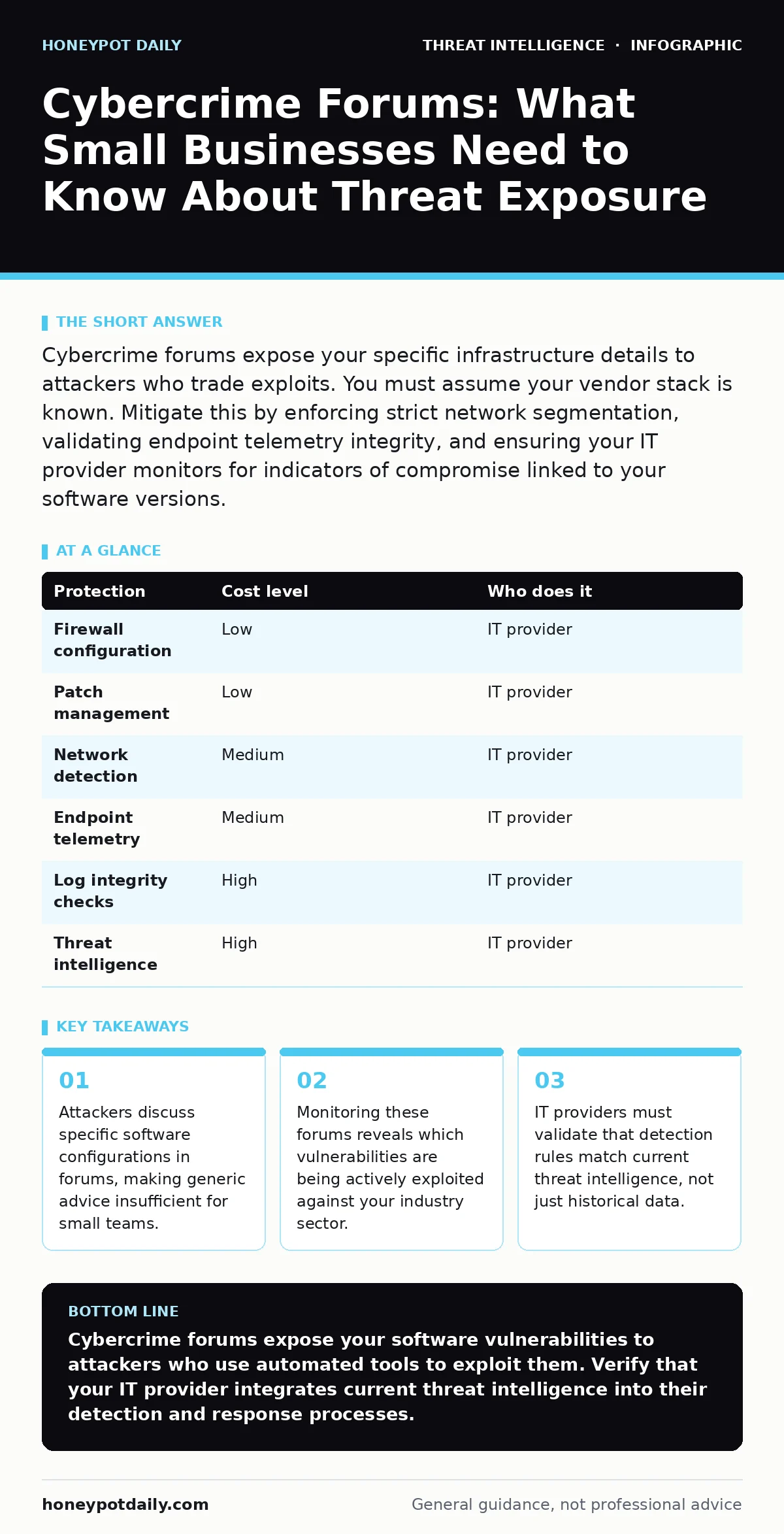
Cybercrime forums expose your specific infrastructure details to attackers who trade exploits. You must assume your vendor stack is known. Mitigate this by enforcing strict network segmentation, validating endpoint telemetry integrity, and ensuring your IT provider monitors for indicators of compromise linked to your software versions.
Why Small Scale Matters in Threat Intelligence
Small organisations often believe they are invisible to cybercriminals. This assumption is dangerous. Cybercrime forums do not target individuals by name; they target software stacks. Attackers list the vulnerabilities of common business applications, such as accounting platforms or remote access tools. If your organisation uses these standard tools, you appear on the target list. The cost of entry for attackers is low when they can purchase scripts that exploit known weaknesses in widely used software.
The scale of your operation does not protect you. It only limits the time an attacker spends on your network. A small business has fewer security controls than a large enterprise. This means an attacker moves faster. They do not need to bypass complex firewalls. They need to find one unpatched service. Forums provide the exact details of which services are vulnerable and how to exploit them. You are competing against automated tools that execute these exploits at high speed.
The Mechanics of Forum-Based Targeting
Cybercrime forums operate as marketplaces for technical knowledge. Users post "proof of concept" code that demonstrates how to breach a system. Others refine this code into reliable exploits. This cycle shortens the time between a vulnerability discovery and its weaponisation. For a small business, this window is often measured in days. The forums also share lists of compromised credentials. These lists are filtered by industry and geography. An attacker can buy a list of credentials likely to work against your sector.
This process relies on network enumeration. Attackers scan ranges of IP addresses to identify live hosts and open ports. They then match the services running on those ports against the vulnerabilities discussed in forums. If your organisation runs a service with a known flaw, the scanner flags it. The attacker then applies the exploit. This is not random guessing. It is a systematic process driven by open-source intelligence. Your exposure is determined by how visible your services are to these scanners.
Practical Defences Against Known Exploits
Defending against forum-driven attacks requires reducing your attack surface. This means closing ports that are not required for business operations. Every open port is a potential entry point. You must configure firewalls to deny all incoming traffic by default. Then, you open only the specific ports needed for your services. This approach limits the options available to an attacker. It forces them to guess which service is running behind the few open ports.
You must also ensure that your software is updated promptly. Vendors release patches to fix vulnerabilities. These patches are often discussed in forums before they are widely applied. Delaying updates leaves your systems exposed to known exploits. Automated patch management helps, but it must be verified. Manual checks ensure that the patch was applied correctly and that the service restarted as expected. This verification step is often skipped, leaving the system vulnerable despite the patch being "installed".
Integrating Threat Intelligence into Operations
Threat intelligence feeds provide data on active threats. These feeds list indicators of compromise, such as malicious IP addresses or file hashes. You can use this data to block known bad actors. However, static blocking is not enough. Attackers change their infrastructure frequently. You need dynamic detection that looks for behaviour, not just signatures. This requires network detection and response systems that analyse traffic patterns. These systems can identify unusual activity, such as a sudden increase in outbound connections to a new IP address.
Integrating this data into your security operations requires context. Not every alert is a threat. Some alerts are false positives. You must tune your detection rules to reduce noise. This tuning process is ongoing. It requires reviewing alerts and adjusting thresholds. Blue team operations focus on this continuous improvement. The goal is to ensure that your team can respond to real threats quickly without being overwhelmed by irrelevant alerts. This balance is difficult to achieve but necessary for effective defence.
The Role of Endpoint Visibility
Endpoints, such as laptops and servers, are often the first line of defence. Endpoint telemetry collects data on processes, file changes, and network connections. This data allows you to see what is happening on your devices. If an attacker exploits a vulnerability, they will run code on an endpoint. Telemetry can detect this execution. However, attackers are aware of telemetry. They use techniques to hide their activity. This is where log tampering becomes a concern. Attackers may delete or alter logs to cover their tracks.
You must protect your log integrity. This involves sending logs to a secure, remote server. This server should be write-only for the endpoints. Attackers cannot modify logs that are stored remotely. This ensures that you have a reliable record of activity. If an attacker tampers with local logs, the remote copy remains intact. This discrepancy can itself be an indicator of compromise. Your detection system should alert on any attempt to modify or delete log files.
See also: Block OSINT Tool Reconnaissance Across Your Surface · Port Scanning Mistakes: 7 Errors That Leave Your Network Exposed
What to Ask Your IT Provider
Your IT provider plays a critical role in your defence. They manage your infrastructure and security tools. You need to ensure they are using current threat intelligence. Ask them how they integrate external data into their monitoring. Do they update their rules based on new vulnerabilities? Do they test their detection capabilities against known exploits? These questions reveal their level of preparedness. A provider who relies on static rules is not keeping pace with evolving threats.
You should also ask about their incident response plan. How do they handle a breach? What is their communication protocol? Do they have a clear process for containment and eradication? These questions ensure that you are not left in the dark during a crisis. Your provider must be transparent about their capabilities and limitations. Understanding their approach helps you make informed decisions about your security posture.
| Protection | Cost level | Who does it |
|---|---|---|
| Firewall configuration | Low | IT provider |
| Patch management | Low | IT provider |
| Network detection | Medium | IT provider |
| Endpoint telemetry | Medium | IT provider |
| Log integrity checks | High | IT provider |
| Threat intelligence | High | IT provider |
Questions for Your IT Provider
- How do you update detection rules to reflect new vulnerabilities discussed in threat intelligence feeds?
- Do you monitor for specific indicators of compromise related to our software stack?
- How do you ensure that logs are not tampered with during an incident?
- What is your process for validating that patches have been applied correctly?
- How do you distinguish between normal business traffic and malicious activity?
- Do you use YARA rules to detect known malicious file patterns?
- How frequently do you test your incident response plan?
- What metrics do you use to measure the effectiveness of our security controls?
The Hidden Cost of Complacency
The biggest risk for small businesses is complacency. Assuming that you are too small to target is a fatal error. Attackers use automated tools that do not discriminate based on size. They target efficiency. Your organisation is efficient if you use standard software and have weak security controls. This combination makes you an attractive target. The cost of a breach far exceeds the cost of proper security measures.
You must treat your security as a continuous process. There is no final state of "secure". Threats evolve, and so must your defences. Regular reviews of your security posture are necessary. These reviews should include testing your controls against current threats. This proactive approach reduces the likelihood of a successful breach. It also reduces the impact if a breach does occur. Your goal is to make the attack difficult and costly for the attacker.
Key takeaways
- Attackers discuss specific software configurations in forums, making generic advice insufficient for small teams.
- Monitoring these forums reveals which vulnerabilities are being actively exploited against your industry sector.
- IT providers must validate that detection rules match current threat intelligence, not just historical data.
Cybercrime forums expose your software vulnerabilities to attackers who use automated tools to exploit them. Verify that your IT provider integrates current threat intelligence into their detection and response processes.
Frequently asked questions
Do cybercrime forums discuss small businesses specifically?
No, they discuss software and vulnerabilities. Small businesses are targeted because they use common software with known flaws.
How often should I review my security settings?
Review them after every significant software update or when new vulnerabilities are disclosed for your tools.
Can I monitor cybercrime forums myself?
You can, but it requires technical expertise. Most small businesses benefit from an IT provider who handles this monitoring.
What is the first step to improve my security?
Close all unnecessary ports and ensure your software is up to date with the latest security patches.
How this guide was produced: written by the Honeypot Daily editorial team with AI assistance, checked against the public references listed below, and reviewed when the facts change. See our editorial policy or report an error.