OSINT investigations explained: how to map data without leaving traces
Open-source intelligence relies on correlating public fragments to reveal hidden structures, requiring careful handling to avoid detection.
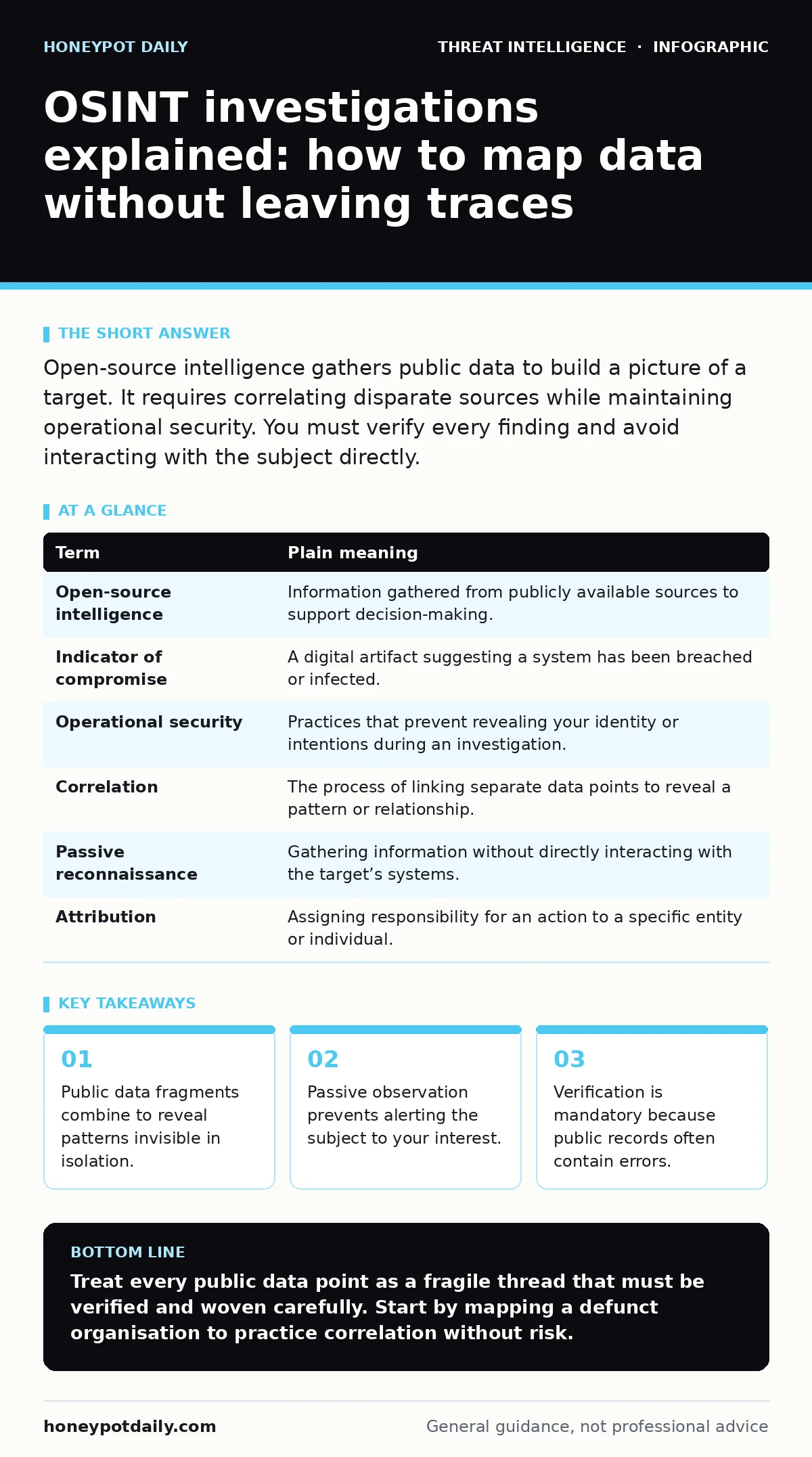
Open-source intelligence gathers public data to build a picture of a target. It requires correlating disparate sources while maintaining operational security. You must verify every finding and avoid interacting with the subject directly.
The Mosaic Principle
Imagine you are observing a busy market from a balcony. You cannot hear conversations or see faces clearly. However, you notice a person dropping a receipt. Another observer sees the same person buying a specific type of fruit. A third notes their departure time. Individually, these facts are trivial. Combined, they reveal a routine, a budget, and a destination.
Open-source intelligence operates on this same principle. You collect small, public fragments of information. You then correlate them to construct a coherent picture. The goal is not to hack a system but to understand it through its external footprint.
Defining the Field
Many practitioners confuse this discipline with general web searching. There is a distinct difference in methodology and intent. Standard searching seeks answers to specific questions. This approach seeks context and relationships between entities.
You are building a model of a target’s digital presence. This model helps you understand attack surfaces, organisational structure, or individual habits. The accuracy of your model depends on the quality of your sources and your ability to connect disparate dots.
| Term | Plain meaning |
|---|---|
| Open-source intelligence | Information gathered from publicly available sources to support decision-making. |
| Indicator of compromise | A digital artifact suggesting a system has been breached or infected. |
| Operational security | Practices that prevent revealing your identity or intentions during an investigation. |
| Correlation | The process of linking separate data points to reveal a pattern or relationship. |
| Passive reconnaissance | Gathering information without directly interacting with the target’s systems. |
| Attribution | Assigning responsibility for an action to a specific entity or individual. |
The Cost of Visibility
The most significant risk in this work is not finding nothing. It is being seen while you look. Every query you make, every page you visit, and every tool you use leaves a trace. If you visit a company’s website from your personal browser, their logs record your IP address.
This visibility can alert the subject to your interest. In a security context, this may trigger defensive measures or, worse, lead to counter-investigation against you. You must assume that any system you touch is logging your presence.
Imagine you are mapping a building’s layout. If you knock on every door to see if it is open, the occupants will notice you. If you watch from the street and note which lights go on at night, you remain unseen. The latter is passive; the former is active and risky.
Structuring the Search
Begin with known entities and expand outward. If you are investigating a domain, start with the domain registration details. Note the registrar, the creation date, and the nameservers. These details often link to other domains owned by the same entity.
Next, look for historical data. Public archives may show previous versions of a website. These snapshots might contain old contact details, employee names, or software versions that are no longer visible on the live site. This historical context is often richer than current data.
You should also examine social media profiles. Even with privacy settings, users often leave traces in public groups, comments, or shared photos. Geolocation metadata in images can reveal physical locations. Always check for consistency across platforms.
Verification and Hygiene
Never trust a single source. Public records are prone to error, outdated information, or deliberate deception. A phone number listed in a directory may belong to a former employee. A social media profile may be fake.
Cross-reference every finding with at least two independent sources. If a document claims an employee works for a company, verify this against a professional networking site and the company’s official press releases. Discrepancies often reveal more truth than confirmations.
Maintain strict hygiene in your own environment. Use separate browsers or virtual machines for investigations. Clear cookies and history after each session. Ensure your personal accounts are not linked to your investigative work.
See also: Block OSINT Tool Reconnaissance Across Your Surface · Cybercrime Forums: What Small Businesses Need to Know About Threat Exposure
Practical Application
Start with a low-risk exercise to build your skills. Choose a public organisation or a defunct company. These targets are unlikely to react negatively to your presence. Map their public footprint using the methods described above.
- Identify the main domain and check its registration history.
- Search for archived versions of their website to find old content.
- Look for employee names and cross-reference them with public professional profiles.
Document your findings in a structured format. Note the source of each piece of information. This documentation helps you track the reliability of your sources and identify gaps in your knowledge.
Integrating with Operations
This intelligence feeds directly into broader security workflows. The data you collect helps refine YARA rules for detecting specific file signatures. It informs Windows event log monitoring by highlighting unusual login patterns from known locations.
Understanding the external attack surface reduces mean time to detect internal breaches. When you know what the organisation looks like from the outside, you can better identify anomalies from the inside. This context is vital for effective alert triage, allowing analysts to dismiss false positives quickly.
Avoiding Common Pitfalls
Do not rely on automated tools blindly. They may miss context or generate false positives. Always review the raw data. Automated scrapers can also trigger rate-limiting or blocking mechanisms if used aggressively.
Respect legal boundaries. While the data is public, how you use it may be restricted. Do not access content behind login walls unless you have explicit permission. Do not harass individuals or organisations.
Moving Forward
Mastering this discipline requires patience and attention to detail. It is not about finding the one big clue. It is about assembling many small ones into a reliable picture.
As you gain experience, you will develop an intuition for which sources are reliable and which are noise. You will learn to spot inconsistencies that indicate deception. This skill set is foundational for any security professional.
Consider how this intelligence supports blue team operations. By understanding the external view, you can harden your defences against the most likely attack vectors. This proactive stance reduces the risk of successful breaches.
Key takeaways
- Public data fragments combine to reveal patterns invisible in isolation.
- Passive observation prevents alerting the subject to your interest.
- Verification is mandatory because public records often contain errors.
Treat every public data point as a fragile thread that must be verified and woven carefully. Start by mapping a defunct organisation to practice correlation without risk.
Frequently asked questions
Is OSINT legal?
Gathering publicly available information is generally legal, but using that data to harass, defraud, or access systems without permission is not.
How do I stay anonymous?
Use dedicated hardware or virtual machines, separate browser profiles, and avoid logging into personal accounts during investigations.
What if I find sensitive data?
If you discover sensitive information that should not be public, report it to the owner responsibly and do not disseminate it further.
Can I use automated tools?
Yes, but use them cautiously. Aggressive automation can trigger blocks and may miss nuanced context that manual review would catch.
How this guide was produced: written by the Honeypot Daily editorial team with AI assistance, checked against the public references listed below, and reviewed when the facts change. See our editorial policy or report an error.