
What Is Threat Actors: Definitions, Tactics and Detection Strategies
Threat actors exploit human psychology and system misconfigurations, not just software bugs, to bypass perimeter defences and steal data silently.
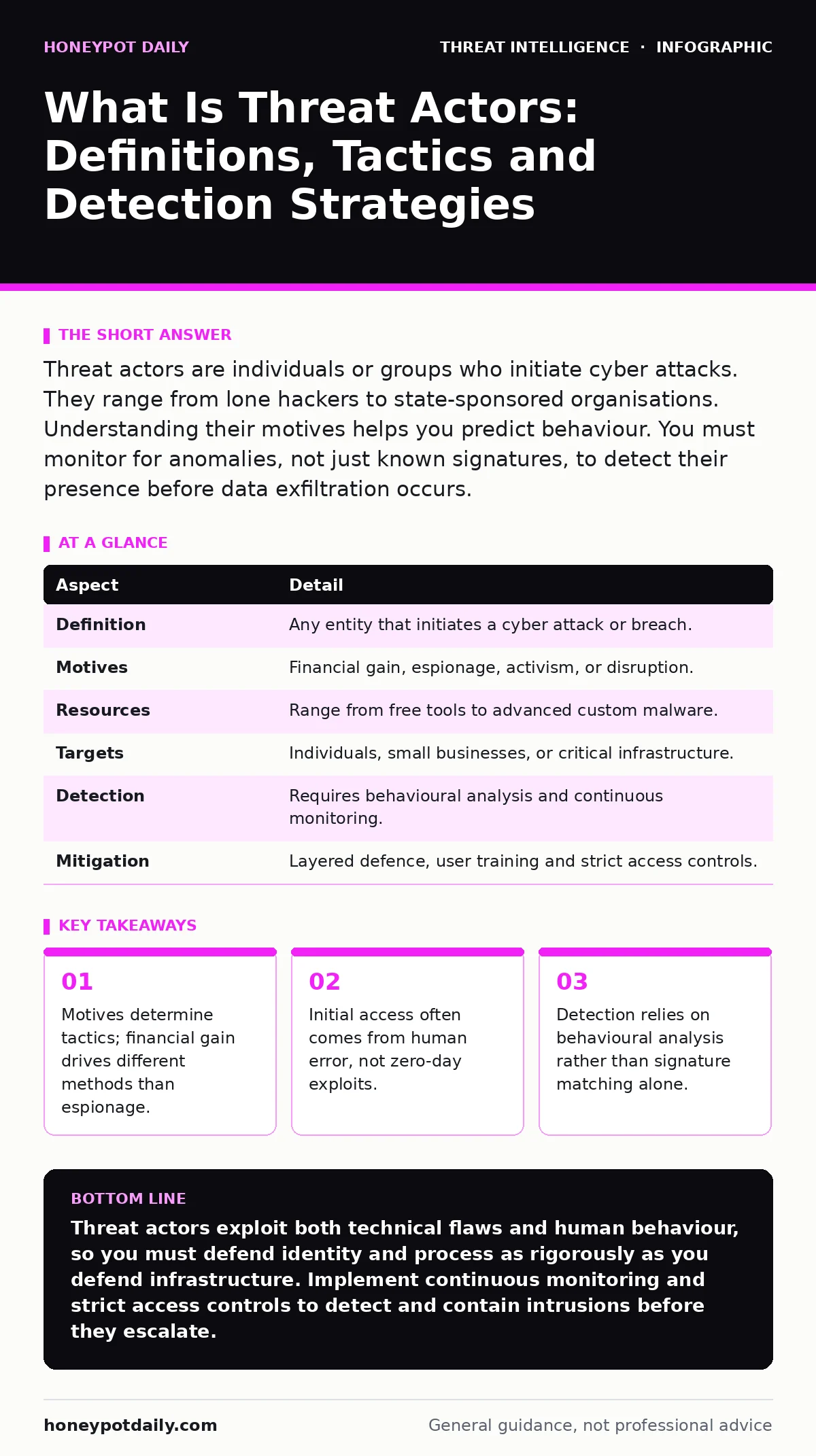
Threat actors are individuals or groups who initiate cyber attacks. They range from lone hackers to state-sponsored organisations. Understanding their motives helps you predict behaviour. You must monitor for anomalies, not just known signatures, to detect their presence before data exfiltration occurs.
What is threat actors and why does it matter
What is threat actors refers to the entities behind malicious digital activity. These are not abstract concepts but real people or organised groups with specific goals. A threat actor might be a single individual testing skills or a nation-state seeking intelligence. The definition matters because motive dictates method. Financial criminals move fast and leave traces. Espionage agents move slow and hide deeply. You cannot defend against an unknown enemy. You must understand who they are to predict what they will do next. This understanding shapes your security strategy from the ground up. It moves you from reactive patching to proactive observation.
Imagine a bank vault. Most people focus on the steel door. A threat actor looks at the cleaning staff. They study routines, find loose keys, or bribe an employee. The vault remains locked, but the contents disappear. Cybersecurity works the same way. The firewall is the door. The human element is the cleaning staff. Threat actors target the weakest link, which is often a person or a process. They do not always break in through technical force. They often walk in through the front door, invited by a mistake.
At a glance: Understanding threat actors
| Aspect | Detail |
|---|---|
| Definition | Any entity that initiates a cyber attack or breach. |
| Motives | Financial gain, espionage, activism, or disruption. |
| Resources | Range from free tools to advanced custom malware. |
| Targets | Individuals, small businesses, or critical infrastructure. |
| Detection | Requires behavioural analysis and continuous monitoring. |
| Mitigation | Layered defence, user training and strict access controls. |
How threat actors operate in practice
Threat actors follow a structured lifecycle. They begin with reconnaissance. They gather information about your network, employees and technology stack. This phase is quiet. They might scan for open ports or search social media for employee names. Next comes weaponisation. They create a payload, such as malicious code or a phishing email. Delivery follows. They send the weapon to the target. Execution happens when the victim opens the file or clicks the link. Persistence allows them to stay inside. They install backdoors to return later. Finally, they exfiltrate data or disrupt systems.
This process is not linear. Actors may loop back to earlier stages. If detection occurs, they pause and adapt. They change their tools or methods. This adaptability makes them dangerous. You cannot rely on static defences. Your systems must detect changes in behaviour. A sudden spike in data transfer is a red flag. An unusual login time is another. You must look for deviations from the norm. Standard signatures miss new attacks. Behavioural analytics catch them. This requires high-quality data and careful tuning.
Who threat actors target and why
Threat actors choose targets based on value and vulnerability. Financial institutions are prime targets for theft. Healthcare providers hold valuable personal data. Governments are targets for espionage. Small businesses are often attacked because they lack defences. They are easy wins. Actors assume they will not be noticed. This assumption is often correct. Small organisations rarely have dedicated security teams. They rely on basic firewalls and antivirus. These tools are insufficient against determined attackers.
The motive changes the approach. Ransomware groups want quick payment. They encrypt files and demand money. They do not care about stealth. They want chaos. Espionage groups want long-term access. They avoid detection at all costs. They may sit in your network for months. They steal small amounts of data regularly. This is harder to detect. You must monitor for low-and-slow activity. High-volume attacks are loud. Low-volume attacks are quiet. Both are dangerous. You must prepare for both. Understanding the motive helps you prioritise your alerts. Not all alerts are equal. Context matters.
What people usually get wrong
Many organisations believe threat actors are always external. This is a dangerous assumption. Insider threats are a major risk. Employees may leak data intentionally or accidentally. They have legitimate access. They know the systems. They bypass perimeter defences easily. You must monitor internal activity as closely as external traffic. Another common mistake is focusing only on technology. People are the weakest link. Phishing emails trick users into giving up credentials. Technical controls cannot stop a user from typing a password into a fake site. Training is not optional. It is a core security control. You must teach users to recognise social engineering.
Another error is assuming detection equals protection. Finding an actor is only half the battle. You must contain the threat. You must remove their access. You must recover your systems. Many organisations detect an intrusion but fail to respond effectively. They lack a clear incident response plan. They do not know who to call. They do not know how to isolate affected systems. This delay allows the actor to cause more damage. You need a plan before an attack happens. Test it regularly. Update it when systems change. A static plan is a useless plan.
See also: OSINT investigations mistakes and how to avoid false leads · How security operations centers detect and respond to threats
What to do about threat actors
You must adopt a layered defence strategy. No single tool stops all attacks. Combine technical controls with human processes. Start with strong identity management. Use multi-factor authentication everywhere. This stops many credential-based attacks. Next, limit access. Users should only have permissions they need. This reduces the damage if an account is compromised. Monitor your systems continuously. Use threat intelligence feeds to stay updated on new tactics. These feeds provide context for your alerts. They help you distinguish noise from real threats.
Implement security telemetry across your environment. Collect logs from servers, endpoints and networks. Analyse them for anomalies. Look for unusual patterns. A user logging in from two countries in one hour is suspicious. A process creating many files in a system directory is odd. Investigate these events. Do not ignore them. Alert triage is critical. You will receive many false positives. Train your team to prioritise real threats. Ignore the noise, but never ignore the signal. Regular testing helps. Conduct penetration tests. Simulate attacks. Find your weaknesses before the enemy does. Fix them quickly.
Common misconceptions about threat actors
People often think threat actors are always highly skilled. This is not true. Many attacks use automated tools. A script kiddie can cause significant damage with basic tools. They do not need to understand code. They just need to run a program. This makes attacks more frequent. The barrier to entry is low. You must defend against amateurs as well as experts. Another myth is that encryption solves everything. Encryption protects data at rest and in transit. It does not stop an attacker from accessing your system. If they have admin rights, they can steal data before encryption applies. You must protect the access, not just the data.
Staying ahead of evolving tactics
Threat actors constantly change their methods. They learn from failed attacks. They adopt new tools. You must stay informed. Follow threat intelligence feeds to see what others are facing. Share information with peers. Collective defence is stronger than individual effort. Update your systems regularly. Patch vulnerabilities quickly. Unpatched systems are easy targets. Threat actors scan for known vulnerabilities. They exploit them automatically. Delaying updates gives them time. You must reduce your exposure window. Automate patching where possible. Manual processes are slow and error-prone.
Consider PowerShell abuse as a specific risk. This tool is legitimate and powerful. Threat actors use it to execute commands remotely. It leaves few traces. You must monitor PowerShell activity. Log all script executions. Block unsigned scripts. Limit its use to administrators. This reduces the attack surface. Similarly, network enumeration is a common first step. Threat actors map your network. They find valuable assets. Hide non-essential services. Use network segmentation. Limit lateral movement. If an actor breaches one segment, they cannot reach others. This containment strategy saves your critical data.
Integrating detection and response
Detection is useless without response. You must have a clear process. Define roles and responsibilities. Who decides to shut down a server? Who contacts law enforcement? Document these steps. Practice them. Windows event log monitoring is vital for Windows environments. It provides detailed records of system activity. Configure it to capture key events. Login attempts, process creations, file modifications. Analyse these logs for anomalies. Do not let them sit unused. They are your eyes inside the system. Use automated tools to correlate events. Manual review is too slow for large environments. Automation helps you spot patterns. It reduces the burden on your team.
Key takeaways
- Motives determine tactics; financial gain drives different methods than espionage.
- Initial access often comes from human error, not zero-day exploits.
- Detection relies on behavioural analysis rather than signature matching alone.
Threat actors exploit both technical flaws and human behaviour, so you must defend identity and process as rigorously as you defend infrastructure. Implement continuous monitoring and strict access controls to detect and contain intrusions before they escalate.
Frequently asked questions
Are threat actors always foreign?
No, threat actors can be domestic. Insider threats and local criminal groups are common. Geography is less relevant than motive and capability.
Can small businesses afford to defend against threat actors?
Yes. Basic hygiene like multi-factor authentication and regular updates stops many attacks. You do not need expensive tools to reduce risk significantly.
How do I know if a threat actor is in my network?
Look for behavioural anomalies. Unusual data transfers, strange login times, and unexpected process executions are indicators. Continuous monitoring is key.
What is the biggest mistake organisations make?
Assuming perimeter security is enough. Threat actors bypass firewalls easily. You must monitor internal activity and protect user identities.
How this guide was produced: written by the Honeypot Daily editorial team with AI assistance, checked against the public references listed below, and reviewed when the facts change. See our editorial policy or report an error.