
Network Enumeration Mistakes That Expose Your Internal Assets
Default protocols and misconfigured services leak detailed internal maps before any exploit code touches your perimeter defences.
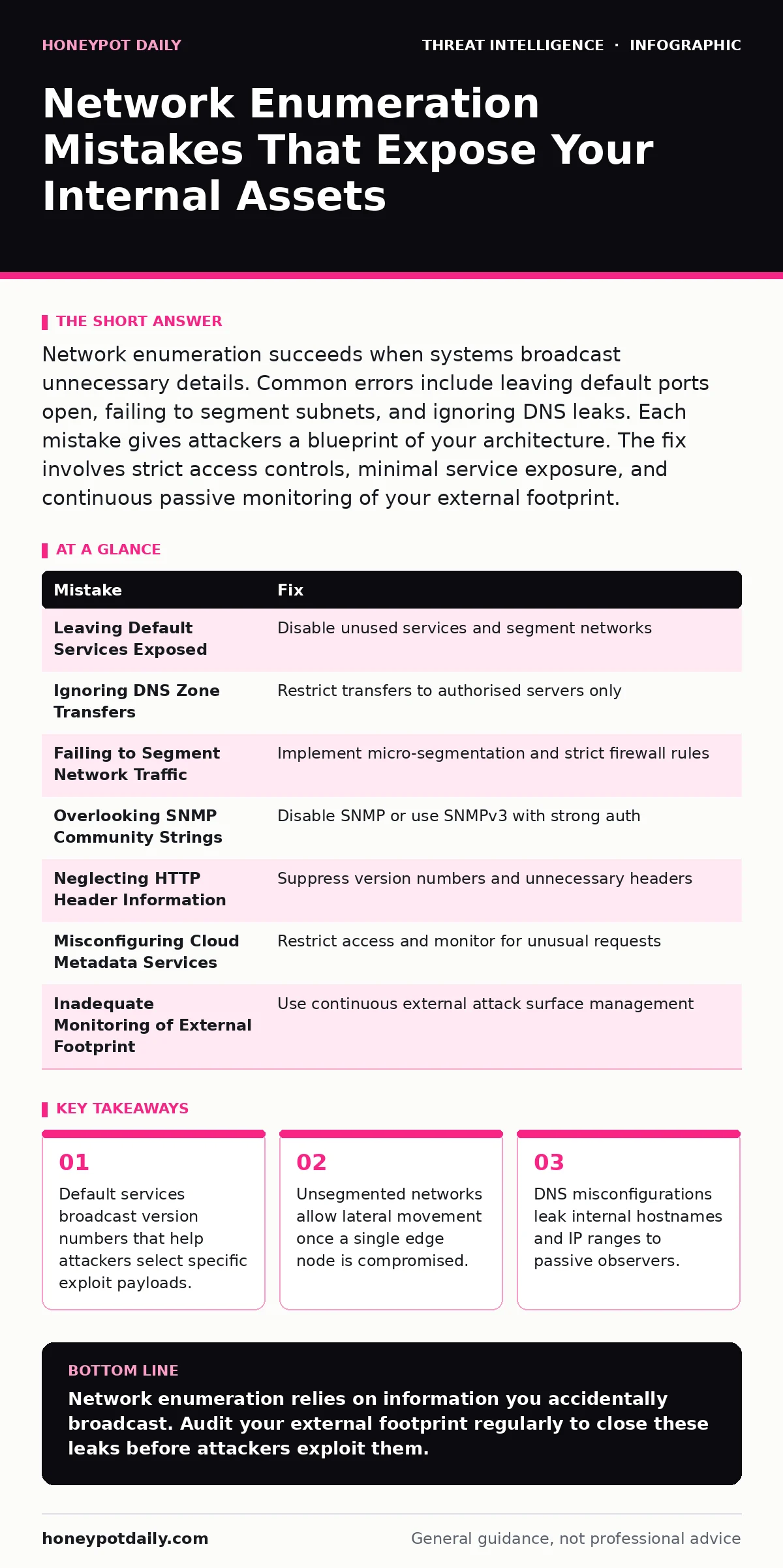
Network enumeration succeeds when systems broadcast unnecessary details. Common errors include leaving default ports open, failing to segment subnets, and ignoring DNS leaks. Each mistake gives attackers a blueprint of your architecture. The fix involves strict access controls, minimal service exposure, and continuous passive monitoring of your external footprint.
Mistake 1: Leaving Default Services Exposed
Default services often run on well-known ports without authentication or with weak defaults. Attackers scan for these open doors to gain initial footholds. You leave your internal map visible when you do not disable unused protocols.
Why it hurts:
Exposed services reveal software versions and configurations. This information allows threat actors to select known exploits that match your specific environment. You effectively hand them the weapon before they even knock on the door.
The fix:
Disable all services that are not strictly required for business operations. Apply network segmentation to isolate remaining services from general user traffic. Regular audits of listening ports prevent drift back to insecure defaults.
Mistake 2: Ignoring DNS Zone Transfers
Domain Name System (DNS) zone transfers allow secondary servers to replicate the primary database. If misconfigured, this mechanism leaks every internal hostname and IP address to anyone who requests it. You expose your entire network topology through a single query.
Why it hurts:
Attackers use this data to build a complete map of your infrastructure. They identify critical servers, backup systems, and administrative endpoints without scanning a single port. This passive intelligence is highly accurate and difficult to detect.
The fix:
Restrict zone transfers to authorised secondary DNS servers only. Use access control lists to block requests from unknown IP addresses. Monitor logs for unexpected transfer attempts to detect reconnaissance early.
Mistake 3: Failing to Segment Network Traffic
Flat networks allow any device to communicate with any other device. This lack of boundaries means that compromising one low-value endpoint gives access to high-value targets. You create a wide-open playground for lateral movement.
Why it hurts:
Once inside, attackers move freely between segments. They enumerate internal hosts and services without triggering perimeter alerts. This freedom reduces the time needed to reach critical assets like databases or domain controllers.
The fix:
Implement micro-segmentation to isolate workloads by function and sensitivity. Apply strict firewall rules between segments. Use network detection and response tools to monitor for anomalous cross-segment traffic that indicates lateral movement.
Mistake 4: Overlooking SNMP Community Strings
Simple Network Management Protocol (SNMP) uses community strings for authentication. Many administrators leave the default "public" string unchanged. This allows anyone to read device configurations and performance data remotely.
Why it hurts:
SNMP responses contain detailed information about network devices, including operating system details and connected interfaces. Attackers use this data to identify vulnerable hardware and plan targeted attacks. It is a rich source of passive intelligence.
The fix:
Disable SNMP where not required for monitoring. If needed, change default community strings to complex, unique values. Upgrade to SNMPv3, which supports encryption and strong authentication, to protect data in transit.
Mistake 5: Neglecting HTTP Header Information
Web servers often include default headers that reveal server software, version numbers, and plugin details. These headers are visible to any visitor and provide a clear picture of your web stack. You broadcast your technical debt to the world.
Why it hurts:
Specific software versions have known vulnerabilities. Attackers match these versions against public exploit databases to find working attacks. This reduces the effort required to compromise your web applications significantly.
The fix:
Configure web servers to suppress unnecessary headers. Remove version numbers from responses and error pages. Use a web application firewall to sanitise outgoing traffic and hide backend details from external users.
See also: Network Scanning: How Defenders Spot and Stop Port Probes · Network Detection and Response: How It Works and Why You Need It
Mistake 6: Misconfiguring Cloud Metadata Services
Cloud instances often have metadata services that provide configuration data. If these services are accessible from unauthorised networks, attackers can retrieve credentials and API keys. You hand over administrative access through a single URL.
Why it hurts:
Metadata services contain sensitive information like access tokens and instance profiles. Compromise of these services grants full control over the cloud environment. This is a high-impact error that bypasses traditional network defences.
The fix:
Restrict access to metadata services using network policies. Require non-default metadata endpoints for newer cloud instances. Monitor for unusual requests to metadata URLs, which often indicate an attacker attempting to escalate privileges.
Mistake 7: Inadequate Monitoring of External Footprint
Your external digital footprint changes constantly as new services are deployed. Without regular monitoring, you may not notice new exposures or misconfigurations. You operate blind to the surface area attackers are targeting.
Why it hurts:
New vulnerabilities are introduced daily through software updates and configuration changes. If you do not track your external presence, you miss the window to patch or isolate new risks. This delay increases the likelihood of successful enumeration and exploitation.
The fix:
Implement continuous external attack surface management. Use OSINT investigations techniques to monitor for new subdomains and services. Integrate findings into your alert triage process to ensure rapid response to new exposures.
| Mistake | Fix |
|---|---|
| Leaving Default Services Exposed | Disable unused services and segment networks |
| Ignoring DNS Zone Transfers | Restrict transfers to authorised servers only |
| Failing to Segment Network Traffic | Implement micro-segmentation and strict firewall rules |
| Overlooking SNMP Community Strings | Disable SNMP or use SNMPv3 with strong auth |
| Neglecting HTTP Header Information | Suppress version numbers and unnecessary headers |
| Misconfiguring Cloud Metadata Services | Restrict access and monitor for unusual requests |
| Inadequate Monitoring of External Footprint | Use continuous external attack surface management |
Key takeaways
- Default services broadcast version numbers that help attackers select specific exploit payloads.
- Unsegmented networks allow lateral movement once a single edge node is compromised.
- DNS misconfigurations leak internal hostnames and IP ranges to passive observers.
Network enumeration relies on information you accidentally broadcast. Audit your external footprint regularly to close these leaks before attackers exploit them.
Frequently asked questions
How do I detect if someone is enumerating my network?
Look for unusual patterns in firewall logs, such as many failed connection attempts from a single IP address. Monitor for scans that target specific ports sequentially.
Can segmentation stop network enumeration?
Segmentation limits the scope of enumeration by blocking visibility between network segments. Attackers cannot see services in other segments without first compromising a gateway.
Should I block all external scans?
Blocking all scans is difficult and may break legitimate services. Instead, use rate limiting and honeypots to detect and deter aggressive scanning activity.
How often should I review my external footprint?
Review your external footprint continuously. Automated tools can provide real-time alerts for new services, domains, or misconfigurations that appear on the public internet.
How this guide was produced: written by the Honeypot Daily editorial team with AI assistance, checked against the public references listed below, and reviewed when the facts change. See our editorial policy or report an error.