
Hybrid Cloud Security: Definition, Purpose and Hidden Gaps
Unified visibility fails when public clouds hide metadata, leaving hybrid environments blind to lateral movement between distinct networks.
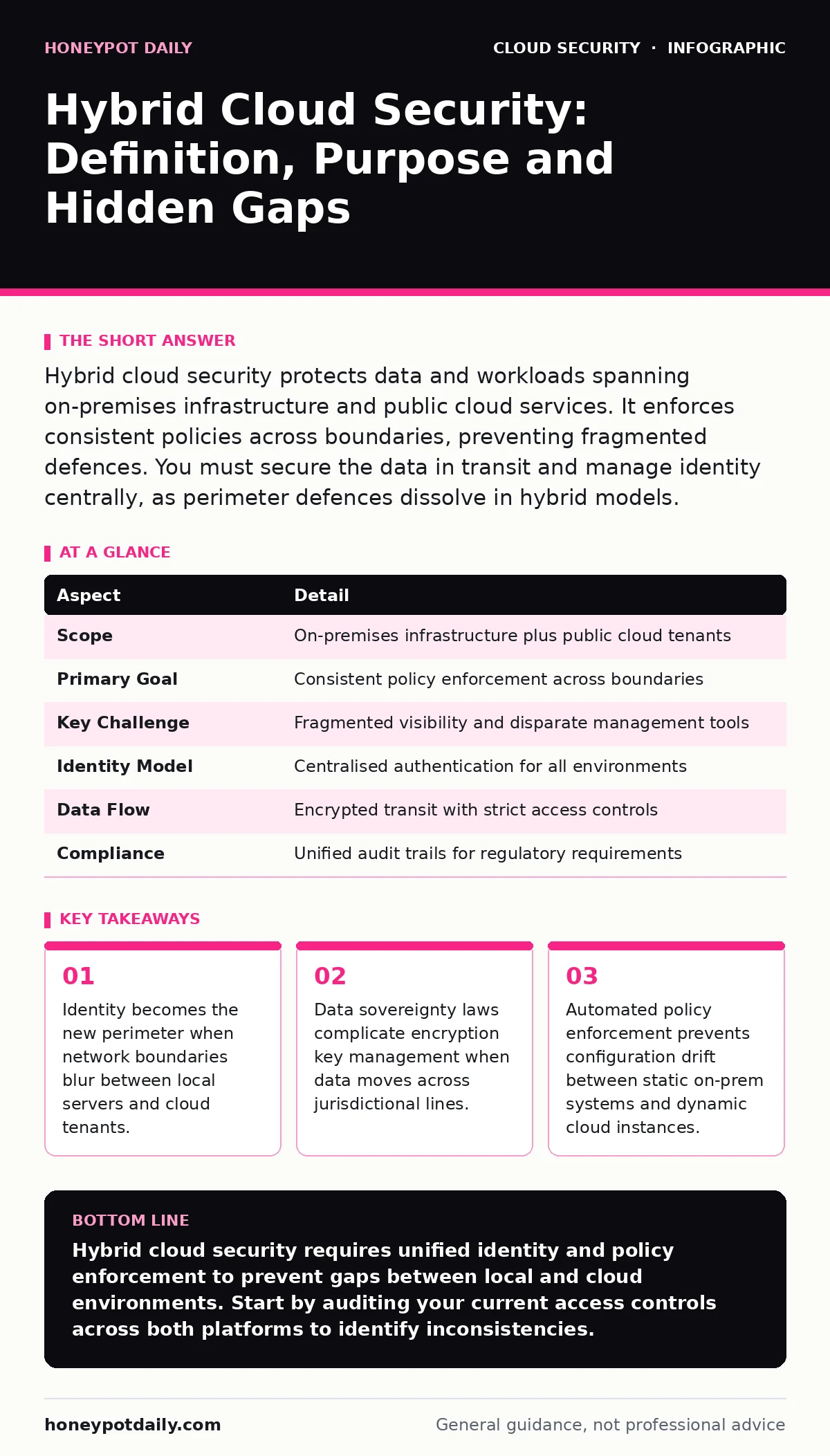
Hybrid cloud security protects data and workloads spanning on-premises infrastructure and public cloud services. It enforces consistent policies across boundaries, preventing fragmented defences. You must secure the data in transit and manage identity centrally, as perimeter defences dissolve in hybrid models.
The Fractured Perimeter Analogy
Imagine a castle with a high wall. You guard the gate, check every visitor, and sleep soundly. Now imagine the castle has a second courtyard in a different country, connected by a teleportation device. The wall no longer matters. An intruder can step through the portal and bypass your guards entirely. This is the fundamental shift hybrid cloud security addresses.
Traditional security relies on a defined boundary. Firewalls sit at the edge, and everything inside is trusted. Hybrid environments shatter this model. You have data in a local server room and applications in a public cloud region. The connection between them is dynamic, encrypted, and often invisible to traditional network monitors.
What Hybrid Cloud Security Actually Is
Hybrid cloud security is the practice of applying consistent security controls across both private and public cloud environments. It is not a single product. It is a strategy that unifies policy, visibility, and response. The goal is to ensure that a security rule applied to a local database also applies to its cloud replica.
The purpose is risk reduction through consistency. When policies differ between environments, gaps appear. Attackers exploit these inconsistencies. They move laterally from a weak cloud configuration to a stronger on-premises system, or vice versa. Hybrid security closes these loops by enforcing a single source of truth for access and encryption.
The Core Problem It Solves
The primary issue is context loss. Security tools in the data centre see traffic differently than tools in the cloud. A packet leaving your firewall looks different than a request hitting a cloud load balancer. Without unified telemetry, you cannot trace an attack path.
Consider encryption keys. In a local server, you might store keys in a hardware module. In the cloud, keys might live in a managed service. If the key management systems do not communicate, you cannot rotate keys simultaneously. This creates a window of vulnerability where one environment is protected while the other is exposed.
| Aspect | Detail |
|---|---|
| Scope | On-premises infrastructure plus public cloud tenants |
| Primary Goal | Consistent policy enforcement across boundaries |
| Key Challenge | Fragmented visibility and disparate management tools |
| Identity Model | Centralised authentication for all environments |
| Data Flow | Encrypted transit with strict access controls |
| Compliance | Unified audit trails for regulatory requirements |
Identity as the Unified Control
When the network perimeter dissolves, identity becomes the new boundary. You must verify who is accessing resources, regardless of where those resources sit. Single sign-on integrates local directories with cloud identity providers. This ensures that a user’s permissions are consistent whether they access a local file server or a cloud storage bucket.
This approach reduces the attack surface. If you revoke a user’s access in the central directory, it propagates to both environments. Without this integration, a terminated employee might retain access to cloud resources even after losing local network access. This is a common failure point in hybrid setups.
Securing Data in Transit and Rest
Data moves constantly between hybrid environments. Replication, backups, and application calls create continuous streams. Each stream is a potential interception point. Encryption must be mandatory and automated. You cannot rely on administrators to manually encrypt every connection.
The complexity lies in key management. You must decide where keys are generated and stored. Keeping keys in the cloud provider’s service is convenient but may conflict with compliance requirements. Keeping keys on-premises adds latency and management overhead. The choice dictates your security posture and operational speed.
You must also consider data residency. Some regulations require data to stay within specific geographic boundaries. Hybrid architectures must enforce these rules automatically. If a cloud service replicates data to a region outside your allowed zones, you face legal and security risks.
See also: Orphaned Cloud Resources: Definition, Risks, and Cleanup Strategy · Shift Left Security Meaning: Move Checks to Code Before Build
Where It Fits in the Defence Stack
Hybrid cloud security does not replace other controls. It sits above them, orchestrating their application. It relies on cloud guardrails to prevent misconfigurations at scale. It uses Kubernetes network policies to isolate workloads within container clusters, whether those clusters run locally or in the cloud.
It complements private endpoints by ensuring that traffic between services never traverses the public internet. It works alongside cloud migration security to ensure that legacy systems are hardened before moving to the cloud. It also mitigates risks like denial-of-wallet attacks by enforcing budget alerts and usage limits across all cloud accounts.
This layering is critical. A firewall alone cannot stop an insider threat with valid credentials. Encryption alone cannot stop a misconfigured storage bucket. Hybrid security ties these controls together, ensuring they work in concert rather than in isolation.
Common Misconceptions and Pitfalls
Many teams assume that buying a cloud security platform solves the hybrid problem. It does not. These tools often focus on cloud-native services and lack deep integration with legacy on-premises systems. You must bridge the gap yourself, often with custom scripts or middleware.
Another mistake is assuming that cloud providers are responsible for your security. They secure the infrastructure, but you secure what you put on it. This shared responsibility model is often misunderstood. In a hybrid setup, the ambiguity increases. You must clearly define who manages which controls.
Finally, teams often neglect the management plane. They secure the data and the applications but forget to secure the APIs that manage them. Compromised management credentials can lead to total environment takeover. You must apply the same rigor to management access as you do to user data access.
Key takeaways
- Identity becomes the new perimeter when network boundaries blur between local servers and cloud tenants.
- Data sovereignty laws complicate encryption key management when data moves across jurisdictional lines.
- Automated policy enforcement prevents configuration drift between static on-prem systems and dynamic cloud instances.
Hybrid cloud security requires unified identity and policy enforcement to prevent gaps between local and cloud environments. Start by auditing your current access controls across both platforms to identify inconsistencies.
Frequently asked questions
Does hybrid cloud security require new hardware?
No, it primarily requires software solutions for identity management, policy enforcement, and monitoring that integrate with existing infrastructure.
How does this differ from multi-cloud security?
Multi-cloud focuses on multiple public providers, while hybrid combines on-premises infrastructure with one or more public clouds, adding complexity in network and legacy system integration.
Can I use the same encryption keys for both environments?
Yes, but you must ensure secure key distribution and rotation mechanisms that work across both network boundaries without introducing latency or security risks.
What is the biggest risk in hybrid architectures?
Configuration drift and inconsistent identity management, which create blind spots where attackers can move laterally between environments undetected.
How this guide was produced: written by the Honeypot Daily editorial team with AI assistance, checked against the public references listed below, and reviewed when the facts change. See our editorial policy or report an error.