
Orphaned Cloud Resources: Definition, Risks, and Cleanup Strategy
Orphaned cloud resources persist after their parent service is deleted, creating silent security gaps and unmanaged attack surfaces that standard inventory tools often miss.
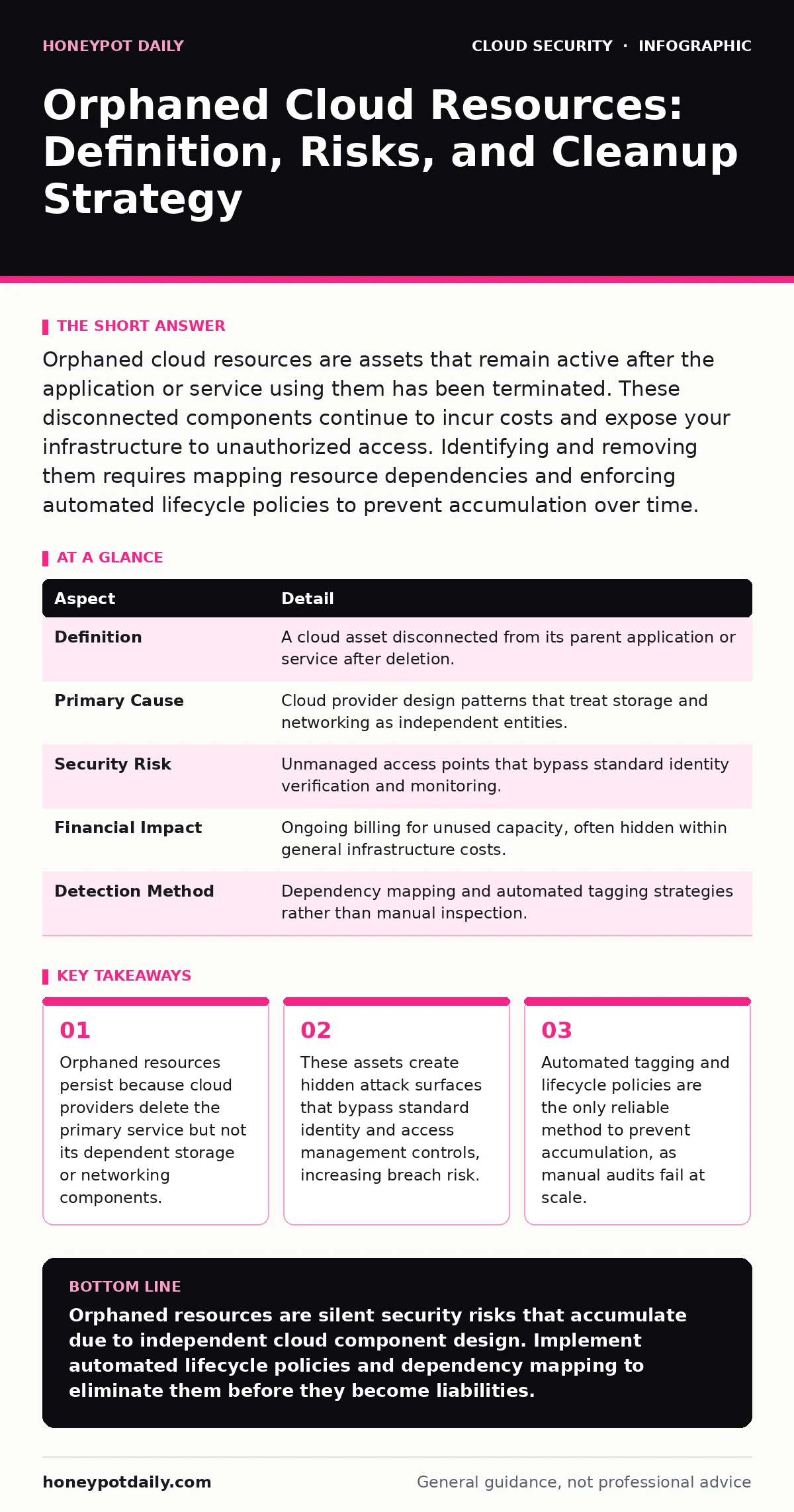
Orphaned cloud resources are assets that remain active after the application or service using them has been terminated. These disconnected components continue to incur costs and expose your infrastructure to unauthorized access. Identifying and removing them requires mapping resource dependencies and enforcing automated lifecycle policies to prevent accumulation over time.
The Concept of Orphaned Cloud Resources
Imagine a rental car returned to a depot, but the GPS tracker remains active and continues to charge your credit card for data usage. In cloud computing, an orphaned resource is any infrastructure component that remains active after the primary service or application that created it has been deleted. These resources lack a clear owner or purpose. They exist in the background, consuming compute power, storage space, or network bandwidth without providing value. The cloud provider does not automatically delete these dependent assets because they are often shared or reusable by design. This decoupling creates a maintenance burden that grows silently over time.
| Aspect | Detail |
|---|---|
| Definition | A cloud asset disconnected from its parent application or service after deletion. |
| Primary Cause | Cloud provider design patterns that treat storage and networking as independent entities. |
| Security Risk | Unmanaged access points that bypass standard identity verification and monitoring. |
| Financial Impact | Ongoing billing for unused capacity, often hidden within general infrastructure costs. |
| Detection Method | Dependency mapping and automated tagging strategies rather than manual inspection. |
How Orphaned Resources Emerge
Cloud infrastructure is modular. When you terminate a virtual machine, the underlying storage volume often persists by default. This design allows for data recovery if the deletion was accidental. However, in automated environments, this safeguard becomes a liability. Developers spin up test environments, attach storage volumes, and then delete the instances. The volumes remain. Over months, these detached disks accumulate.
They are no longer attached to any running system, but they still exist in your account. The same pattern applies to security groups, network interfaces, and IP addresses. Each component is managed separately. The cloud provider assumes you want to keep the data or configuration. You must explicitly instruct the system to remove these dependencies. Without that explicit instruction, the resource becomes orphaned.
Common Forms of Orphaned Assets
Storage volumes are the most frequent form of orphaned resources. Detached block storage devices hold data that is no longer accessible through any active interface. They sit idle, yet they consume storage capacity and may contain sensitive information. Network interfaces also become orphaned when virtual machines are deleted. These interfaces retain security group associations and IP addresses.
They can still accept traffic if the security groups are misconfigured. Elastic IP addresses are another example. These static IP addresses are reserved for specific use cases. When the associated instance is gone, the IP address remains reserved and billable. Load balancer listeners may also persist if the target groups are not updated. These components create a complex web of dependencies that are difficult to trace manually.
Who Is Affected by Orphaned Resources
Any organization using cloud infrastructure is affected by orphaned resources. The impact scales with the size of the deployment. Small teams may notice the financial impact first, seeing unexpected charges on their bills. Larger organizations face significant security risks. The volume of orphaned assets grows exponentially with the number of deployments. Security operations teams struggle to maintain an accurate inventory.
Unknown assets mean unknown risks. If an attacker compromises a standard service, they may pivot to an orphaned resource that lacks monitoring. These assets are often overlooked in security audits. They do not appear in active service lists. They exist in the shadows of the infrastructure. The lack of ownership means no one is responsible for patching or securing them.
Security Implications of Unmanaged Assets
Orphaned resources create a hidden attack surface. They often retain the same permissions as when they were active. If a storage volume was mounted to a server with broad access rights, that data remains readable if the volume is attached to another instance. Security groups attached to orphaned network interfaces may allow traffic from public IP ranges. This bypasses the shared responsibility model principles because the cloud provider secures the infrastructure, but you secure the data within it.
If the data is in an orphaned volume, you are responsible for its protection. Furthermore, these assets are not monitored by standard application performance tools. Intrusion detection systems may not alert on activity related to orphaned resources. They fall outside the scope of normal operational visibility. This blind spot allows attackers to operate undetected for extended periods.
See also: Difference Between Virtual Private Cloud and Private Cloud · Private Endpoints: Answers to Ten Cloud Network Questions
What People Usually Get Wrong
Many teams assume that deleting a service deletes everything associated with it. This assumption is false. Cloud providers design services to be independent. A database is separate from its storage. A virtual machine is separate from its network interface. Deleting one does not delete the other. Another common mistake is relying on manual audits. Humans cannot effectively track thousands of resources across multiple regions and accounts. Manual checks are slow and error-prone.
They miss new orphans created between audits. Teams also often ignore the security implications, focusing only on cost reduction. While financial waste is a problem, the security risk is far greater. An orphaned resource is a door left open. It does not matter if no one is using the room; the door is still open. Finally, teams often fail to update their documentation. When a resource is deleted, the documentation should reflect the change. If the documentation is outdated, it becomes a source of confusion and error.
Reducing Risk Through Automation
To reduce the risk of orphaned resources, you must automate dependency management. Start by implementing strict tagging policies. Every resource should have a tag that identifies its owner and purpose. This makes it easier to track dependencies. Use infrastructure as code to define relationships. When you define a resource in code, you can specify that it should be deleted when the parent resource is deleted. This ensures consistency. Implement automated lifecycle policies.
These policies can identify resources that have not been accessed or modified in a set period. They can then delete or archive these resources. Regular audits are still necessary, but they should be automated. Tools can scan for orphaned resources and generate reports. This allows you to react quickly. You should also review your cloud guardrails to ensure that new resources are created with the correct dependencies. This prevents the accumulation of orphans in the first place.
Integrating with Broader Security Strategies
Managing orphaned resources is part of a broader security strategy. It connects to just-in-time access principles. If resources are only active when needed, they are less likely to become orphaned. It also relates to hybrid cloud security. Orphaned resources can exist in on-premises environments as well. A consistent approach is necessary. You should also consider denial-of-wallet attacks. Attackers may create resources to incur charges. Orphaned resources can be used to mask these activities.
By maintaining a clean infrastructure, you make it easier to detect anomalies. Finally, review your container runtime security practices. Containers often create temporary storage and network interfaces. These must be cleaned up after the container stops. Neglecting this leads to accumulation. A holistic view of infrastructure management is required. Orphaned resources are a symptom of poor lifecycle management. Addressing them requires a shift in how you design and deploy infrastructure.
Key takeaways
- Orphaned resources persist because cloud providers delete the primary service but not its dependent storage or networking components.
- These assets create hidden attack surfaces that bypass standard identity and access management controls, increasing breach risk.
- Automated tagging and lifecycle policies are the only reliable method to prevent accumulation, as manual audits fail at scale.
Orphaned resources are silent security risks that accumulate due to independent cloud component design. Implement automated lifecycle policies and dependency mapping to eliminate them before they become liabilities.
Frequently asked questions
How do I find orphaned cloud resources?
Use cloud provider tools to identify resources without associated parents. Look for detached storage volumes, unused IP addresses, and network interfaces without attached instances. Automated scanning tools can also help.
Do orphaned resources cost money?
Yes. Most cloud providers charge for storage, reserved IP addresses, and other resources regardless of whether they are actively used. These costs can add up significantly over time.
Can I prevent orphaned resources?
You can prevent them by using infrastructure as code and defining deletion dependencies. Automated lifecycle policies can also delete resources that are no longer needed. Strict tagging helps track ownership.
Are orphaned resources a security risk?
Yes. They retain permissions and may contain sensitive data. They are often unmonitored, making them attractive targets for attackers. They bypass standard security controls and create blind spots.
How this guide was produced: written by the Honeypot Daily editorial team with AI assistance, checked against the public references listed below, and reviewed when the facts change. See our editorial policy or report an error.