
Shift Left Security Meaning: Move Checks to Code Before Build
Catching flaws in source code avoids the exponential cost of fixing them after deployment, turning security from a gate into a continuous filter.
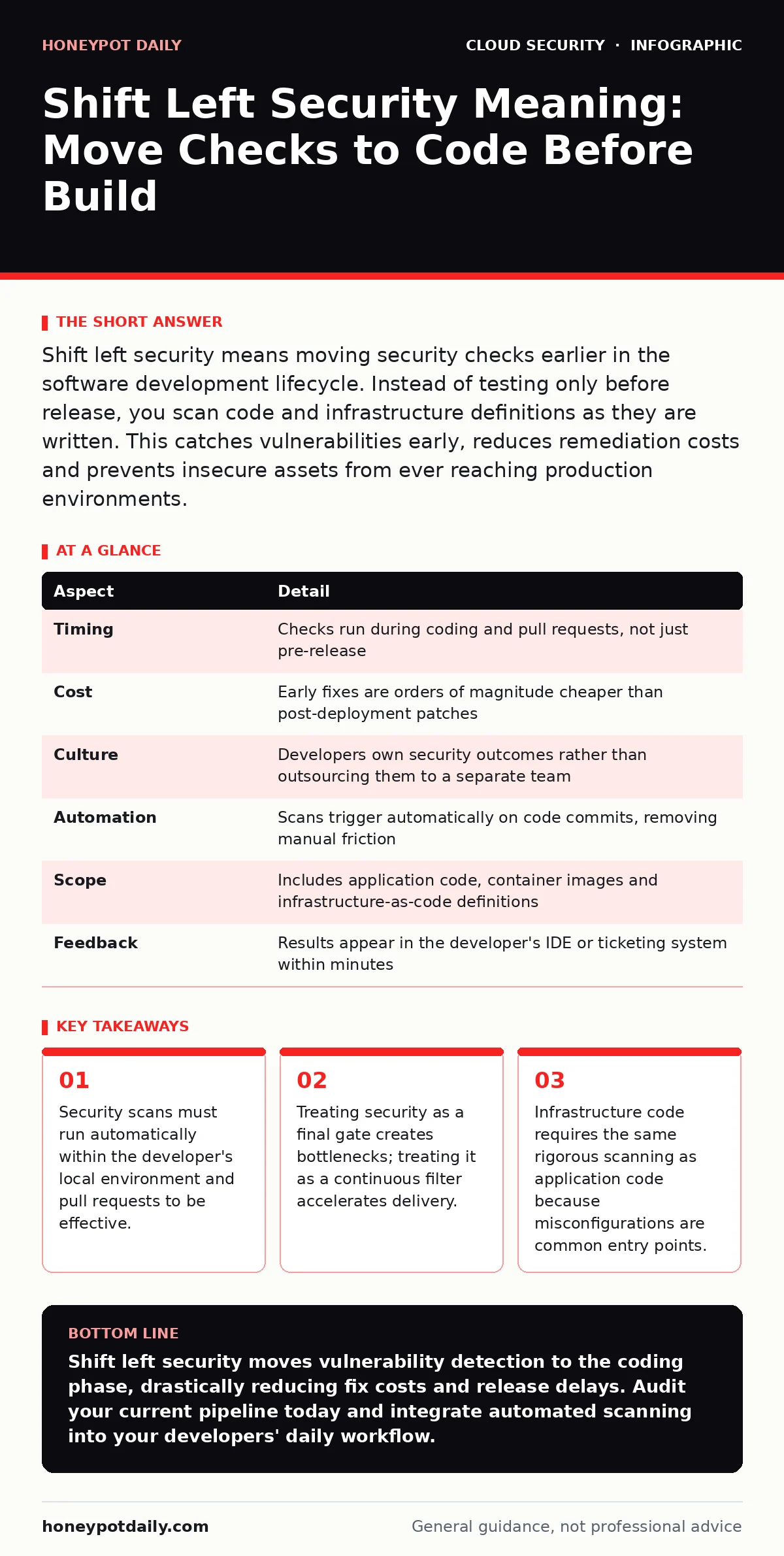
Shift left security means moving security checks earlier in the software development lifecycle. Instead of testing only before release, you scan code and infrastructure definitions as they are written. This catches vulnerabilities early, reduces remediation costs and prevents insecure assets from ever reaching production environments.
Everyday Analogy: The Blueprint Check
Imagine constructing a house. Traditional security is like hiring an inspector after the roof is on. The inspector finds a load-bearing wall is missing. You must tear down the roof, remove the floors and rebuild the wall. This is expensive and slow. Shift left security is like checking the blueprints before laying the foundation. You spot the missing wall on paper. You correct the drawing. The house is built correctly the first time. The cost of correction is zero.
What Is the Shift Left Security Meaning?
Shift left security meaning refers to the practice of performing security testing and analysis earlier in the software development lifecycle. Historically, security teams operated at the far right of the timeline, just before deployment. This created a bottleneck where developers waited for security approval. The "left" refers to the start of the timeline: planning, writing code and defining infrastructure. Moving security left means integrating checks into these early stages. The goal is to detect flaws when they are cheap to fix. A flaw in a design document costs minutes to correct. The same flaw in production costs days to resolve.
| Aspect | Detail |
|---|---|
| Timing | Checks run during coding and pull requests, not just pre-release |
| Cost | Early fixes are orders of magnitude cheaper than post-deployment patches |
| Culture | Developers own security outcomes rather than outsourcing them to a separate team |
| Automation | Scans trigger automatically on code commits, removing manual friction |
| Scope | Includes application code, container images and infrastructure-as-code definitions |
| Feedback | Results appear in the developer's IDE or ticketing system within minutes |
How the Mechanism Works in Practice
The mechanism relies on automated tooling integrated into the developer workflow. When a developer writes code, static application security testing (SAST) tools analyse the source code for known vulnerability patterns. These tools look for issues like buffer overflows or SQL injection flaws. They do not execute the code. They read it. The tool flags the issue and highlights the exact line in the editor. The developer fixes it before saving.
Dynamic application security testing (DAST) tools run against a local instance of the application. They simulate attacks to find runtime vulnerabilities. Software composition analysis (SCA) tools check third-party libraries for known weaknesses. These scans run on every commit. If a scan fails, the build fails. The developer cannot merge the code until the issue is resolved. This prevents insecure code from entering the shared repository.
The process extends to infrastructure. Infrastructure-as-code (IaC) files define servers, networks and databases. Misconfigurations in these files are common causes of breaches. Policy-as-code tools scan IaC files against best-practice rules. They ensure that storage buckets are not public and that encryption is enabled. This aligns with the principles of cloud guardrails, which provide predefined boundaries for safe cloud usage.
Who This Approach Affects
This approach affects every role in the technology stack. Developers face a change in daily routine. They must understand basic security concepts. They must interpret scan results and apply fixes. This requires training and clear documentation. Security engineers shift from manual testing to building and maintaining the tooling. They define the rules that the scanners use. They tune the tools to reduce false positives.
Product managers see faster release cycles. Fewer last-minute security blocks mean fewer delays. Operations teams benefit from fewer incidents. Vulnerabilities are removed before they can be exploited in production. This reduces the burden on incident response teams. The entire organisation adopts a shared responsibility model. Security is no longer a separate department. It is a collective duty.
Common Misconceptions and Errors
Many organisations misunderstand the scope of shift left. They believe it replaces traditional security testing. It does not. Late-stage testing remains necessary for complex integration issues. Shift left complements, rather than replaces, existing controls. Another error is focusing only on application code. Infrastructure misconfigurations are equally dangerous. Ignoring IaC leaves the environment exposed even if the code is secure.
Some teams implement tools without training. Developers receive alerts they cannot understand. They bypass the checks to meet deadlines. This defeats the purpose. Tools must be user-friendly. Results must be actionable. Integration with Kubernetes network policies helps enforce security at the cluster level, but only if the policies are correctly defined in the IaC.
Another mistake is assuming automation solves everything. Automated tools miss logic flaws. They cannot understand business context. Human review remains necessary for complex decisions. Automation handles the repetitive checks. Humans handle the nuanced analysis. Balancing both ensures thorough coverage.
See also: Difference Between Virtual Private Cloud and Private Cloud · Private Endpoints: Answers to Ten Cloud Network Questions
What To Do About It
Start by auditing your current workflow. Identify where security checks currently occur. Map the path from code commit to deployment. Find the gaps. Introduce SAST and SCA tools into the local developer environment. Configure them to run on every save or commit. Ensure the feedback is immediate.
Next, extend scanning to infrastructure. Use policy-as-code tools to check IaC files. Define rules that align with your security standards. Integrate these checks into the pull request process. Block merges that violate critical policies. This prevents misconfigurations from reaching staging.
Train developers on basic security concepts. Teach them how to read scan results. Show them how to fix common vulnerabilities. Provide examples and templates. Make security part of the engineering culture. Encourage developers to report issues they find. Reward proactive security behaviour.
Monitor the effectiveness of your tools. Track the number of findings and the time to fix. Adjust the rules to reduce noise. Continuously improve the process. Security is not a one-time project. It is an ongoing discipline. Regularly review your hybrid cloud security posture to ensure consistency across environments.
Integrating With Broader Controls
Shift left works best when combined with other controls. For instance, just-in-time access limits the duration of privileged access. This reduces the risk of compromised credentials. Virtual private clouds provide network isolation. Combining secure code with isolated networks creates defence in depth.
Consider private endpoints for accessing sensitive services. This restricts traffic to authorised networks. Kubernetes misconfigurations are a frequent source of risk. Scanning IaC for these issues prevents them from being deployed. Regularly review your controls to ensure they remain effective. Adapt to new threats and technologies. Stay informed about industry best practices.
Key takeaways
- Security scans must run automatically within the developer's local environment and pull requests to be effective.
- Treating security as a final gate creates bottlenecks; treating it as a continuous filter accelerates delivery.
- Infrastructure code requires the same rigorous scanning as application code because misconfigurations are common entry points.
Shift left security moves vulnerability detection to the coding phase, drastically reducing fix costs and release delays. Audit your current pipeline today and integrate automated scanning into your developers' daily workflow.
Frequently asked questions
Does shift left mean security teams are no longer needed?
No. Security teams shift their focus from manual testing to building and maintaining automated tooling. They provide expertise and governance.
How do I choose the right tools for shift left?
Look for tools that integrate with your existing IDE and CI/CD pipeline. Prioritise ease of use and accurate results to avoid alert fatigue.
Can shift left detect all types of vulnerabilities?
No. It excels at finding known patterns and misconfigurations. Logic flaws and business-specific risks often require manual review or late-stage testing.
How do I measure the success of shift left?
Track metrics like time to remediation, number of findings blocked pre-production and developer satisfaction. Improvement in these areas indicates success.
How this guide was produced: written by the Honeypot Daily editorial team with AI assistance, checked against the public references listed below, and reviewed when the facts change. See our editorial policy or report an error.