
Private Endpoints: Answers to Ten Cloud Network Questions
Private endpoints keep traffic on the internal network backbone, preventing it from touching the public internet even when accessing public cloud services.
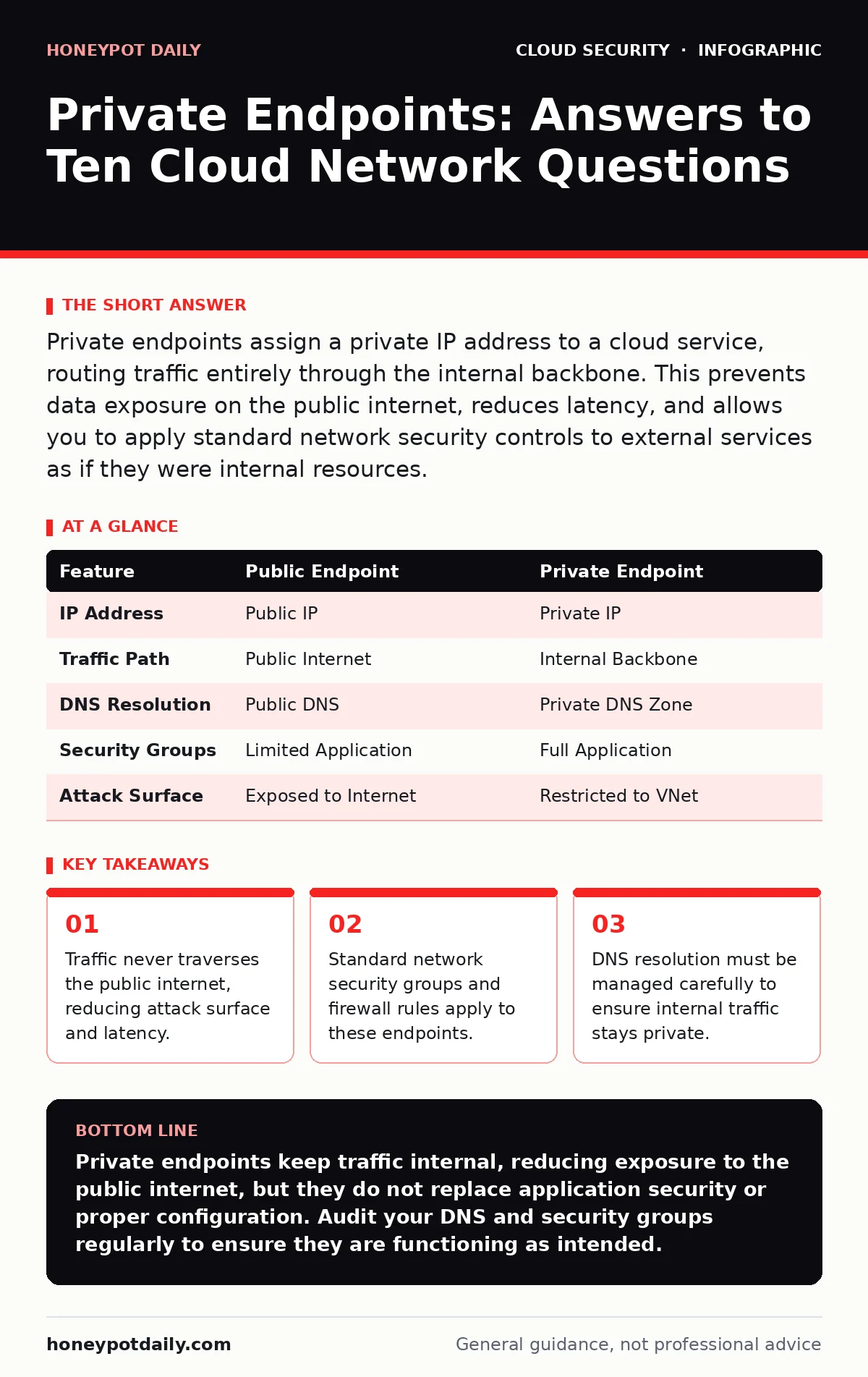
Private endpoints assign a private IP address to a cloud service, routing traffic entirely through the internal backbone. This prevents data exposure on the public internet, reduces latency, and allows you to apply standard network security controls to external services as if they were internal resources.
What exactly is a private endpoint?
A private endpoint is a network interface that connects your virtual network to a cloud service securely over a private link. It assigns a private IP address to the service, ensuring that all traffic between your environment and the service stays on the internal network backbone. This mechanism prevents data from being exposed to the public internet, even if the service itself is publicly accessible by default. You treat the service as if it were a local resource within your own infrastructure.
How does it differ from a private link?
The private link is the underlying service or technology that provides the private connectivity. The private endpoint is the specific network interface you deploy in your virtual network to use that connectivity. Think of the private link as the private road and the private endpoint as the driveway connecting your house to it. You cannot have one without the other, but they serve distinct architectural roles in your network design.
Does traffic really never touch the public internet?
Yes, when configured correctly, all traffic between your virtual network and the service via the private endpoint remains on the cloud provider’s internal backbone. No data packets traverse the public internet infrastructure, which means they are not subject to public IP-based attacks or interception. This isolation is fundamental to reducing the attack surface for sensitive data in transit.
Why should I use it instead of a firewall?
A firewall filters traffic but does not change the path the traffic takes. A private endpoint changes the path entirely, keeping traffic internal and invisible to the public internet. While a firewall can block malicious requests, it cannot prevent data from being exposed to public IP addresses or scanned by internet-wide bots. Combining both provides defence in depth, but the endpoint offers a stronger baseline of isolation.
How does DNS resolution work with private endpoints?
You must configure your virtual network’s DNS to resolve the service’s domain name to the private IP address of the endpoint. If DNS resolves to the public IP address, traffic will bypass the private endpoint and go out to the internet, defeating the purpose. Most cloud providers offer a private DNS zone that you can link to your virtual network to automate this resolution. Misconfigured DNS is the most common reason private endpoints fail to secure traffic.
See also: Shift Left Security Meaning: Move Checks to Code Before Build · Difference Between Virtual Private Cloud and Private Cloud
Can I connect to services in other regions?
Yes, private endpoints can connect to services in different regions within the same cloud provider. The traffic still stays on the internal backbone, but latency may increase due to the physical distance. You should test performance carefully, as the private path is not always the fastest route compared to public internet optimisations. Cross-region private links are useful for centralising services while maintaining security.
What happens if the service is unavailable?
The private endpoint itself does not provide redundancy or failover. If the underlying service is down, the endpoint will not connect, just as a local server would be unreachable. You must design your application to handle connectivity failures and timeouts appropriately. High availability is achieved by deploying multiple endpoints across different availability zones, not by the endpoint feature itself.
Do I still need application-level security?
Yes, a private endpoint only secures the network path, not the data or access permissions. Attackers who compromise your internal network can still reach the service if application authentication is weak. You must enforce strict identity and access management policies, such as requiring specific credentials or tokens, regardless of the network location. Network isolation is not a substitute for application security.
How do I monitor traffic to a private endpoint?
You can use standard network monitoring tools to inspect traffic flowing through the virtual network interface. Most cloud providers integrate private endpoints with their logging and analytics services, allowing you to see connection attempts, data volumes, and error rates. You should set up alerts for unusual traffic patterns, such as sudden spikes in connection attempts or data exfiltration. Monitoring helps you detect internal threats that bypass network perimeter controls.
| Feature | Public Endpoint | Private Endpoint |
|---|---|---|
| IP Address | Public IP | Private IP |
| Traffic Path | Public Internet | Internal Backbone |
| DNS Resolution | Public DNS | Private DNS Zone |
| Security Groups | Limited Application | Full Application |
| Attack Surface | Exposed to Internet | Restricted to VNet |
Can I use private endpoints for third-party services?
Only if the third-party service supports the cloud provider’s private link technology. Many major SaaS providers now offer this integration, allowing you to connect securely without exposing data to the public internet. If the service does not support it, you cannot use a private endpoint and must rely on other security measures, such as API gateways or VPNs. Check the provider’s documentation for supported services.
How do private endpoints affect cost?
You typically pay for the data transferred through the private endpoint, often at a lower rate than public internet egress. Some providers charge a small hourly fee for the endpoint resource itself. The cost structure varies by cloud provider and region, so you should review the pricing details for your specific use case. While not free, the security benefits often outweigh the additional costs.
Do private endpoints work with hybrid cloud security?
Yes, you can extend your on-premises network to the cloud using virtual network peering or VPNs, and then use private endpoints to access cloud services. This creates a seamless, secure connection between your data centre and cloud resources. Traffic from on-premises systems flows through the private link, maintaining the same security posture as internal cloud traffic. This approach simplifies security management across hybrid environments.
What are the limitations of private endpoints?
They only work with services that support the technology, and they do not provide encryption for data at rest. You must still manage DNS, security groups, and application authentication. They also add complexity to your network architecture, requiring careful planning and monitoring. Understanding these limitations helps you design a balanced security strategy.
How do I migrate existing services to private endpoints?
You must update your application configurations to use the private IP address or the private DNS name. This often involves changing connection strings and updating firewall rules to allow traffic from the new subnet. Test thoroughly in a non-production environment to ensure no connectivity issues arise. Plan for downtime or use blue-green deployment strategies to minimise disruption.
Do private endpoints protect against denial-of-wallet attacks?
No, they do not prevent attackers from consuming cloud resources and incurring costs. If an attacker gains access to your account, they can still spin up resources or increase data transfer volumes. You must implement billing alerts, quota limits, and strict identity controls to mitigate financial risk. Private endpoints secure the network path, not the billing account.
How do they interact with Kubernetes network policies?
If you run workloads in Kubernetes, private endpoints appear as external services to the cluster. You can use Kubernetes network policies to restrict which pods can communicate with the private endpoint. This adds an extra layer of control, ensuring that only authorised applications within the cluster can access the service. Combining network policies with private endpoints provides strong segmentation.
Can I use private endpoints for single sign-on?
Yes, you can connect your identity provider via a private endpoint to keep authentication traffic internal. This prevents credential data from traversing the public internet, reducing the risk of interception. Many identity providers support this integration, allowing you to maintain secure single sign-on flows. This is particularly useful for highly regulated industries with strict data residency requirements.
What is the impact on latency?
Latency is typically lower because traffic stays on the internal backbone, avoiding internet congestion and routing hops. However, cross-region private links may introduce higher latency than local public connections. You should measure performance in your specific environment to ensure it meets your application’s requirements. Optimising for security should not compromise user experience.
Key takeaways
- Traffic never traverses the public internet, reducing attack surface and latency.
- Standard network security groups and firewall rules apply to these endpoints.
- DNS resolution must be managed carefully to ensure internal traffic stays private.
- Private endpoints do not replace the need for application-level authentication.
Private endpoints keep traffic internal, reducing exposure to the public internet, but they do not replace application security or proper configuration. Audit your DNS and security groups regularly to ensure they are functioning as intended.
Frequently asked questions
Can I use private endpoints for public websites?
No, private endpoints are for backend services and APIs. Public websites must remain accessible via the public internet to serve users, though you can use a web application firewall for protection.
Do I need a private endpoint for every service?
Only for services that handle sensitive data or require strict isolation. Non-sensitive services can often use public endpoints with appropriate firewall rules, reducing complexity and cost.
How do I troubleshoot connection issues?
Check DNS resolution first, then verify security group rules. Ensure the private endpoint is in the same region as the service or that cross-region connectivity is configured correctly.
Are private endpoints supported in all cloud regions?
Support varies by region and service. Check your cloud provider’s documentation for the latest availability information, as new regions and services are added regularly.
How this guide was produced: written by the Honeypot Daily editorial team with AI assistance, checked against the public references listed below, and reviewed when the facts change. See our editorial policy or report an error.