
Single Sign-On Explained: Architecture, Risks and Cloud Reality
Single sign-on centralises identity verification, turning every connected service into a potential pivot point for attackers who bypass perimeter defences.
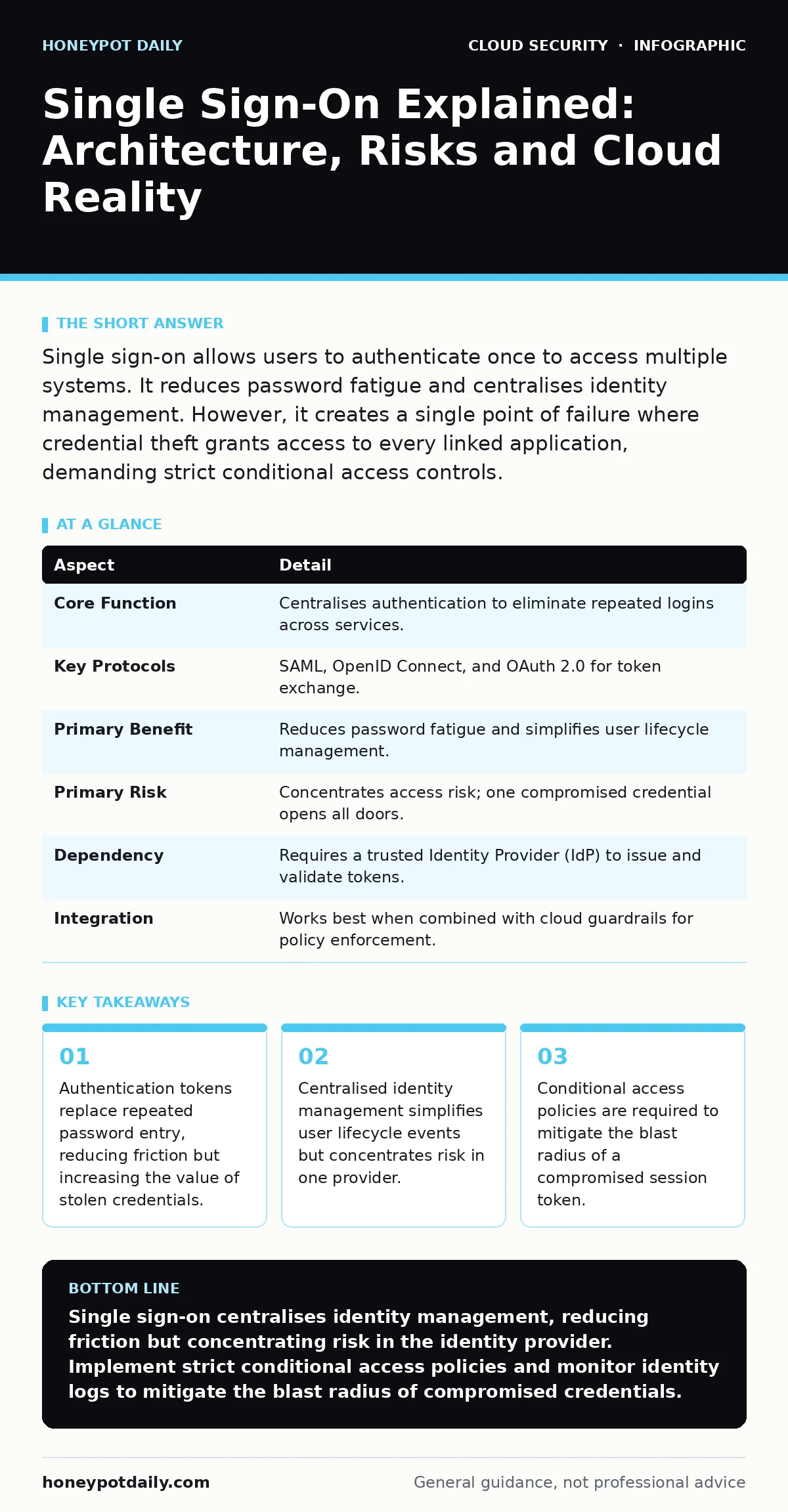
Single sign-on allows users to authenticate once to access multiple systems. It reduces password fatigue and centralises identity management. However, it creates a single point of failure where credential theft grants access to every linked application, demanding strict conditional access controls.
The Mechanics of Trust Delegation
Imagine handing a valet your car keys. You do not park the car yourself; the valet does it for you based on your single token of authority. Single sign-on (SSO) operates on this same principle of delegated trust. Instead of carrying a unique key for every door, you present one verified credential to an identity provider. That provider vouches for your identity to other systems, allowing them to grant access without asking you to prove who you are again.
This mechanism relies on standardised protocols that translate trust between systems. The most common standards are SAML and OpenID Connect. SAML, or Security Assertion Markup Language, exchanges XML-based security tokens containing assertions about the user. OpenID Connect, built on top of OAuth 2.0, uses JSON Web Tokens to provide identity information alongside authorization scopes. These protocols ensure that the application receiving the token can verify its signature and validity without ever seeing your actual password.
| Aspect | Detail |
|---|---|
| Core Function | Centralises authentication to eliminate repeated logins across services. |
| Key Protocols | SAML, OpenID Connect, and OAuth 2.0 for token exchange. |
| Primary Benefit | Reduces password fatigue and simplifies user lifecycle management. |
| Primary Risk | Concentrates access risk; one compromised credential opens all doors. |
| Dependency | Requires a trusted Identity Provider (IdP) to issue and validate tokens. |
| Integration | Works best when combined with cloud guardrails for policy enforcement. |
Solving the Credential Sprawl Problem
Before SSO, users managed dozens of passwords. This led to two predictable outcomes: weak, reused passwords or written-down credentials. Security teams responded by enforcing complex password policies, which only increased user frustration and helpdesk tickets. SSO solves this by decoupling authentication from each individual application. The application no longer stores or verifies passwords. It only checks the token issued by the identity provider.
This shift moves the burden of security from the application layer to the identity layer. Applications become stateless regarding user credentials. They do not need to patch password storage vulnerabilities or manage password reset flows. This reduces the attack surface of each individual service. However, it shifts the critical security function to the identity provider. If the identity provider is compromised, the entire ecosystem is exposed. This is why identity security is now a primary focus in cloud migration security strategies.
The Architecture of Identity Providers
The identity provider is the central authority in this model. It maintains the user directory, stores authentication factors, and issues tokens. When you log in, the identity provider performs the actual verification. It checks your credentials against its database and may prompt for multi-factor authentication. Once verified, it generates a signed token. This token contains claims about your identity, such as your user ID, role, and email address.
The relying party, or the application you want to access, receives this token. It validates the token’s signature using the identity provider’s public key. If the signature is valid, the application trusts the claims inside. It does not contact the identity provider for every request. It only checks the token’s expiration and signature locally. This design improves performance and reduces load on the identity infrastructure. It also means that revoking access requires the token to expire or the application to check a revocation list, which adds complexity.
Conditional Access and Risk Context
SSO is not just about logging in once. It is about logging in safely based on context. Conditional access policies evaluate risk factors before granting or denying a session. These factors include device compliance, geographic location, and user behaviour. If you log in from a new device in an unusual country, the policy might block access or require step-up authentication. This adds a layer of intelligence that static passwords cannot provide.
This context-aware approach is vital for hybrid cloud security environments. Users may access resources from corporate networks, home networks, or public Wi-Fi. The risk profile changes with each context. Conditional access allows the identity provider to adapt the authentication requirement dynamically. A low-risk login might only require a password. A high-risk login might require a hardware security key. This balance between security and usability is the core value proposition of modern identity platforms.
What People Usually Get Wrong
Many teams assume that implementing SSO eliminates the need for multi-factor authentication. This is incorrect. SSO simplifies the login process, but it does not verify that the person holding the token is the legitimate user. If an attacker steals your password and your SSO token, they are in. Multi-factor authentication adds a second layer of verification that is tied to something you have or are, not just something you know. Without it, SSO merely centralises the target for credential theft.
Another common misconception is that SSO provides authorisation. SSO handles authentication: proving who you are. Authorisation handles permissions: what you are allowed to do. SSO tokens may contain role claims, but the application must still enforce these roles correctly. If an application has a flaw in its role-based access control, SSO will not fix it. In fact, it might make the flaw worse by granting broader initial access. This is why understanding the difference between identity and access management is critical.
See also: Hybrid Cloud Security: Definition, Purpose and Hidden Gaps · Orphaned Cloud Resources: Definition, Risks, and Cleanup Strategy
Integration with Cloud Defences
SSO does not operate in isolation. It must integrate with broader cloud security controls. Private endpoints, for instance, restrict access to services by requiring connections from specific network locations. When combined with SSO, you can ensure that only authenticated users from approved networks can access sensitive resources. This defence-in-depth approach reduces the likelihood of external attacks succeeding.
Network detection and response systems can monitor traffic patterns associated with SSO usage. Unusual spikes in authentication requests or access from anomalous IP addresses can trigger alerts. These systems help detect credential stuffing attacks or token replay attacks. By correlating identity data with network behaviour, security teams can identify threats that neither system could detect alone. This integration is particularly important when managing Kubernetes misconfigurations, as identity decisions often determine which pods and services a user can interact with.
Managing the Blast Radius
The centralisation of identity creates a single point of failure. If the identity provider goes down, no one can log in. If it is compromised, every connected service is at risk. To manage this risk, organisations should implement break-glass accounts. These are emergency accounts that bypass SSO and allow direct access to critical systems. They should be protected by hardware security keys and stored in secure, offline locations.
Regularly reviewing access rights is also necessary. Over time, users accumulate permissions as they move between roles. SSO makes it easy to grant access, but hard to remove it if not managed. Automated provisioning and de-provisioning workflows ensure that access is granted and revoked based on employment status and role changes. This reduces the risk of former employees retaining access to sensitive data.
The Future of Identity in Cloud
As organisations adopt more cloud services, the number of identity touchpoints grows. SSO remains the standard for managing this complexity. However, the nature of threats is evolving. Denial-of-wallet attacks, which exploit cloud billing systems, can be mitigated by strict identity-based spending limits. SSO provides the identity context needed to enforce these limits. By tying financial permissions to specific identities and roles, organisations can prevent abuse.
The integration of SSO with other security controls will continue to deepen. Zero trust architectures rely on continuous verification, not just initial login. SSO provides the initial trust anchor, but ongoing validation is required. This means that SSO is not the end of the security journey. It is the foundation upon which more sophisticated, context-aware security controls are built.
Key takeaways
- Authentication tokens replace repeated password entry, reducing friction but increasing the value of stolen credentials.
- Centralised identity management simplifies user lifecycle events but concentrates risk in one provider.
- Conditional access policies are required to mitigate the blast radius of a compromised session token.
- Integration with cloud guardrails ensures identity decisions align with resource protection rules.
Single sign-on centralises identity management, reducing friction but concentrating risk in the identity provider. Implement strict conditional access policies and monitor identity logs to mitigate the blast radius of compromised credentials.
Frequently asked questions
Does SSO replace multi-factor authentication?
No. SSO handles the login process, while multi-factor authentication verifies your identity. They work together to secure access. SSO without MFA leaves you vulnerable to credential theft.
Can SSO be used for external partners?
Yes. SSO supports federated identity, allowing partners to use their own identity providers. This reduces the need to create and manage separate accounts for each partner, improving security and usability.
What happens if the identity provider is compromised?
If the identity provider is compromised, attackers may gain access to all connected services. This is why identity providers must be highly secured, with strict access controls and monitoring. Incident response plans should include steps to revoke all tokens and reset credentials.
Is SSO suitable for small teams?
Yes. SSO benefits teams of any size by reducing password fatigue and simplifying access management. Many cloud providers offer SSO as part of their standard security features, making it easy to implement even for small organisations.
How this guide was produced: written by the Honeypot Daily editorial team with AI assistance, checked against the public references listed below, and reviewed when the facts change. See our editorial policy or report an error.