
Hybrid Cloud Security: Seven Controls to Close the Gap
Identity boundaries rarely match network boundaries in hybrid environments, creating blind spots that traditional perimeter tools cannot see or control.
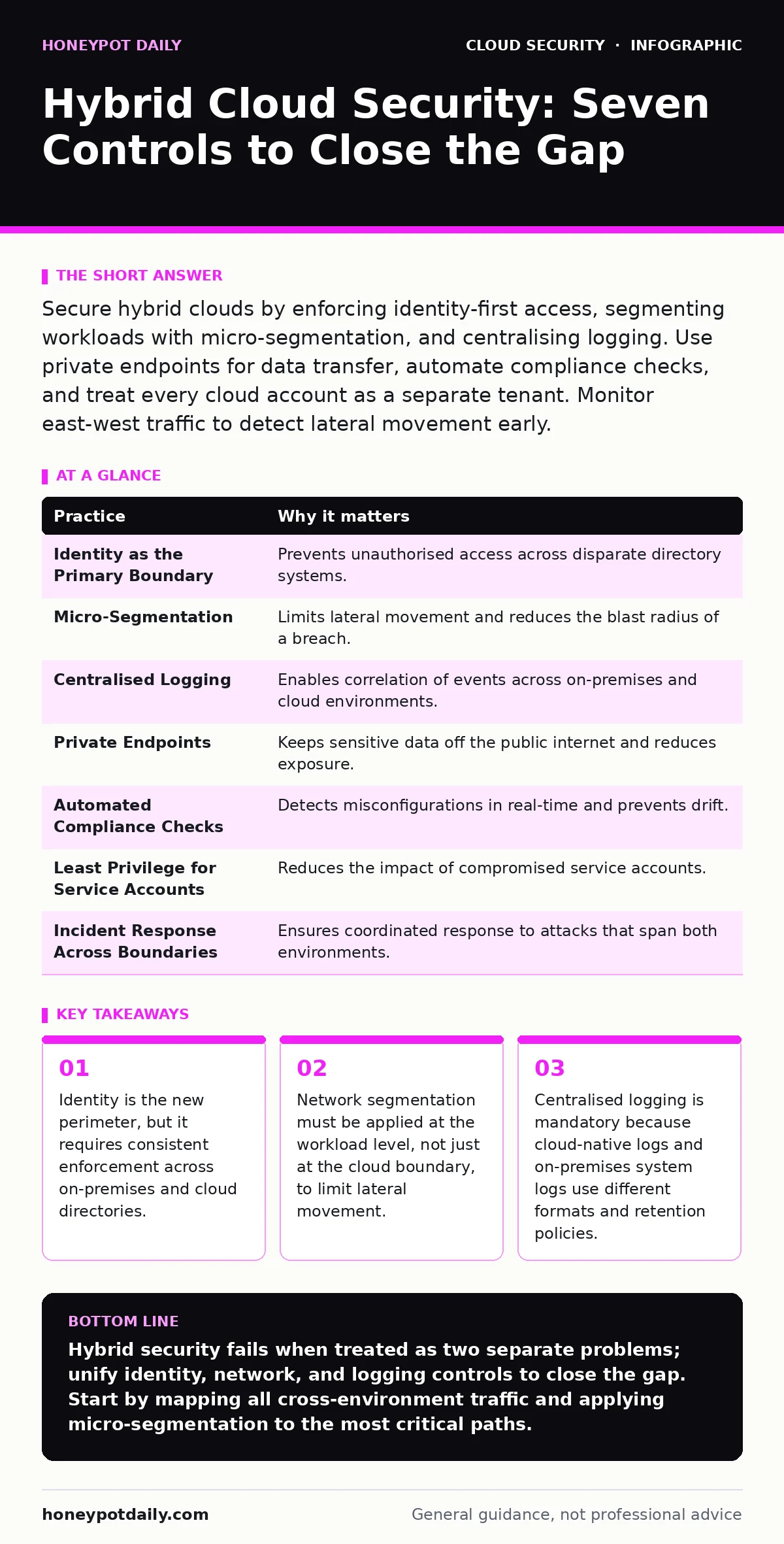
Secure hybrid clouds by enforcing identity-first access, segmenting workloads with micro-segmentation, and centralising logging. Use private endpoints for data transfer, automate compliance checks, and treat every cloud account as a separate tenant. Monitor east-west traffic to detect lateral movement early.
Identity as the Primary Boundary
In a hybrid environment, the traditional network perimeter dissolves. You cannot rely on firewalls alone because users and services access resources from both corporate data centres and public cloud regions. Identity becomes the new perimeter. This means every request must be authenticated and authorised based on the identity of the user or service, not just the IP address it comes from.
The challenge is consistency. On-premises directories often use different schemas than cloud identity providers. If these systems do not synchronise correctly, you create gaps where accounts exist in one system but not the other. These orphaned accounts are prime targets for attackers who understand that security teams often focus on the primary directory.
Implement single sign-on to unify access across both environments. This ensures that when an employee leaves, their access is revoked everywhere simultaneously. Do not rely on manual de-provisioning scripts. Synchronise attributes carefully, ensuring that group memberships translate correctly between the local directory and the cloud provider.
Micro-Segmentation for Workload Isolation
Hybrid architectures often connect on-premises servers to cloud instances via virtual private networks or dedicated circuits. This connectivity is necessary for integration, but it also creates a direct path for attackers to move laterally. If a web server in the cloud is compromised, the attacker can pivot to the on-premises database if the network allows it.
Micro-segmentation restricts traffic between workloads based on specific policies. Instead of allowing all traffic within a subnet, you define exactly which applications can talk to each other and on which ports. This limits the blast radius of a breach. Even if an attacker gains access to one component, they cannot easily reach others.
Apply network policies at the workload level, not just at the subnet boundary. For example, ensure that Kubernetes network policies are configured to deny all ingress traffic by default. This forces you to explicitly allow only the traffic required for business operations. It is more work upfront, but it prevents accidental exposure.
Centralised Logging and Monitoring
Cloud providers generate vast amounts of log data, but these logs are often siloed within the cloud console. On-premises systems generate logs in different formats, stored on different servers. Without a centralised view, you cannot correlate events across the hybrid boundary. An attacker might trigger an alert in the cloud but go unnoticed in the on-premises environment.
Centralised logging aggregates data from all sources into a single platform. This allows you to create detection rules that span both environments. For instance, you can look for a user logging in from the cloud and then accessing a sensitive file on-premises within a short timeframe. This kind of correlation is impossible if the data is scattered.
Ensure that logs are immutable and retained for a sufficient period. Attackers often try to delete logs to cover their tracks. Use a write-once-read-many storage solution for log archives. This ensures that even if the logging platform is compromised, the historical data remains intact for forensic analysis.
Private Endpoints for Data Transfer
Transferring data between on-premises systems and cloud services over the public internet is risky. Even with encryption, metadata can be exposed, and the connection is vulnerable to man-in-the-middle attacks or denial-of-service attempts. Private endpoints allow you to route traffic through a private network, keeping it off the public internet.
Imagine a database that needs to be accessed by an application running in the cloud. Instead of exposing the database to the internet, you create a private endpoint. This creates a direct, private connection between the cloud application and the on-premises database. The traffic never traverses the public internet, reducing the attack surface.
Use private endpoints for all sensitive data transfers. This includes database connections, API calls, and management interfaces. Do not rely on encryption alone. Encryption protects the data in transit, but it does not hide the fact that the connection is happening. Private endpoints hide the connection entirely.
Automated Compliance Checks
Hybrid environments are complex and change frequently. Manual compliance checks are slow and error-prone. By the time you finish checking one system, another has changed. Automated compliance tools continuously scan your environment against a set of policies. This ensures that you always know if your configuration drifts from the desired state.
Compliance is not just about meeting regulatory requirements. It is about maintaining a secure baseline. Misconfigurations are the leading cause of cloud breaches. Automated tools can detect issues such as open storage buckets, overly permissive firewall rules, or unencrypted data at rest.
Integrate these checks into your deployment pipeline. This prevents non-compliant configurations from being deployed in the first place. If a configuration fails the check, the deployment is blocked. This shifts security left, catching issues before they become vulnerabilities. Refer to cloud guardrails for a structured approach to defining these policies.
See also: Orphaned Cloud Resources: Definition, Risks, and Cleanup Strategy · Shift Left Security Meaning: Move Checks to Code Before Build
Least Privilege for Service Accounts
Service accounts are used by applications to access resources. In a hybrid environment, these accounts often have broad permissions to simplify development and testing. This is a significant risk. If a service account is compromised, the attacker gains access to everything the account can do.
Apply the principle of least privilege. Give each service account only the permissions it needs to perform its specific function. Regularly review these permissions and remove any that are no longer required. Use role-based access control to manage permissions centrally.
Avoid using long-term credentials for service accounts. Instead, use short-lived tokens that are automatically rotated. This limits the window of opportunity for an attacker. If a token is stolen, it expires quickly, reducing the impact.
Incident Response Across Boundaries
Incident response plans often focus on either on-premises or cloud environments. In a hybrid setup, an incident can span both. Your response plan must account for this complexity. You need to know how to isolate systems in both environments, how to preserve evidence, and how to communicate with different teams.
Test your incident response plan regularly. Simulate scenarios where an attacker moves from the cloud to on-premises and vice versa. Identify gaps in your detection and response capabilities. Update your plan based on the lessons learned from these exercises.
Ensure that your blue team operations include monitoring for cross-environment attacks. This requires coordination between the teams responsible for on-premises security and cloud security. They must share information and work together to detect and respond to threats.
| Practice | Why it matters |
|---|---|
| Identity as the Primary Boundary | Prevents unauthorised access across disparate directory systems. |
| Micro-Segmentation | Limits lateral movement and reduces the blast radius of a breach. |
| Centralised Logging | Enables correlation of events across on-premises and cloud environments. |
| Private Endpoints | Keeps sensitive data off the public internet and reduces exposure. |
| Automated Compliance Checks | Detects misconfigurations in real-time and prevents drift. |
| Least Privilege for Service Accounts | Reduces the impact of compromised service accounts. |
| Incident Response Across Boundaries | Ensures coordinated response to attacks that span both environments. |
Key takeaways
- Identity is the new perimeter, but it requires consistent enforcement across on-premises and cloud directories.
- Network segmentation must be applied at the workload level, not just at the cloud boundary, to limit lateral movement.
- Centralised logging is mandatory because cloud-native logs and on-premises system logs use different formats and retention policies.
Hybrid security fails when treated as two separate problems; unify identity, network, and logging controls to close the gap. Start by mapping all cross-environment traffic and applying micro-segmentation to the most critical paths.
Frequently asked questions
How do I handle legacy on-premises systems that cannot support modern cloud security tools?
Use network-level controls to isolate these systems. Create a dedicated segment for legacy infrastructure and restrict access to it. Use jump hosts with strict logging to manage administrative access.
Can I use the same identity provider for both on-premises and cloud environments?
Yes, this is recommended. A unified identity provider simplifies management and improves security. Ensure that it supports the protocols used by both environments and can synchronise attributes correctly.
What is the biggest risk in hybrid cloud security?
The biggest risk is inconsistent policy enforcement. If security controls are applied differently in the cloud and on-premises, attackers will exploit the weaker side. Consistency is key.
How often should I review my hybrid security architecture?
Review it continuously. Use automated tools to monitor for changes and drift. Conduct formal reviews quarterly or after significant changes to the environment.
How this guide was produced: written by the Honeypot Daily editorial team with AI assistance, checked against the public references listed below, and reviewed when the facts change. See our editorial policy or report an error.