
Cloud Migration Security: Defining the Hidden Risks and Controls
Migration security is not a phase but a continuous state of verifying that cloud-native threats do not bypass legacy defence models.
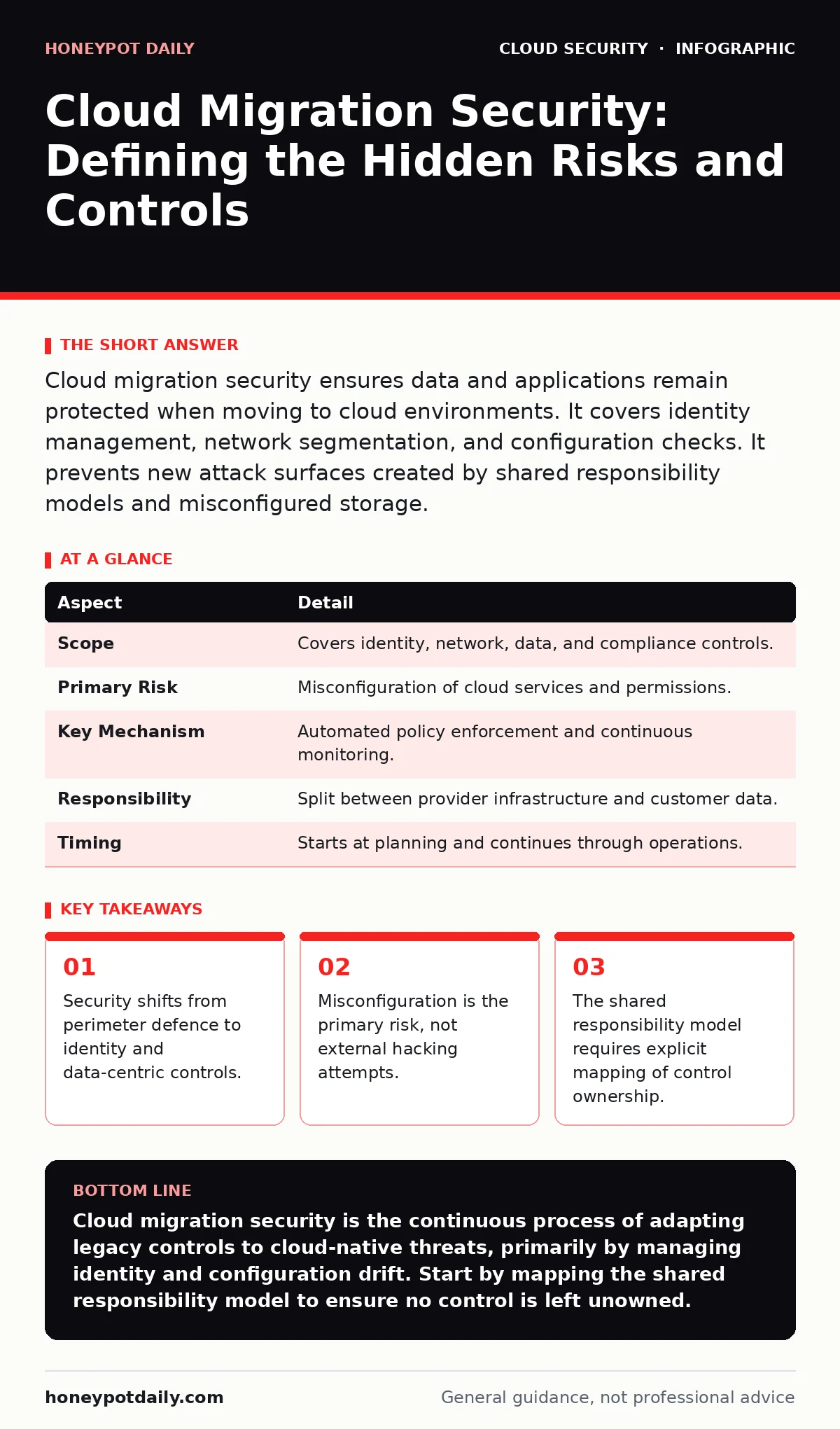
Cloud migration security ensures data and applications remain protected when moving to cloud environments. It covers identity management, network segmentation, and configuration checks. It prevents new attack surfaces created by shared responsibility models and misconfigured storage.
Moving Furniture Through a Narrow Door
Imagine you are moving a house full of antique furniture through a narrow door. You cannot simply shove everything through at once. You must measure each item, disassemble the large pieces, and ensure the new room has the right climate control. Cloud migration is similar. You are moving complex applications and sensitive data into a new environment with different rules. The goal is not just speed but ensuring nothing breaks or gets stolen in transit.
Most teams focus on the lift. They worry about downtime and cost. They forget that the destination environment operates on a completely different security model. The old walls are gone. The new defences are software-defined and dynamic. If you treat the cloud like a data centre, you will fail.
The Core Definition and Purpose
Cloud migration security is the practice of maintaining confidentiality, integrity, and availability during the transition to cloud infrastructure. It is not a single tool. It is a process that spans planning, execution, and post-migration validation. The purpose is to close the gap between on-premise security controls and cloud-native protections.
This discipline solves the problem of visibility loss. When you move workloads, you lose physical control over the hardware. You gain access to powerful APIs and automated scaling. These features create new attack vectors. Without specific migration security, you expose your data to misconfiguration and unauthorized access.
The Shared Responsibility Trap
The biggest conceptual hurdle is the shared responsibility model. This framework divides security duties between the cloud provider and the customer. The provider secures the infrastructure. The customer secures the data and access. This division is often misunderstood.
Many teams assume the provider handles encryption at rest. In reality, the provider offers the capability. The customer must enable and manage the keys. If you do not define who owns each control, gaps appear. These gaps are where breaches happen. You must map every security control to a specific owner before moving a single byte of data.
| Aspect | Detail |
|---|---|
| Scope | Covers identity, network, data, and compliance controls. |
| Primary Risk | Misconfiguration of cloud services and permissions. |
| Key Mechanism | Automated policy enforcement and continuous monitoring. |
| Responsibility | Split between provider infrastructure and customer data. |
| Timing | Starts at planning and continues through operations. |
Identity as the New Perimeter
In traditional networks, the firewall is the perimeter. In the cloud, identity is the perimeter. Every user, service, and application needs an identity. This identity dictates what it can access. If you do not manage these identities tightly, you create a wide-open door.
Single sign-on is often the first step in this process. It centralises authentication and allows for better monitoring. However, it also creates a single point of failure. If the identity provider is compromised, every connected service is at risk. You must implement multi-factor authentication and conditional access policies. These policies check the context of the login, such as location and device health.
Configuration and Drift
Cloud services are complex. They have dozens of settings. Most of these settings are secure by default. However, convenience often leads to insecure choices. A storage bucket might be set to public for testing and forgotten. A database might lack encryption. This is known as configuration drift.
Drift happens when the actual state of your environment differs from the intended state. It is rarely malicious. It is usually accidental. A developer changes a setting to fix a bug. They forget to revert it. Over time, these small changes accumulate. They create a fragile security posture. You need automated tools to detect and remediate drift. Manual checks are too slow and prone to error.
See also: Shift Left Security Meaning: Move Checks to Code Before Build · Difference Between Virtual Private Cloud and Private Cloud
Network Segmentation and Isolation
Network architecture in the cloud is virtual. You can create networks that span multiple regions. This flexibility is powerful but dangerous. If you do not segment your network, a breach in one part can spread to all.
Private endpoints allow you to connect services without exposing them to the public internet. This reduces the attack surface significantly. You should also use virtual private clouds to isolate workloads. Each workload should have its own network segment. This limits the blast radius of an incident. If one service is compromised, the attacker cannot easily move laterally to others.
What People Usually Get Wrong
Teams often treat migration security as a phase. They secure the data before moving it. They assume the job is done once the migration is complete. This is a critical error. Security is continuous. The cloud environment changes constantly. New services are added. Permissions are updated. You must monitor for changes continuously.
Another common mistake is ignoring the software supply chain. Many teams focus on the infrastructure. They forget about the code running on it. If the application has vulnerabilities, the cloud security controls will not help. You must scan your code and dependencies. You must ensure that the software itself is secure.
Integrating with Broader Defences
Cloud migration security does not exist in a vacuum. It must integrate with your existing security framework. This includes incident response, compliance, and risk management. You need to update your policies to reflect the cloud environment.
Consider how hybrid cloud security fits into your model. Many organisations run workloads in both on-premise and cloud environments. This creates a complex network. You must ensure consistent security policies across both. Similarly, cloud guardrails help enforce best practices. These guardrails prevent users from making dangerous changes. They act as a safety net.
You should also consider immutable backups. These are backups that cannot be altered or deleted for a set period. They protect against ransomware and accidental deletion. In a cloud migration, ensuring your backups are immutable is vital. It provides a last line of defence. If your primary data is compromised, you can restore from a clean, unchangeable backup.
The Hidden Cost of Speed
Speed is often the primary driver for cloud migration. Teams want to move fast. They skip security checks to meet deadlines. This creates technical debt. Fixing security issues later is more expensive and harder. It often requires re-architecting the application.
The hidden cost is not just financial. It is reputational. A breach during or after migration damages trust. It takes years to rebuild. You must balance speed with security. Use automated tools to speed up security checks. Do not skip them. Integrate security into your development pipeline. This is known as DevSecOps. It ensures that security is built in from the start.
Final Considerations
Cloud migration security is a mindset. It requires a shift from static controls to dynamic, automated protections. You must understand the shared responsibility model. You must manage identity and configuration carefully. You must integrate with broader security frameworks.
Do not treat it as a one-time project. Treat it as a continuous process. The cloud environment will change. Your security must change with it. Stay alert for drift. Monitor for anomalies. Test your controls regularly. This ensures that your migration remains secure over time.
Key takeaways
- Security shifts from perimeter defence to identity and data-centric controls.
- Misconfiguration is the primary risk, not external hacking attempts.
- The shared responsibility model requires explicit mapping of control ownership.
Cloud migration security is the continuous process of adapting legacy controls to cloud-native threats, primarily by managing identity and configuration drift. Start by mapping the shared responsibility model to ensure no control is left unowned.
Frequently asked questions
Does cloud migration security replace traditional firewall rules?
No, it supplements them. Firewalls still protect network traffic, but identity and data encryption become the primary controls in the cloud.
How do I prevent configuration drift in the cloud?
Use automated policy engines that continuously scan your environment and automatically remediate non-compliant settings.
Is the cloud provider responsible for my data security?
The provider secures the infrastructure. You are responsible for securing the data, access controls, and encryption keys.
Can I migrate legacy applications securely?
Yes, but you must refactor or wrap them with modern security controls. Legacy apps often lack the necessary identity and encryption features.
How this guide was produced: written by the Honeypot Daily editorial team with AI assistance, checked against the public references listed below, and reviewed when the facts change. See our editorial policy or report an error.