
Denial-of-Wallet Attacks: Mechanics, Detection and Mitigation
Denial-of-wallet attacks exploit public cloud pricing models to drain budgets, often bypassing traditional security alerts that monitor for data exfiltration rather than resource consumption.
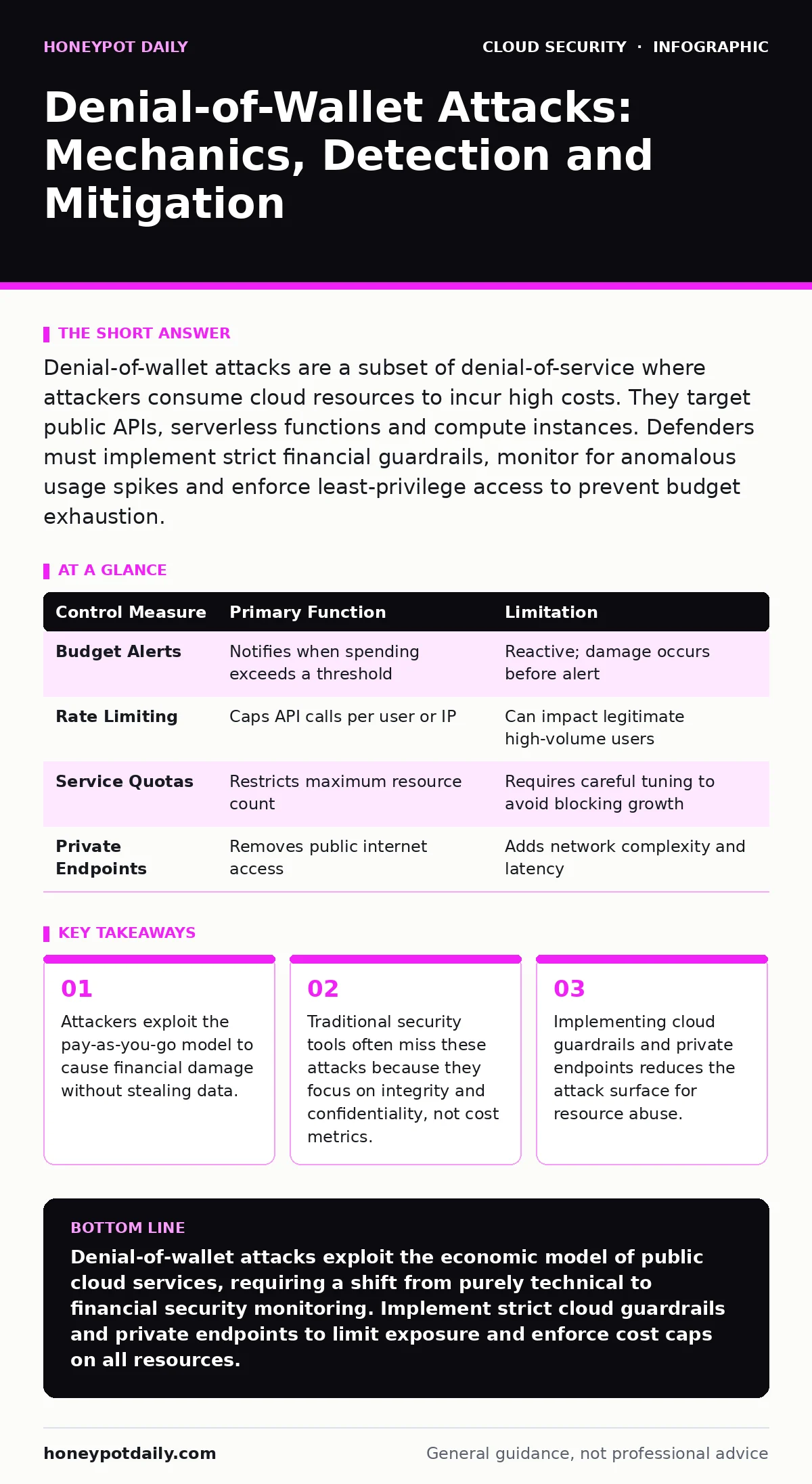
Denial-of-wallet attacks are a subset of denial-of-service where attackers consume cloud resources to incur high costs. They target public APIs, serverless functions and compute instances. Defenders must implement strict financial guardrails, monitor for anomalous usage spikes and enforce least-privilege access to prevent budget exhaustion.
What is a denial-of-wallet attack?
A denial-of-wallet attack is a malicious attempt to exhaust an organisation’s cloud budget by consuming excessive resources. Unlike traditional denial-of-service attacks that aim to disrupt availability for users, this variant targets the financial stability of the victim. The attacker triggers expensive operations, such as high-frequency API calls or massive data transfers, to generate unmanageable bills.
How does it differ from a standard DDoS?
Standard denial-of-service attacks overwhelm network bandwidth or application logic to make services unavailable to legitimate users. Denial-of-wallet attacks may leave the service partially functional while draining funds through high-cost operations. The primary metric of success for the attacker is the invoice amount, not the downtime duration. This distinction means that standard network-level mitigation often fails to stop the financial damage.
Which cloud services are most at risk?
Serverless computing functions and public application programming interfaces are prime targets due to their granular billing models. Attackers can trigger millions of function executions with minimal effort, each incurring a small cost that aggregates into significant damage. Data transfer services are also vulnerable, as egress fees can escalate rapidly when attackers exfiltrate large datasets or amplify traffic. Understanding these vectors requires a clear view of your data inventory and mapping.
Why do traditional security tools miss these attacks?
Most security information and event management systems are configured to detect anomalies in authentication patterns or data access logs. They rarely correlate resource usage spikes with financial impact in real time. An attacker can stay within normal operational thresholds for CPU or memory while triggering expensive outbound traffic. This blind spot allows the attack to persist until the billing cycle reveals the damage, often weeks later.
What are the common entry points?
Unsecured public endpoints and misconfigured identity permissions are the most frequent vectors. If an application programming interface lacks rate limiting or authentication, an attacker can invoke it repeatedly. Weak identity and access management settings allow compromised accounts to spin up high-cost resources. Proper implementation of single sign-on helps ensure that only authorised identities can trigger expensive operations.
See also: Shift Left Security Meaning: Move Checks to Code Before Build · Difference Between Virtual Private Cloud and Private Cloud
How can you detect a denial-of-wallet attack early?
Monitoring for anomalous cost patterns is more effective than monitoring for traffic volume alone. Set alerts for sudden increases in specific service usage, such as data egress or function invocations. Compare current spending against historical baselines to identify deviations that do not align with business activity. Integrating cloud security posture management with financial monitoring provides a holistic view of risk.
What is the role of cloud guardrails in prevention?
Cloud guardrails enforce policies that restrict resource creation and usage based on predefined rules. These policies can limit the size of instances, cap data transfer volumes and restrict API call rates. By embedding these controls directly into the infrastructure, you prevent accidental or malicious over-consumption. This approach complements hybrid cloud security strategies by ensuring consistent controls across environments.
| Control Measure | Primary Function | Limitation |
|---|---|---|
| Budget Alerts | Notifies when spending exceeds a threshold | Reactive; damage occurs before alert |
| Rate Limiting | Caps API calls per user or IP | Can impact legitimate high-volume users |
| Service Quotas | Restricts maximum resource count | Requires careful tuning to avoid blocking growth |
| Private Endpoints | Removes public internet access | Adds network complexity and latency |
How do you mitigate the financial impact?
Implement hard caps on resource usage and enforce strict least-privilege access controls. Use private endpoints to remove public internet access from sensitive services, reducing the attack surface. Regularly review and update your cloud migration security plans to include financial risk assessments. These measures ensure that even if an account is compromised, the attacker cannot escalate costs beyond a manageable limit.
What are the hidden costs of these attacks?
Beyond the direct cloud bills, organisations face operational overhead in investigating the incident and restoring services. There may be reputational damage if customers experience service degradation during the attack. Legal and compliance costs can arise if data was exfiltrated during the resource consumption. These indirect costs often exceed the direct financial loss, making prevention a priority.
How do Kubernetes misconfigurations contribute?
In containerised environments, misconfigured Kubernetes network policies can allow unrestricted traffic between pods. Attackers can exploit this to launch cryptomining or data exfiltration tasks within the cluster. Without proper resource quotas, a single compromised pod can consume cluster-wide resources. Ensuring that Kubernetes misconfigurations are regularly audited is vital for preventing internal lateral movement and resource abuse.
What is the long-term strategy for resilience?
Adopt a zero-trust architecture where every request is verified and authorised regardless of origin. Continuously monitor cloud usage patterns and update guardrails as the environment evolves. Educate development teams on the financial implications of their code and architecture decisions. This cultural shift ensures that security and cost efficiency are considered from the design phase, reducing the risk of denial-of-wallet attacks.
Key takeaways
- Attackers exploit the pay-as-you-go model to cause financial damage without stealing data.
- Traditional security tools often miss these attacks because they focus on integrity and confidentiality, not cost metrics.
- Implementing cloud guardrails and private endpoints reduces the attack surface for resource abuse.
Denial-of-wallet attacks exploit the economic model of public cloud services, requiring a shift from purely technical to financial security monitoring. Implement strict cloud guardrails and private endpoints to limit exposure and enforce cost caps on all resources.
Frequently asked questions
Can denial-of-wallet attacks target on-premises infrastructure?
No, these attacks specifically exploit the pay-per-use billing model of public cloud providers. On-premises infrastructure has fixed costs that do not scale with usage in the same way.
Do cloud providers reimburse victims of these attacks?
Policies vary by provider, but generally, customers are responsible for costs incurred due to unsecured configurations or compromised credentials. Some providers may offer credits in exceptional circumstances, but this is not guaranteed.
How quickly can a denial-of-wallet attack drain a budget?
Attacks can generate significant costs within minutes if they target high-frequency operations like data egress or serverless function invocations. Without immediate mitigation, the financial impact can escalate rapidly.
Is encryption a defence against denial-of-wallet attacks?
Encryption protects data confidentiality but does not prevent resource consumption. An attacker can still trigger expensive operations on encrypted data, so encryption must be combined with usage controls.
How this guide was produced: written by the Honeypot Daily editorial team with AI assistance, checked against the public references listed below, and reviewed when the facts change. See our editorial policy or report an error.