Difference Between Virtual Private Cloud and Private Cloud
Virtual private clouds share physical hardware with other tenants, whereas private clouds dedicate infrastructure to a single organisation, creating distinct risk profiles.
A virtual private cloud is an isolated section of a public cloud provider's infrastructure, sharing physical hardware but logically separated. A private cloud is dedicated infrastructure owned or leased exclusively by one organisation. The core difference lies in hardware isolation versus logical isolation.
What is the difference between virtual private cloud and private cloud?
The difference between virtual private cloud and private cloud centres on hardware ownership and isolation mechanisms. A virtual private cloud (VPC) creates a logically isolated network within a public cloud environment. It shares physical servers with other tenants but uses software to separate traffic. A private cloud provides dedicated hardware or a dedicated virtualisation cluster for a single organisation. This physical separation eliminates the risk of noisy neighbour effects and certain side-channel attacks.
How does isolation work in each model?
Isolation in a virtual private cloud relies on software-defined networking and hypervisor security. The cloud provider manages the underlying physical network, using virtual switches and firewalls to ensure your traffic never mixes with others. In a private cloud, isolation is physical or near-physical. You control the hypervisor, the switches, and the cabling. This allows for air-gapped configurations or strict hardware-level encryption keys that never leave your premises. The trade-off is that you must manage the patching and security of the entire stack.
Who manages the underlying infrastructure?
In a virtual private cloud, the provider manages the physical servers, storage arrays, and network backbone. You manage the guest operating systems, applications, and security groups. This follows the standard shared responsibility model. In a private cloud, you manage everything from the power supply to the application layer. If a physical switch fails, your operations team must replace it. This operational burden is the primary hidden cost of private clouds, often requiring 24/7 on-site staff or expensive managed service contracts.
What are the scalability limits?
Virtual private clouds scale almost instantly because they draw from a massive pool of shared resources. You can provision thousands of servers in minutes during a traffic spike. Private clouds scale only as fast as you can procure and install new hardware. Capacity planning becomes a critical function. If you underestimate growth, you face performance bottlenecks. If you overestimate, you pay for idle hardware. This rigidity makes private clouds unsuitable for workloads with unpredictable demand patterns.
How does data sovereignty differ?
Data sovereignty refers to the legal jurisdiction governing your data. In a virtual private cloud, your data resides in the provider's data centres, which may be subject to foreign surveillance laws or compliance regimes. Even if you choose a specific region, the provider's employees and automated systems have potential access paths. A private cloud allows you to host data in your own facilities, ensuring it never leaves your physical control. This is vital for industries with strict regulatory requirements regarding data location and handling.
See also: Shift Left Security Meaning: Move Checks to Code Before Build · Private Endpoints: Answers to Ten Cloud Network Questions
What are the network security implications?
Virtual private clouds use private endpoints to connect securely to other cloud services without traversing the public internet. This reduces the attack surface significantly. However, misconfigured security groups remain a common vulnerability. Private clouds require you to build and maintain your own network security architecture. You must implement intrusion detection systems, web application firewalls, and segment your network manually. The security posture depends entirely on your team's expertise, not a provider's baseline controls.
Which model prevents denial-of-wallet attacks?
Denial-of-wallet attacks involve adversaries consuming your cloud resources to generate massive bills. In a virtual private cloud, these attacks are possible if you lack strict budget alerts and resource limits. The attacker exploits your account's access to the provider's infinite resource pool. A private cloud naturally limits this risk because your infrastructure capacity is finite. An attacker can cause a denial-of-service by exhausting CPU or memory, but they cannot generate unexpected financial costs. This physical cap provides a unique financial safety net.
How do you handle orphaned resources?
Orphaned cloud resources are unused assets that continue to incur costs or pose security risks. In virtual private clouds, these accumulate rapidly due to the ease of provisioning. Automated tagging and lifecycle policies are necessary to identify and terminate them. In private clouds, orphaned resources are physical servers or virtual machines that remain powered on without purpose. They consume electricity and cooling capacity. Identifying them requires regular asset audits and strict change management processes to ensure decommissioning happens when projects end.
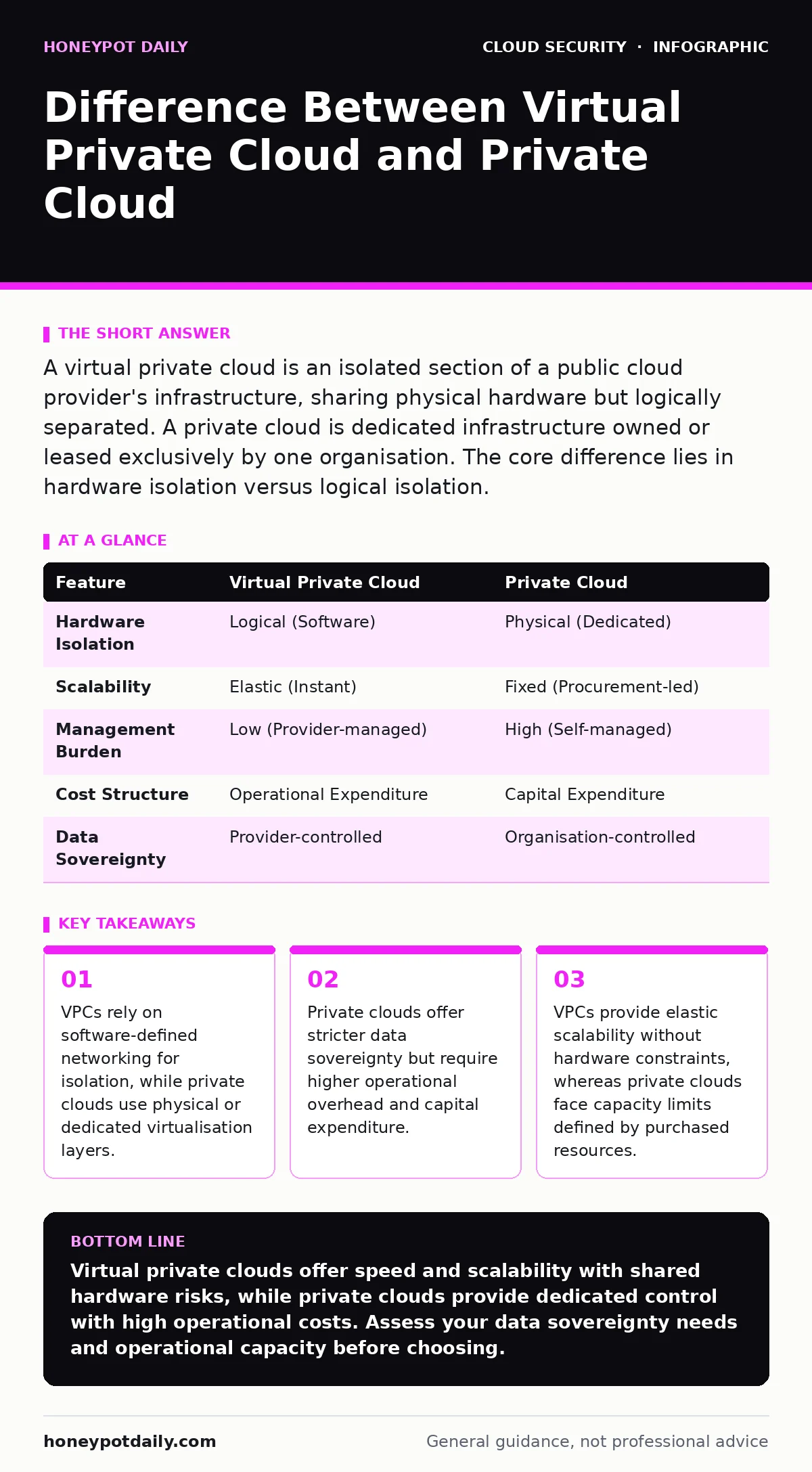
| Feature | Virtual Private Cloud | Private Cloud |
|---|---|---|
| Hardware Isolation | Logical (Software) | Physical (Dedicated) |
| Scalability | Elastic (Instant) | Fixed (Procurement-led) |
| Management Burden | Low (Provider-managed) | High (Self-managed) |
| Cost Structure | Operational Expenditure | Capital Expenditure |
| Data Sovereignty | Provider-controlled | Organisation-controlled |
When should you choose one over the other?
Choose a virtual private cloud for most workloads, especially those with variable demand or rapid development cycles. The speed of innovation and reduced operational overhead outweigh the shared hardware risks for most organisations. Choose a private cloud only when you have strict regulatory requirements, need air-gapped isolation, or have predictable, steady workloads that justify the capital investment. For organisations moving between these models, refer to the hybrid cloud security guide to understand the complexity of managing consistent policies across both environments.
Key takeaways
- VPCs rely on software-defined networking for isolation, while private clouds use physical or dedicated virtualisation layers.
- Private clouds offer stricter data sovereignty but require higher operational overhead and capital expenditure.
- VPCs provide elastic scalability without hardware constraints, whereas private clouds face capacity limits defined by purchased resources.
Virtual private clouds offer speed and scalability with shared hardware risks, while private clouds provide dedicated control with high operational costs. Assess your data sovereignty needs and operational capacity before choosing.
Frequently asked questions
Can a virtual private cloud be as secure as a private cloud?
Yes, through strict network segmentation, encryption, and identity management, a VPC can achieve comparable security levels for most workloads, though the physical isolation benefit is absent.
Do private clouds support cloud migration security best practices?
Private clouds require different migration strategies, focusing on hardware compatibility and data transfer speeds, rather than the API-driven approaches used in public cloud migrations.
How do Kubernetes network policies apply to VPCs?
Kubernetes network policies define traffic rules between pods within a VPC, adding an extra layer of micro-segmentation that complements the VPC's broader security groups and firewalls.
What is the risk of shared responsibility model confusion?
Confusion leads to unpatched vulnerabilities, where teams assume the provider secures the guest OS or the provider assumes the team secures the underlying hypervisor, leaving gaps in defence.
How this guide was produced: written by the Honeypot Daily editorial team with AI assistance, checked against the public references listed below, and reviewed when the facts change. See our editorial policy or report an error.