
Penetration Testing Best Practices: Nine Rules for Accurate Results
Most penetration tests fail because scope ambiguity allows testers to miss critical business logic flaws that automated scans ignore completely.
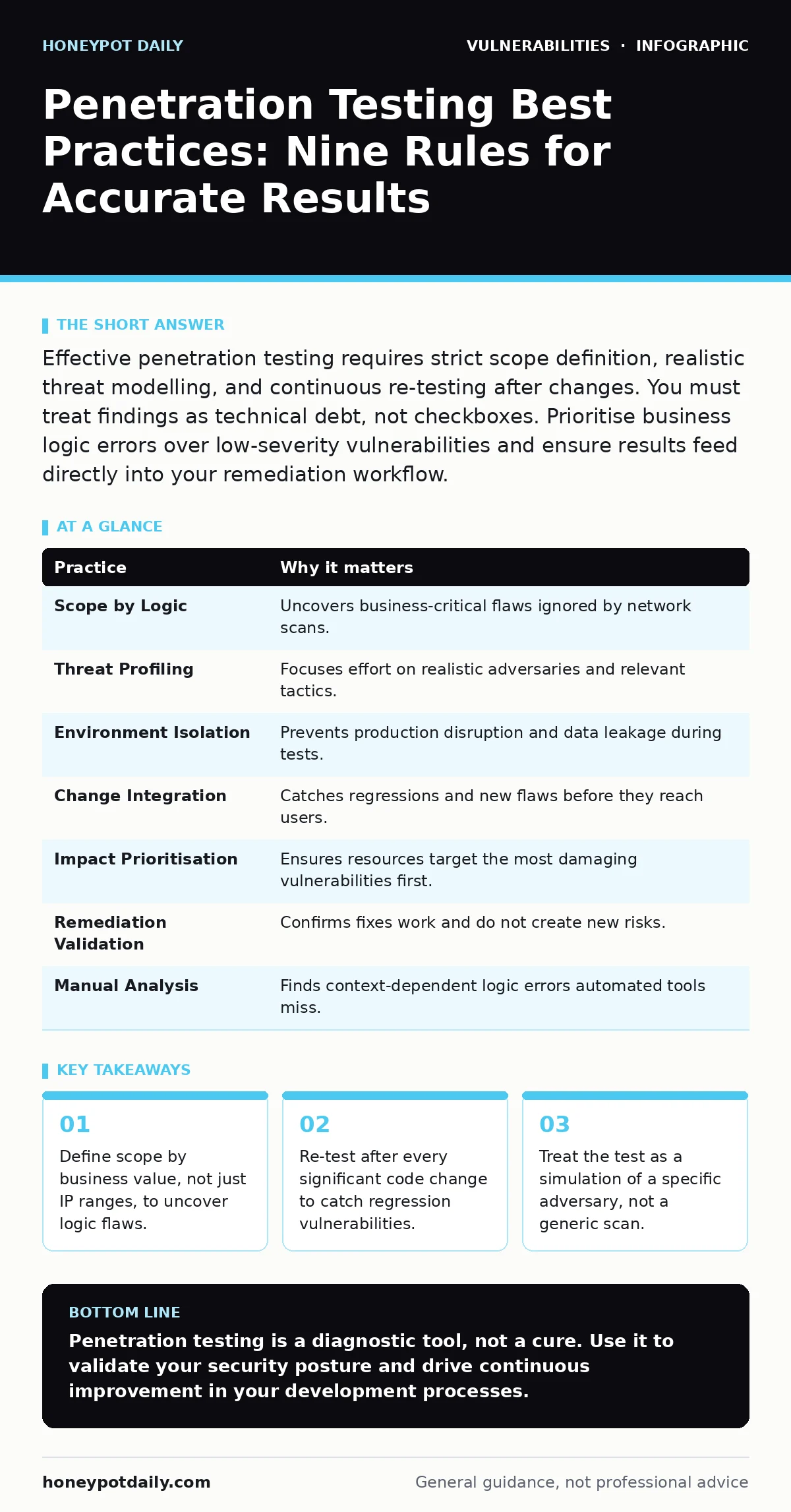
Effective penetration testing requires strict scope definition, realistic threat modelling, and continuous re-testing after changes. You must treat findings as technical debt, not checkboxes. Prioritise business logic errors over low-severity vulnerabilities and ensure results feed directly into your remediation workflow.
1. Define Scope by Business Logic, Not Just Infrastructure
A common failure mode in security assessments is defining scope solely by IP addresses or domain names. This approach treats the application as a network device rather than a business process. You miss critical logic flaws when you focus only on connectivity.
Business logic vulnerabilities, such as privilege escalation or workflow bypass, often reside in how the application processes data, not how it transmits it. If your scope excludes the checkout flow because it is behind a single sign-on gateway, you leave the most valuable asset exposed.
2. Establish Realistic Threat Profiles
Generic testing assumes an attacker with infinite time and resources, which leads to noise. You must define who is attacking you and why. A threat profile dictates the depth and style of the test.
If your application handles sensitive financial data, the adversary likely has specific tools and knowledge of financial fraud techniques. A generic scan will miss these nuanced attacks. Tailoring the test to the threat actor ensures you find the vulnerabilities that actually matter to your risk posture.
This approach aligns with exposure management principles, focusing effort on the most likely attack vectors rather than the widest possible surface area. It prevents wasted effort on theoretical risks that have no path to exploitation in your context.
3. Isolate Test Environments from Production
Testing in production carries the risk of data corruption, service disruption, and legal exposure. You need an environment that mirrors production in structure but contains synthetic data.
Synthetic data allows testers to probe edge cases without compromising real user information. However, the environment must behave identically to production in terms of configuration and dependencies. If the test environment lacks a specific database constraint present in production, the test results become invalid.
4. Integrate Testing into Change Management
Security is not a one-time event. Every code change introduces new surface area and potential regressions. You must integrate testing into your change management for security patches and feature release cycles.
Running a full penetration test after every minor update is impractical. Instead, use dynamic application security testing (DAST) for continuous automated checks. Reserve manual penetration testing for major releases or significant architectural changes.
This hybrid approach ensures you catch obvious bugs early while reserving deep manual analysis for complex logic changes. It reduces the mean time to remediation by identifying issues before they reach production.
5. Prioritise Findings by Business Impact
Not all vulnerabilities are equal. A low-severity information disclosure on an internal admin page may be less critical than a medium-severity flaw on a public-facing API. You must prioritise findings based on their potential business impact.
Work with your development teams to understand the context of each finding. A cross-site scripting vulnerability in a read-only blog is less urgent than one in a comment section that allows stored scripts.
See also: Citrix NetScaler Vulnerabilities Prevention Checklist · CVSS 4.0 Misreadings: What Security Teams Get Wrong
6. Validate Remediations Through Re-Testing
Fixing a vulnerability is not enough. You must verify that the fix works and does not introduce new issues. Re-testing ensures that the remediation is effective and stable.
Developers often apply patches that address the symptom but not the root cause. A re-test confirms that the underlying logic is secure. It also checks for regressions, where the fix breaks existing functionality or opens a new attack vector.
Treat re-testing as a mandatory step in your mitigations and workarounds process. Without verification, you are guessing whether the risk has been reduced.
7. Leverage Manual Analysis for Logic Flaws
Automated tools excel at finding known signatures but fail at understanding context. You need human analysts to explore complex workflows and stateful interactions.
Manual testing uncovers flaws in authentication flows, session management, and authorisation checks. These are areas where code structure matters more than input syntax.
Combine this with input validation strategies to ensure that manual testers focus on data flow rather than just syntax errors. This depth is where the most critical business-logic vulnerabilities hide.
8. Document Assumptions and Limitations Clearly
Every test has boundaries. Documenting these limits is as important as the findings themselves. You must state what was not tested and why.
This transparency helps stakeholders understand the residual risk. It also provides a baseline for future tests, allowing you to track progress over time.
9. Feed Results Back into Security Design
The ultimate goal of testing is improvement. You must feed the results back into your security design process.
Use the findings to update your threat models and security requirements. This creates a feedback loop that strengthens your architecture over time.
| Practice | Why it matters |
|---|---|
| Scope by Logic | Uncovers business-critical flaws ignored by network scans. |
| Threat Profiling | Focuses effort on realistic adversaries and relevant tactics. |
| Environment Isolation | Prevents production disruption and data leakage during tests. |
| Change Integration | Catches regressions and new flaws before they reach users. |
| Impact Prioritisation | Ensures resources target the most damaging vulnerabilities first. |
| Remediation Validation | Confirms fixes work and do not create new risks. |
| Manual Analysis | Finds context-dependent logic errors automated tools miss. |
| Document Limits | Clarifies residual risk and sets baselines for future tests. |
| Design Feedback | Improves long-term security architecture and reduces debt. |
Key takeaways
- Define scope by business value, not just IP ranges, to uncover logic flaws.
- Re-test after every significant code change to catch regression vulnerabilities.
- Treat the test as a simulation of a specific adversary, not a generic scan.
Penetration testing is a diagnostic tool, not a cure. Use it to validate your security posture and drive continuous improvement in your development processes.
Frequently asked questions
How often should we perform penetration testing?
Perform full manual tests annually or after major changes. Use automated scans continuously to catch regressions between manual assessments.
Do we need a separate environment for testing?
Yes, to prevent data leaks and service disruption. Ensure the test environment mirrors production configuration to maintain result validity.
Can we use automated tools instead of manual testers?
Automated tools are useful for known vulnerabilities but cannot assess business logic. Combine both for a complete assessment.
How do we prioritise which vulnerabilities to fix first?
Prioritise based on exploitability and business impact. A high-impact flaw on a public-facing component should be fixed before a low-impact internal issue.
How this guide was produced: written by the Honeypot Daily editorial team with AI assistance, checked against the public references listed below, and reviewed when the facts change. See our editorial policy or report an error.