
Difference Between Penetration Testing and Red Teaming: Scope and Outcomes
Penetration testing audits technical controls for vulnerabilities, whereas red teaming simulates adversarial behaviour to test detection capabilities and human responses across the entire organisation.
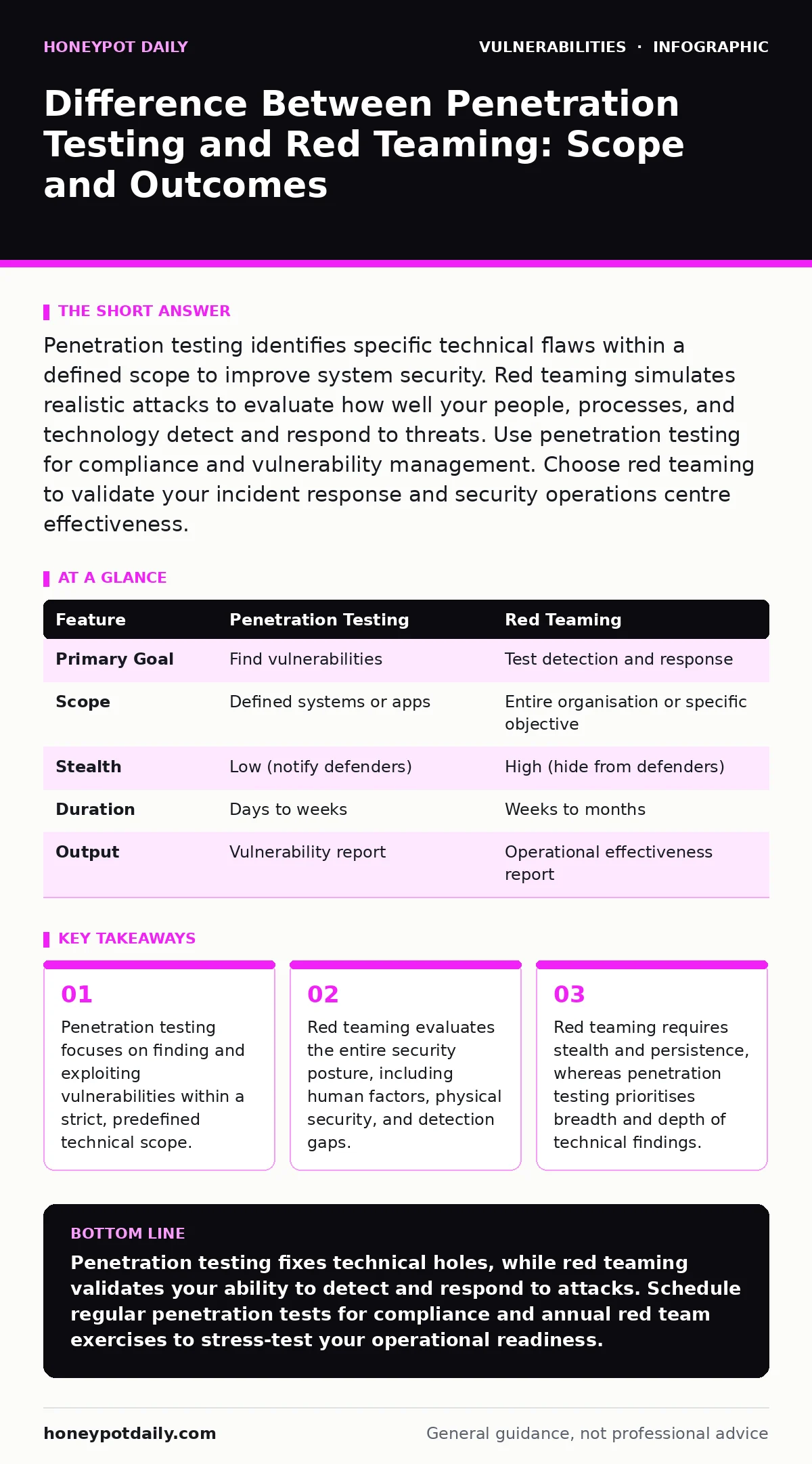
Penetration testing identifies specific technical flaws within a defined scope to improve system security. Red teaming simulates realistic attacks to evaluate how well your people, processes, and technology detect and respond to threats. Use penetration testing for compliance and vulnerability management. Choose red teaming to validate your incident response and security operations centre effectiveness.
What is the difference between penetration testing and red teaming?
Penetration testing is a technical assessment of specific systems or applications to identify and exploit vulnerabilities. Red teaming is a holistic simulation of an adversary to test your organisation’s detection and response capabilities. The core distinction lies in scope and intent. Penetration testing asks whether a system is secure. Red teaming asks whether you can stop an attacker who bypasses technical controls.
When should you choose penetration testing over red teaming?
Choose penetration testing when you need to validate compliance requirements or assess the security of a specific application. This approach provides a detailed inventory of technical weaknesses. It suits regular maintenance cycles where you must demonstrate due diligence. Penetration testing is ideal for new deployments or after significant code changes. It delivers actionable technical fixes for developers and system administrators.
How does red teaming differ in methodology and scope?
Red teaming operates with minimal constraints to mimic a real-world threat actor. The team uses social engineering, physical intrusion, and network attacks to reach a specific objective. This methodology tests the entire security stack, not just software. Red teaming evaluates whether your security operations centre detects the intrusion. It measures how quickly your incident response team contains the breach.
Why does scope definition matter for these assessments?
Scope definition determines the legal and operational boundaries of the assessment. Penetration testing requires a strict scope to avoid disrupting critical production systems. Red teaming needs a clear rules of engagement to prevent accidental data destruction. Imagine a scenario where a red team member accesses a production database. Without clear boundaries, this action could trigger a major incident. Proper scoping ensures the assessment provides value without causing harm.
| Feature | Penetration Testing | Red Teaming |
|---|---|---|
| Primary Goal | Find vulnerabilities | Test detection and response |
| Scope | Defined systems or apps | Entire organisation or specific objective |
| Stealth | Low (notify defenders) | High (hide from defenders) |
| Duration | Days to weeks | Weeks to months |
| Output | Vulnerability report | Operational effectiveness report |
How do you measure success in each approach?
Success in penetration testing is measured by the number and severity of vulnerabilities found. Success in red teaming is measured by how long the adversary remained undetected. If the red team reaches the objective without triggering alerts, your detection capabilities are insufficient. You must evaluate both technical gaps and procedural failures. A successful red team exercise often reveals that technical controls were adequate, but monitoring was poor.
See also: Citrix NetScaler Vulnerabilities Prevention Checklist · CVSS 4.0 Misreadings: What Security Teams Get Wrong
What are the hidden costs of running a red team?
Red teaming consumes significant resources from your security operations centre. Defenders may spend days chasing false positives generated by the simulation. This distraction reduces their ability to monitor real threats. There is also a risk of damaging trust between teams. Imagine a situation where the red team accesses sensitive data. If not handled correctly, this can cause legal and reputational issues. You must budget for additional monitoring and post-exercise review time.
How do you integrate findings into your security programme?
Integrate penetration testing findings into your vulnerability management workflow. Prioritise fixes based on risk and exploitability. Red teaming findings should drive improvements in your detection rules and incident response plans. You must update your threat modeling to reflect the adversary tactics observed. Consider implementing virtual patching for vulnerabilities that cannot be immediately fixed. This approach reduces risk while you develop permanent solutions.
What common mistakes do organisations make with these tests?
Organisations often treat penetration testing as a one-time compliance checkbox. This fails to address evolving threats and new code deployments. Another mistake is running red teaming without preparing the defenders. This leads to frustration and inaccurate results. You must ensure your security tools are calibrated to detect the simulated attacks. Failure to do so skews the assessment and hides critical gaps.
How do you ensure continuous improvement after testing?
Continuous improvement requires regular reassessment and adaptation. Penetration testing should occur before major releases and after significant infrastructure changes. Red teaming should happen annually or after major security programme changes. Use the findings to refine your input validation and access controls. Review your default credentials policy to ensure no weak entry points exist. Regular testing keeps your security posture aligned with the current threat environment.
Key takeaways
- Penetration testing focuses on finding and exploiting vulnerabilities within a strict, predefined technical scope.
- Red teaming evaluates the entire security posture, including human factors, physical security, and detection gaps.
- Red teaming requires stealth and persistence, whereas penetration testing prioritises breadth and depth of technical findings.
Penetration testing fixes technical holes, while red teaming validates your ability to detect and respond to attacks. Schedule regular penetration tests for compliance and annual red team exercises to stress-test your operational readiness.
Frequently asked questions
Can a single vendor perform both penetration testing and red teaming?
Yes, but ensure the teams have different skill sets. Technical exploiters differ from adversary simulators who understand social engineering and physical security.
How often should we conduct penetration testing?
Conduct penetration testing annually and after any significant change to your infrastructure or applications. This ensures new vulnerabilities are identified promptly.
Does red teaming replace vulnerability scanning?
No, red teaming complements vulnerability scanning. Scanners find known issues quickly, while red teaming assesses how those issues can be chained together by an attacker.
What is the role of threat modeling in these assessments?
Threat modeling identifies potential attack paths and priorities. It ensures that penetration testing and red teaming focus on the most likely and damaging threats to your organisation.
How this guide was produced: written by the Honeypot Daily editorial team with AI assistance, checked against the public references listed below, and reviewed when the facts change. See our editorial policy or report an error.