
What Is Tokenization in Language Models: Mechanics, Risks and Control
Tokenization fragments text into mathematical units that obscure original meaning, creating hidden vectors for data leakage and inference attacks.
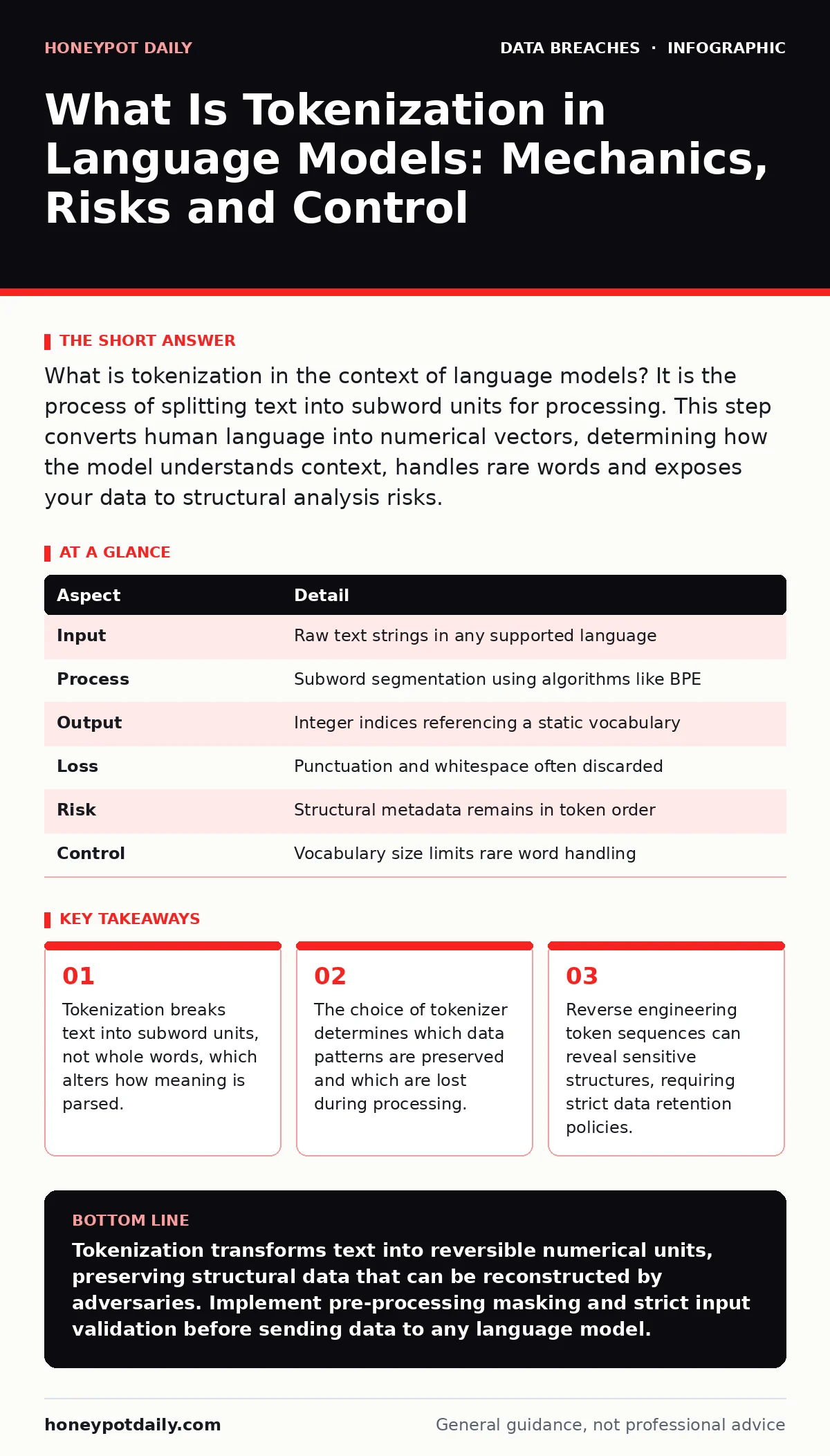
What is tokenization in the context of language models? It is the process of splitting text into subword units for processing. This step converts human language into numerical vectors, determining how the model understands context, handles rare words and exposes your data to structural analysis risks.
What is tokenization in the context of language models
What is tokenization in the context of language models? It is the mechanical process of converting raw text into discrete units that a neural network can process numerically. Language models cannot read characters directly. They require input as vectors of floating-point numbers. Tokenization bridges this gap by mapping text segments to integer indices within a predefined vocabulary.
This step is the first transformation your data undergoes before any reasoning occurs. It defines the granularity of understanding. A tokenizer decides whether "bank" is one unit or part of "river bank". This decision shapes every subsequent output. You must understand this mechanism to audit how your data is interpreted.
Imagine a library that does not catalogue books by title. It chops every book into pages, then into paragraphs, then into phrases. The system indexes these fragments rather than the whole narrative. A language model operates similarly. It does not hold the concept of "privacy". It holds the statistical relationship between the tokens for "pri", "va", "cy" and surrounding context. This fragmentation is efficient for computation. It creates blind spots for semantic integrity. Your input is no longer a sentence. It is a sequence of mathematical identifiers.
| Aspect | Detail |
|---|---|
| Input | Raw text strings in any supported language |
| Process | Subword segmentation using algorithms like BPE |
| Output | Integer indices referencing a static vocabulary |
| Loss | Punctuation and whitespace often discarded |
| Risk | Structural metadata remains in token order |
| Control | Vocabulary size limits rare word handling |
How tokenization works in practice
The mechanism relies on a vocabulary list and a segmentation algorithm. Common algorithms include Byte Pair Encoding and WordPiece. These methods start with individual characters and merge frequent pairs into larger units. This creates a balance between character-level precision and word-level efficiency. Rare words are often split into known subwords. This allows the model to handle unseen text without expanding the vocabulary indefinitely. The tokenizer scans your input from left to right. It matches the longest possible token at each step. This greedy approach can misparse compound words or proper nouns.
Consider the word "unhappiness". A character-level model sees 11 units. A word-level model sees 1 unit if it is in the vocabulary. A subword tokenizer might see "un", "happy", and "ness". Each approach carries trade-offs. Subword tokenization reduces the vocabulary size significantly. It increases the sequence length for long words. Longer sequences consume more computational resources. They also increase the window for context leakage. The model attends to each token individually. If a token represents a sensitive fragment, that fragment is processed in isolation from its protective context.
Who tokenization affects and why it matters
Tokenization affects every entity that inputs text into a language model. This includes developers, end-users and data subjects. The primary impact is on data confidentiality. When text is tokenized, the original formatting is stripped. Whitespace, line breaks and specific punctuation are often removed or normalised. This sanitisation can be beneficial. It reduces noise for the model. It also removes contextual cues that might indicate sensitive data. A phone number surrounded by spaces is easier to detect than one embedded in a token. The tokenizer may merge digits with adjacent characters, obscuring the pattern.
However, this obscuration is not encryption. It is a lossy compression. The information is still present in the sequence of tokens. If an adversary gains access to the token stream and the vocabulary, they can reconstruct the original text. This reconstruction is trivial for standard languages. It is harder for low-resource languages where subword splits are less predictable. You must treat tokenised data as sensitive. It is not anonymous. It is merely transformed. The transformation does not remove personally identifiable information. It changes its shape.
Common misconceptions about token security
Many practitioners assume tokenization provides inherent privacy. This is incorrect. Tokenization is a preprocessing step, not a security control. It does not encrypt data. It does not mask values. It simply converts text to numbers for computation. A common mistake is believing that because the output is integers, the input is safe. The integers map directly back to the text via the vocabulary. If the vocabulary is public, the mapping is transparent. This is different from password hashing and salting. Hashing is a one-way function. Tokenization is a reversible lookup.
Another misconception is that rare words are safe. Tokenizers often split rare words into common subwords. This makes the rare word look like generic text. However, the specific combination of subwords is unique. This uniqueness can act as a fingerprint. If the same rare word appears in multiple inputs, the token sequence will be identical. This allows correlation attacks. An attacker can link different data sources by matching token patterns. You cannot rely on tokenization to break these links. You must implement additional anonymisation techniques before tokenisation.
Edge cases and hidden costs
Tokenization introduces hidden costs in accuracy and security. The first cost is ambiguity. Homographs, words that share spelling but differ in meaning, are often treated as identical tokens. "Bank" as a financial institution and "bank" as a river edge receive the same index. The model must infer meaning from context. This inference is imperfect. It can lead to hallucinations or misclassifications. In security contexts, this ambiguity can be exploited. An attacker might craft inputs that force the model to misinterpret intent.
The second cost is boundary confusion. Tokenizers struggle with code, URLs and structured data. These formats rely on exact character sequences. Tokenization may split a URL at arbitrary points. This breaks the functional integrity of the data. A model might generate a broken link or a malformed command. This is particularly problematic for applications that generate executable code. The tokenizer does not understand syntax. It only understands statistical frequency. You must validate outputs rigorously. Do not trust the model to preserve structure.
Oversharing on social media often exposes users to similar risks. When you post text, platforms tokenize it for recommendation engines. The same fragmentation occurs. Your data is split into units that drive engagement. These units can be used to build profiles. The profile may be more detailed than the original text suggested. Tokenization enables this granularity. It allows systems to detect subtle patterns in your language. These patterns reveal preferences, location and social connections.
See also: How Digital Forensics Works: The Chain of Evidence Explained · How Social Media Oversharing Enables Targeted Attacks
Mitigation strategies for secure usage
You must control the data before it reaches the tokenizer. Implement strict input validation. Remove or mask sensitive fields before submission. Use regular expressions to detect patterns like email addresses or identification numbers. Replace these patterns with placeholders. This ensures the tokenizer processes generic tokens instead of specific values. This approach is known as de-identification. It is more effective than relying on the model to ignore sensitive data.
Consider using a custom vocabulary for sensitive domains. A standard tokenizer is trained on general text. It may not recognise domain-specific terms correctly. A custom vocabulary ensures that critical terms are treated as single units. This preserves their integrity. It also reduces the risk of accidental fragmentation. However, maintaining a custom vocabulary adds operational overhead. You must update it as new terms emerge. This requires ongoing effort and expertise.
Data extortion remains a threat regardless of tokenization. If an attacker obtains your tokenised data, they can reconstruct it. The reconstructed data can be used for leverage. You must assume that any data sent to a third-party model is compromised. Implement access controls and audit logs. Monitor for unusual query patterns. Detect attempts to reverse-engineer the vocabulary. These measures do not prevent tokenization. They mitigate the risks associated with it.
SIM swap fraud and payment card theft are unrelated to tokenization mechanics. However, they highlight the importance of data integrity. If your tokenisation process is flawed, it may expose data to these threats. Ensure your entire pipeline is secure. Do not focus solely on the model. Secure the input, the processing and the output. A breach in any component compromises the whole system.
Operational checklist for tokenisation
- Audit your tokenizer's vocabulary for sensitive terms.
- Implement pre-processing to mask personally identifiable information.
- Validate that output tokens do not leak structural metadata.
- Monitor token sequence lengths for anomalies.
- Review data retention policies for tokenised outputs.
- Test for homograph ambiguities in critical inputs.
- Ensure custom vocabularies are updated regularly.
- Verify that third-party providers handle tokens securely.
Key takeaways
- Tokenization breaks text into subword units, not whole words, which alters how meaning is parsed.
- The choice of tokenizer determines which data patterns are preserved and which are lost during processing.
- Reverse engineering token sequences can reveal sensitive structures, requiring strict data retention policies.
Tokenization transforms text into reversible numerical units, preserving structural data that can be reconstructed by adversaries. Implement pre-processing masking and strict input validation before sending data to any language model.
Frequently asked questions
Does tokenization encrypt my data?
No, tokenization is a reversible mapping process, not encryption. The original text can be reconstructed using the tokenizer's vocabulary.
Can tokenization remove personally identifiable information?
Tokenization fragments text but does not inherently remove sensitive data. You must explicitly mask or redact PII before tokenisation.
How does tokenization affect model accuracy?
Tokenization can introduce ambiguity for homographs and structured data, potentially reducing accuracy in specific contexts.
Is tokenization safe for code generation?
Tokenization often breaks code syntax, leading to malformed outputs. You must validate generated code rigorously.
How this guide was produced: written by the Honeypot Daily editorial team with AI assistance, checked against the public references listed below, and reviewed when the facts change. See our editorial policy or report an error.