
Data Extortion Myths: What Attackers Really Want and How They Win
Attackers rarely leak your data; they prioritise quiet payment over public shame because exposure invites law enforcement scrutiny and reduces their long-term profitability.
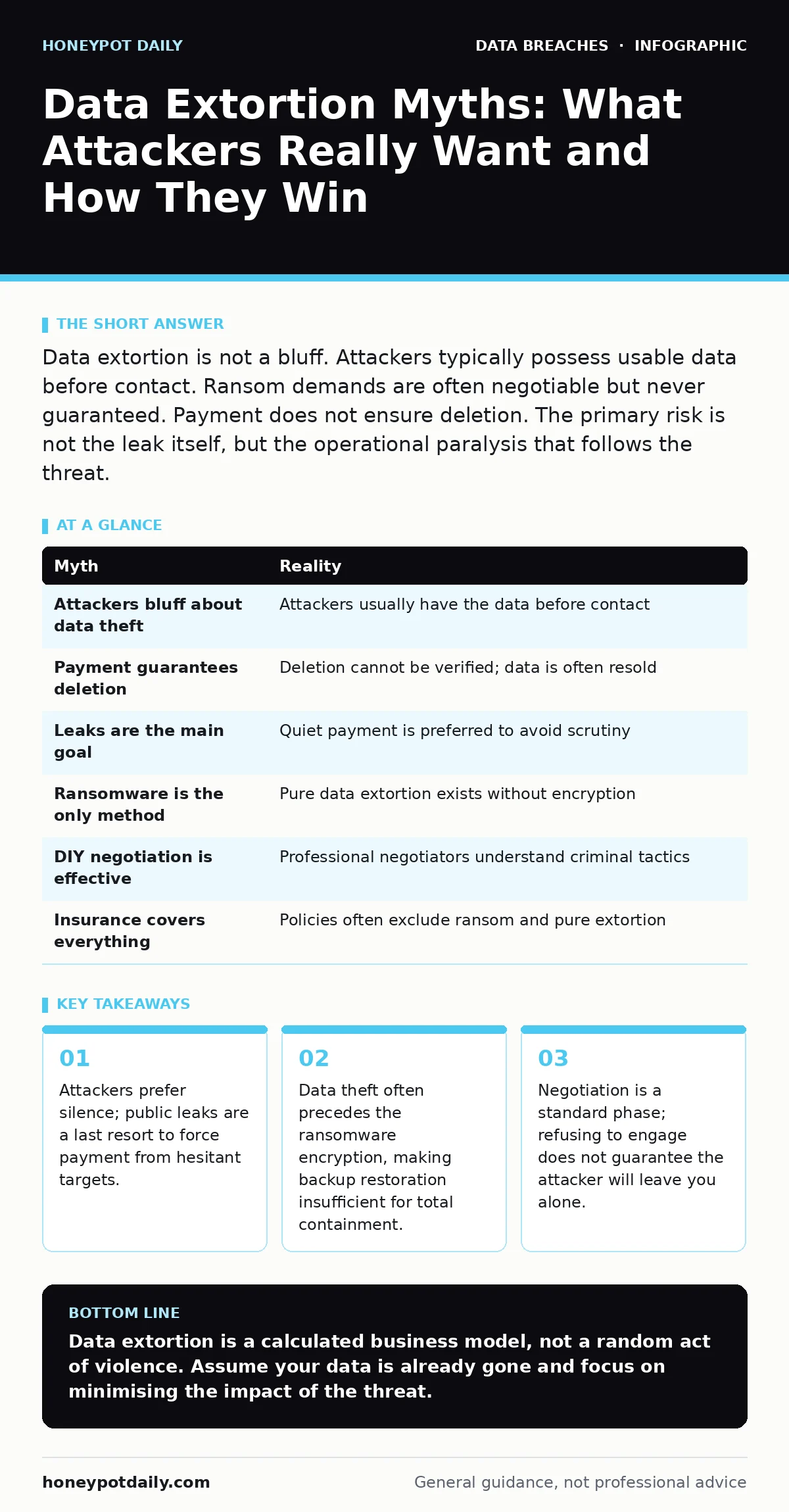
Data extortion is not a bluff. Attackers typically possess usable data before contact. Ransom demands are often negotiable but never guaranteed. Payment does not ensure deletion. The primary risk is not the leak itself, but the operational paralysis that follows the threat.
Myth: The attacker is bluffing about the stolen data
Reality: Attackers almost always possess the data they claim to have stolen. The threat of publication is rarely an empty gesture. Before deploying ransomware or issuing a demand, threat actors typically exfiltrate sensitive files to a remote server. This process, known as double extortion, ensures they have leverage even if you restore your systems from backups.
You cannot assume the data is still on your internal networks. By the time you see the ransom note, the data has likely left your environment. The attacker uses this external copy as insurance against your refusal to pay. They know you cannot easily verify what they have, but they know you cannot afford to assume they are lying.
Myth: Paying the ransom ensures the data is deleted
Reality: There is no technical mechanism to verify that an attacker has destroyed the stolen data. Once the files leave your control, you lose the ability to audit their handling. Attackers often sell the same dataset to multiple buyers on underground markets. Even if the primary contact deletes the files, copies may already reside on other servers or with secondary criminals.
Payment buys silence, not deletion. The attacker may promise to wipe the data, but this promise holds no legal or technical weight. You are paying for their word, which has no enforcement mechanism. In many cases, the data appears on leak sites months after payment, proving the initial destruction claim was false.
Myth: Public leaks are the attacker’s primary goal
Reality: Attackers prefer quiet payments because public leaks attract law enforcement attention and damage their reputation among other criminals. A high-profile leak can lead to sanctions, loss of access to financial clearing services, and increased scrutiny from security researchers. They want to be seen as professional and reliable, not as reckless vandals.
The leak is a pressure tactic, not the end state. They want you to pay so they can close the file and move on. If you refuse, they may leak a small sample to prove capability, but they rarely dump entire databases unless they have exhausted all other options. The goal is profit with minimal risk.
Myth: Ransomware is the only form of data extortion
Reality: Data extortion often occurs without any system encryption. Attackers may simply steal data and threaten to release it, a tactic known as pure data extortion. This method is less disruptive to your operations, making it harder to detect until the demand arrives. It avoids the immediate operational crisis of ransomware, allowing them to work in the shadows longer.
This approach targets organisations that are highly sensitive to reputation but have robust IT resilience. If you have strong backups and incident response plans, ransomware fails. Pure data extortion bypasses those defences entirely. You must treat data theft as a standalone threat, not just a precursor to encryption.
Myth: You can negotiate effectively without professional help
Reality: Negotiation is a specialised skill that requires understanding criminal psychology, language barriers, and market rates. Untrained staff often make emotional decisions or reveal too much about their financial situation. Attackers are experienced in dragging out negotiations to increase the demand. They will feign frustration or threaten immediate leaks to trigger panic.
Professional negotiators can identify when an attacker is bluffing and when they are serious. They know the standard pricing models used in the underground economy. Attempting to negotiate alone often leads to higher payments or worse outcomes. The attacker sees you as inexperienced and exploits that uncertainty.
See also: How security operations centers detect and respond to threats · Whaling Attack Response: Containment, Recovery and Prevention Steps
Myth: Insurance covers all losses from data extortion
Reality: Cyber insurance policies vary widely and often exclude specific scenarios. Many policies do not cover the cost of the ransom itself due to legal restrictions in certain jurisdictions. Others exclude losses from pure data extortion if no ransomware was involved. You must read the exclusions carefully, not just the coverage limits.
Insurance may cover notification costs, legal fees, and crisis management. It rarely covers the ransom payment or the long-term reputational damage. Some policies require you to report the incident within a strict timeframe. Missing these deadlines can void the claim. Do not assume your policy is a catch-all solution.
| Myth | Reality |
|---|---|
| Attackers bluff about data theft | Attackers usually have the data before contact |
| Payment guarantees deletion | Deletion cannot be verified; data is often resold |
| Leaks are the main goal | Quiet payment is preferred to avoid scrutiny |
| Ransomware is the only method | Pure data extortion exists without encryption |
| DIY negotiation is effective | Professional negotiators understand criminal tactics |
| Insurance covers everything | Policies often exclude ransom and pure extortion |
Key takeaways
- Attackers prefer silence; public leaks are a last resort to force payment from hesitant targets.
- Data theft often precedes the ransomware encryption, making backup restoration insufficient for total containment.
- Negotiation is a standard phase; refusing to engage does not guarantee the attacker will leave you alone.
Data extortion is a calculated business model, not a random act of violence. Assume your data is already gone and focus on minimising the impact of the threat.
Frequently asked questions
Should I ever pay a ransom demand?
Paying is generally discouraged as it fuels the criminal ecosystem and offers no guarantee of data deletion. Consult legal and law enforcement before considering any payment.
How do I know if my data was actually stolen?
You often cannot know for sure. Assume theft occurred if you see signs of advanced persistent threat activity or unexplained data transfers. Conduct a forensic investigation to assess the scope.
Does full disk encryption prevent data extortion?
Full disk encryption protects data at rest but not data in transit or in memory. If an attacker accesses your live systems, they can exfiltrate decrypted data. See our guide on full disk encryption for more details.
Can I stop pure data extortion?
You cannot stop the theft if the attacker has access, but you can limit the damage. Implement strict access controls, monitor for unusual data transfers, and maintain a robust data inventory and mapping strategy to know what you have.
How this guide was produced: written by the Honeypot Daily editorial team with AI assistance, checked against the public references listed below, and reviewed when the facts change. See our editorial policy or report an error.