
What Does Personally Identifiable Information Mean and How to Protect It
Personal data loses its protected status when combined with innocuous fragments, turning routine logs into high-value targets for identity fraud.
Personally identifiable information refers to any data that can identify a specific individual, either alone or when combined with other details. This includes names, addresses, and digital identifiers. Understanding the scope prevents accidental exposure through seemingly harmless records.
The Core Definition of Personally Identifiable Information
Imagine a library card. Alone, the number is meaningless. Add your name, and it identifies you. Personally identifiable information operates on this principle of linkage. It is any data point that allows an attacker to distinguish you from everyone else. This definition covers direct identifiers, such as your full name or national insurance number.
It also covers indirect identifiers, like your zip code combined with your birth date. The combination creates a unique profile. Security teams often focus only on the direct identifiers. This creates blind spots where indirect data leaks cause significant harm. The definition is not static. It expands as technology allows more data points to be cross-referenced.
How Identification Mechanisms Work in Practice
Identification works through correlation. An attacker does not need your passport photo. They need enough fragments to reconstruct your identity. This process relies on data aggregation. Social media profiles provide hobbies. Public records provide addresses. Browser cookies provide location history. When these separate streams merge, they form a complete picture.
This is why data minimisation is effective. If you hold fewer fragments, you cannot build the profile. The mechanism fails when organisations hoard data "just in case". This hoarding creates a target rich environment for attackers. They do not need to break into a secure vault. They often find the pieces scattered across public-facing systems.
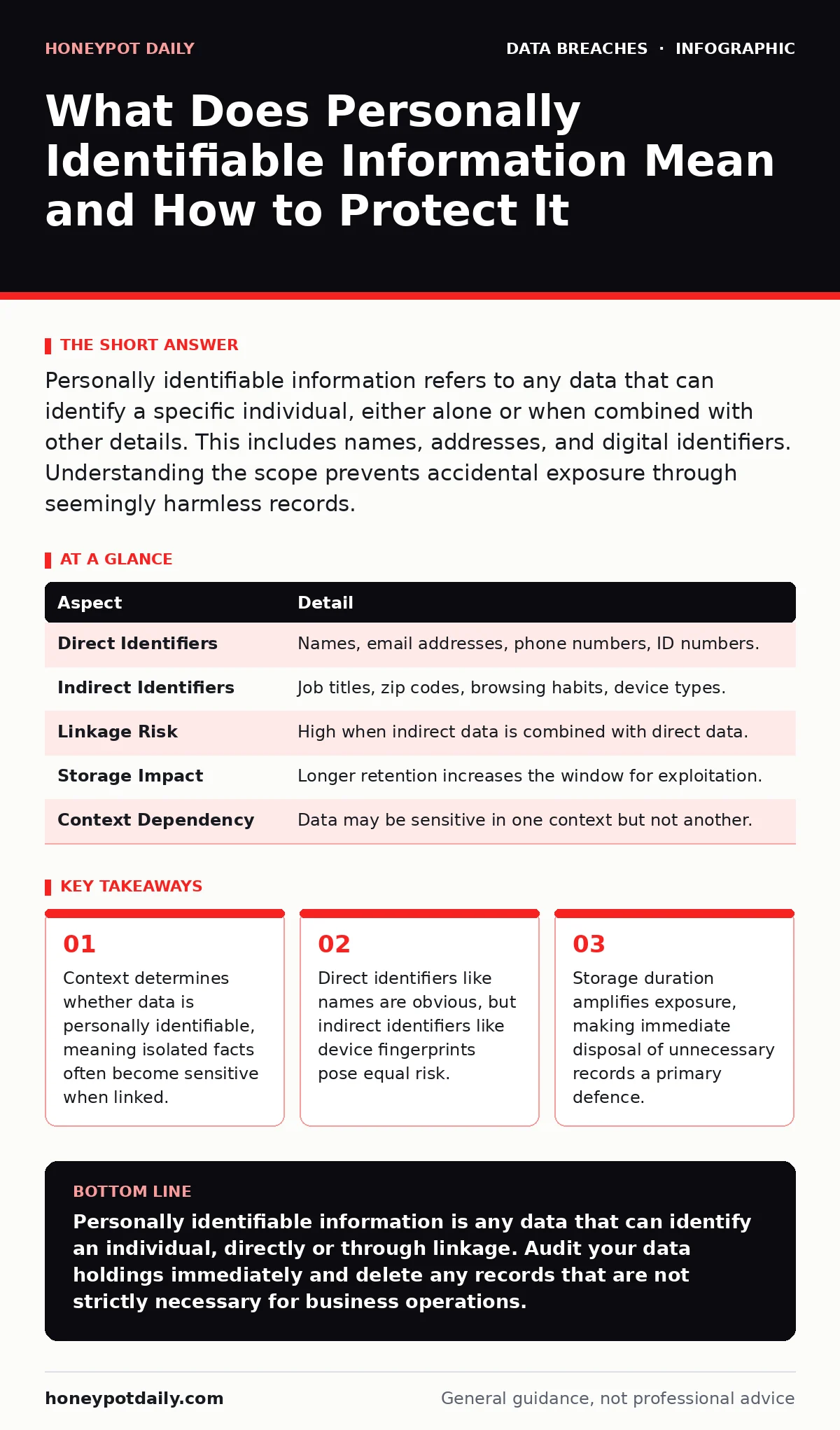
| Aspect | Detail |
|---|---|
| Direct Identifiers | Names, email addresses, phone numbers, ID numbers. |
| Indirect Identifiers | Job titles, zip codes, browsing habits, device types. |
| Linkage Risk | High when indirect data is combined with direct data. |
| Storage Impact | Longer retention increases the window for exploitation. |
| Context Dependency | Data may be sensitive in one context but not another. |
Who Is Affected by Data Exposure
Every individual is affected by the erosion of privacy. However, the impact varies by volume and sensitivity. High-profile individuals face targeted social engineering. Ordinary citizens face mass-scale identity theft. Organisations face regulatory fines and reputational damage. The ripple effect extends to employees. Their personal details often reside in the same databases as corporate secrets.
A breach of one is a breach of the other. This interconnection means that protecting corporate data is also protecting staff. Neglecting this link leaves both the company and its people vulnerable. The cost of remediation falls on the individual in terms of time and stress. Financial loss is secondary to the long-term identity damage.
Common Misconceptions About Data Sensitivity
Many believe that removing a name makes data safe. This is a dangerous assumption. Re-identification attacks use statistical models to match anonymous data back to individuals. For example, a dataset of hospital visits might lack names. If it includes dates and diagnoses, it can often be traced. Another mistake is assuming that internal data is secure. Insider threats and misconfigured cloud storage expose internal records. The belief that encryption equals safety is also flawed. Encryption protects data at rest. It does not protect data in use or in transit if keys are compromised. These misconceptions lead to weak controls. Teams must view all data as potentially identifiable.
The Hidden Costs of Data Retention
Keeping data longer than necessary is a hidden liability. Every record stored is a potential entry point for attackers. The cost of storage is low. The cost of a breach is high. This asymmetry drives poor decisions. Organisations often keep data for legal compliance. They rarely review if it is still needed. This creates legacy archives that are poorly secured. Attacker tools automate the discovery of these archives. They scan for exposed databases and misconfigured permissions. The result is a steady stream of leaked records. Reducing retention periods cuts this attack surface. It also simplifies compliance audits. Less data means fewer things to protect.
See also: How Child Identity Theft Works: The Silent Build-Up
Practical Steps for Mitigation
Mitigation starts with classification. You must know what you hold before you can protect it. Map your data flows. Identify where personally identifiable information enters, moves, and exits. Apply least privilege access. Only those who need the data should see it. Implement strict retention policies. Delete data that is no longer required. Use tokenization to replace sensitive values with non-sensitive equivalents. This breaks the link between the data and the individual. Regular audits ensure compliance. Automated tools can detect sensitive data in unexpected places. These steps reduce the volume of exposed data. They also limit the damage if a breach occurs.
Understanding Related Threat Vectors
Data breaches often lead to secondary attacks. Stolen personally identifiable information fuels SIM swap fraud. Attackers use the data to impersonate victims to mobile carriers. They take control of phone numbers to bypass two-factor authentication. This links data theft directly to account takeover. Similarly, leaked payment details lead to payment card theft. The initial breach provides the raw material. The subsequent fraud causes the financial loss. Monitoring for these signs is critical. Dark web monitoring can alert you to leaked credentials. This allows for early intervention before damage spreads. Understanding these connections helps prioritise defence efforts.
The Role of Technical Controls
Technical controls enforce policy. Full disk encryption protects data on lost devices. It ensures that the physical hardware does not become a data leak. Password rotation is less effective than strong, unique passwords. Frequent changes encourage weak patterns. Focus on password strength and multi-factor authentication instead. These measures prevent initial access. Once inside, attackers look for data repositories. Network segmentation limits lateral movement. It stops attackers from moving from a compromised server to the database. Logging and monitoring detect unusual access patterns. These controls work together to create layers of defence. No single control is sufficient.
| Control Type | Purpose | Limitation |
|---|---|---|
| Encryption | Protects data at rest and in transit. | Does not protect data in use. |
| Tokenization | Replaces sensitive data with tokens. | Requires key management. |
| Access Control | Limits who can view data. | Can be bypassed by insider threats. |
| Monitoring | Detects unusual activity. | Generates false positives. |
Addressing the Search Intent Directly
When you ask what does personally identifiable information mean, you are seeking clarity on scope. The answer is simple but broad. It is any data that identifies you. This includes obvious details and hidden links. The definition matters because it dictates legal obligations. It also dictates security priorities. If you understand what counts as personally identifiable information, you can protect it better. Ignorance leads to accidental exposure. Knowledge leads to intentional design. Design your systems to minimise the collection of this data. Protect what you must keep. Delete what you do not need. This approach reduces risk significantly.
Key takeaways
- Context determines whether data is personally identifiable, meaning isolated facts often become sensitive when linked.
- Direct identifiers like names are obvious, but indirect identifiers like device fingerprints pose equal risk.
- Storage duration amplifies exposure, making immediate disposal of unnecessary records a primary defence.
Personally identifiable information is any data that can identify an individual, directly or through linkage. Audit your data holdings immediately and delete any records that are not strictly necessary for business operations.
Frequently asked questions
Is an email address considered personally identifiable information?
Yes, an email address is a direct identifier. It links directly to a specific individual and is often used as a username for accounts.
Does removing a name make a dataset anonymous?
No, removing names is rarely sufficient. Other data points like location, age, and behaviour can often be combined to re-identify individuals.
How long should I keep personally identifiable information?
Keep it only as long as legally required or operationally necessary. Most data should be deleted or anonymised within a few years.
What is the difference between personally identifiable information and sensitive data?
Personally identifiable information identifies a person. Sensitive data includes health or financial details, which require higher protection levels.
How this guide was produced: written by the Honeypot Daily editorial team with AI assistance, checked against the public references listed below, and reviewed when the facts change. See our editorial policy or report an error.