
How security operations centers detect and respond to threats
Security operations centers filter noise by correlating event logs before human analysts ever review a single alert.
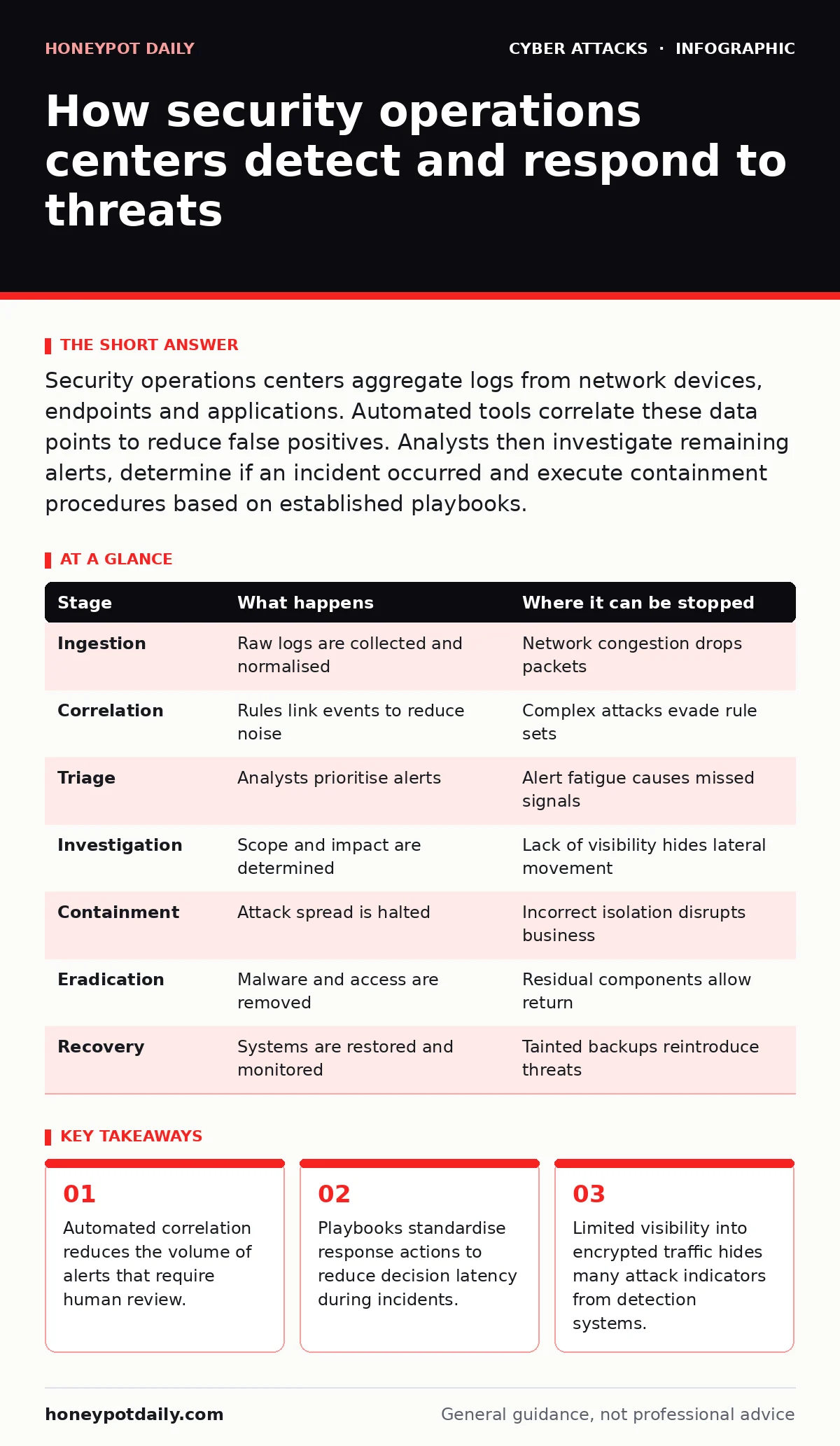
Security operations centers aggregate logs from network devices, endpoints and applications. Automated tools correlate these data points to reduce false positives. Analysts then investigate remaining alerts, determine if an incident occurred and execute containment procedures based on established playbooks.
Data ingestion and normalisation
A security operations center begins by collecting raw telemetry from across the organisation. This data includes firewall logs, endpoint detection records, identity provider events and network flow data. The ingestion process normalises these disparate formats into a common schema. Without normalisation, the system cannot correlate an IP address in a firewall log with a user login in an identity system.
The sheer volume of data creates a processing bottleneck. Systems must parse and index every event before analysis begins. If the ingestion pipeline drops packets during peak traffic, the centre loses visibility into critical moments. You must configure retention policies carefully. Storing too little data prevents historical trend analysis. Storing too much increases storage costs and slows down search queries.
Automated correlation and filtering
Raw logs are useless without context. The security operations platform applies correlation rules to link related events. For example, a failed login followed by a successful login from a new geographic location triggers a specific alert. These rules replace manual log review with automated pattern matching.
This stage eliminates most false positives. A single failed login is noise. Five failed logins from the same source in ten seconds indicate a brute-force attempt. The system aggregates these events into a single, high-priority alert. This reduces the cognitive load on analysts. However, complex multi-stage attacks often evade simple correlation rules. Advanced adversaries mimic normal user behaviour to stay below detection thresholds.
Triage and prioritisation
Analysts review the filtered alerts. They determine whether an alert represents a genuine threat, a false positive or a benign anomaly. Triage relies on context. An alert from a known vulnerable server is higher priority than one from a patched workstation. Analysts use threat intelligence feeds to check if the source IP is associated with known malicious activity.
Prioritisation prevents alert fatigue. If every alert receives equal attention, analysts miss critical incidents buried in routine noise. You must define clear criteria for escalation. A critical alert requires immediate action. A low-priority alert may be queued for batch processing. This hierarchy ensures that resources focus on the highest risk events first.
Investigation and containment
Once a threat is confirmed, analysts investigate the scope. They identify the affected systems, the data at risk and the attacker’s techniques. This phase involves deep-dive analysis of logs and memory dumps. Analysts look for lateral movement indicators, such as unusual internal network connections or privilege escalation events.
Containment stops the attack from spreading. This may involve isolating infected hosts from the network, disabling compromised user accounts or blocking malicious IP addresses. Speed matters here. Every minute of delay allows the attacker to exfiltrate more data or establish persistence. You must balance speed with accuracy. Isolating a critical server without verification can cause business disruption.
Eradication and recovery
Containment is temporary. Eradication removes the attacker’s presence completely. This involves deleting malicious files, removing backdoors and patching the vulnerabilities used for initial access. You must verify that no residual components remain. Hidden processes or scheduled tasks can allow the attacker to return.
Recovery restores systems to normal operation. This includes restoring data from clean backups and validating system integrity. You must monitor recovered systems closely for signs of re-infection. The attack may have compromised backup systems as well. Restoring from a tainted backup reintroduces the threat.
See also: Blue Team Operations: Definition, Purpose and Core Mechanics · Alert Triage Mechanics: How Security Teams Filter Noise
Post-incident analysis and improvement
The incident is not over until you have learned from it. Post-incident reviews analyse what happened, why it happened and how the response performed. These reviews identify gaps in detection and response capabilities. You update correlation rules, playbooks and training based on these findings.
Continuous improvement strengthens the security posture. Each incident reveals new attack vectors or weaknesses in existing controls. You must integrate these lessons into your daily operations. This cycle of detection, response and improvement creates a more resilient defence over time.
| Stage | What happens | Where it can be stopped |
|---|---|---|
| Ingestion | Raw logs are collected and normalised | Network congestion drops packets |
| Correlation | Rules link events to reduce noise | Complex attacks evade rule sets |
| Triage | Analysts prioritise alerts | Alert fatigue causes missed signals |
| Investigation | Scope and impact are determined | Lack of visibility hides lateral movement |
| Containment | Attack spread is halted | Incorrect isolation disrupts business |
| Eradication | Malware and access are removed | Residual components allow return |
| Recovery | Systems are restored and monitored | Tainted backups reintroduce threats |
| Analysis | Lessons are learned and applied | Findings are not implemented |
Integration with identity controls
Security operations centers cannot protect accounts in isolation. They rely on identity systems to enforce access controls. When an analyst detects suspicious activity, they may disable an account. This action triggers account lockout policies. These policies prevent further access attempts from the compromised credentials.
However, aggressive lockout policies can be abused. Attackers may intentionally trigger lockouts to deny legitimate users access. This becomes a form of denial-of-service attack. You must configure lockout thresholds carefully. Balance security with usability. Too many lockouts frustrate users and increase helpdesk volume.
Visibility limits in encrypted environments
Most modern traffic is encrypted. This protects user privacy but hides content from inspection. Security operations centers can see metadata, such as source and destination addresses, but not the payload. This limits the ability to detect malicious commands or data exfiltration within encrypted streams.
You can inspect encrypted traffic using TLS termination. This decrypts traffic for analysis before re-encrypting it. However, this approach raises privacy and legal concerns. It also adds computational overhead. Many organisations choose not to inspect all traffic, leaving blind spots. Understanding these limits is vital for realistic risk assessment.
Related topics include attacks on data centers, which face unique physical and virtualisation challenges. DDoS protection strategies often complement security operations center monitoring by filtering volumetric attacks at the network edge. Understanding the mechanics of watering hole attacks helps analysts recognise patterns of compromise in user traffic.
Key takeaways
- Automated correlation reduces the volume of alerts that require human review.
- Playbooks standardise response actions to reduce decision latency during incidents.
- Limited visibility into encrypted traffic hides many attack indicators from detection systems.
Frequently asked questions
How long does it take to detect a breach?
Detection time varies widely based on complexity and visibility. Simple attacks may be detected in minutes. Advanced persistent threats can remain hidden for months.
What is the difference between a SOC and a SIEM?
A SIEM is a tool that collects and analyses logs. A SOC is a team of people that uses tools like SIEM to monitor and respond to threats.
Can a small business afford a security operations center?
Small businesses often use managed security service providers. These providers offer SOC capabilities on a subscription basis, sharing resources across multiple clients.
How this guide was produced: written by the Honeypot Daily editorial team with AI assistance, checked against the public references listed below, and reviewed when the facts change. See our editorial policy or report an error.