
How Data Center Attacks Work: Step-by-Step Breakdown
Most data centre compromises begin with a single misconfigured external endpoint rather than a direct assault on the core infrastructure.
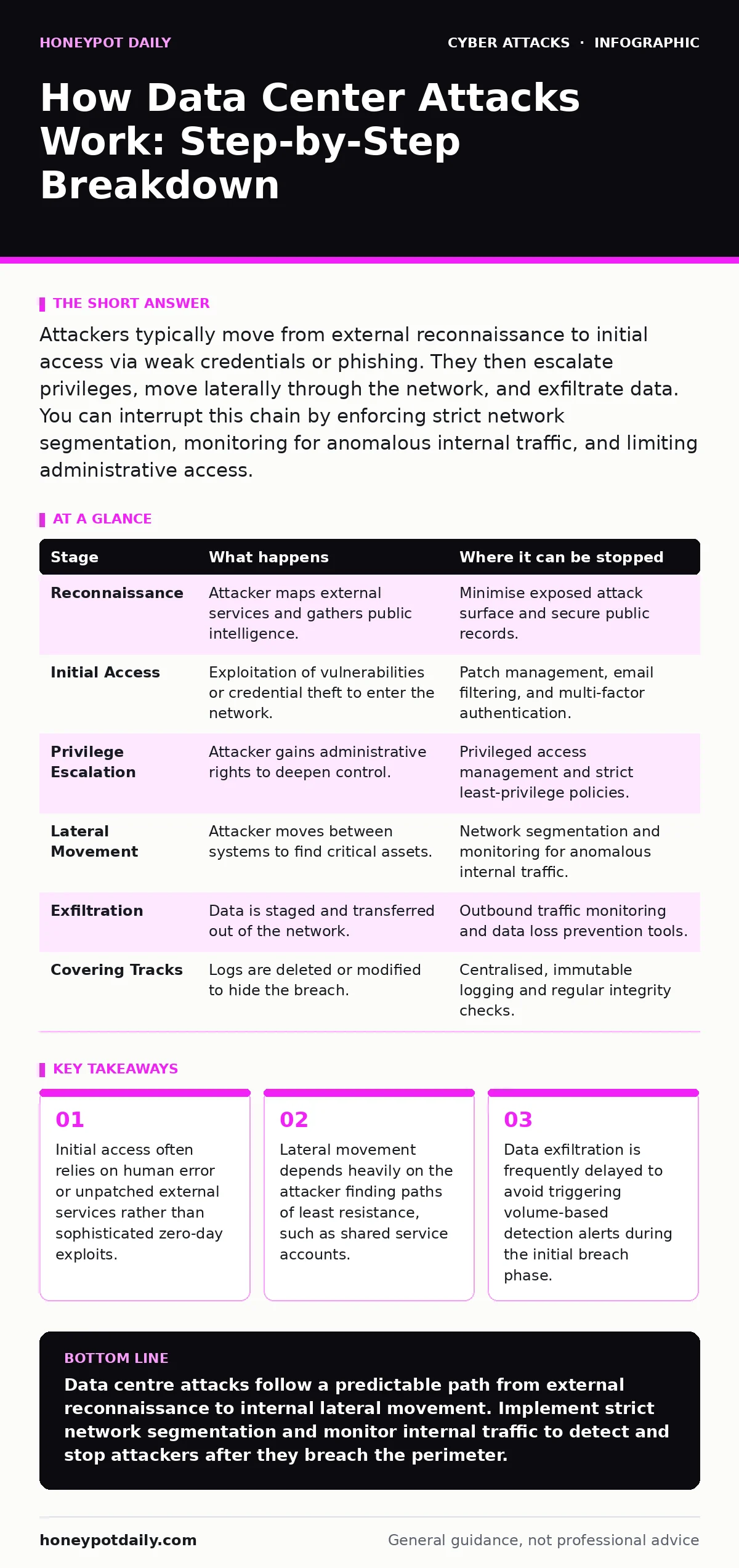
Attackers typically move from external reconnaissance to initial access via weak credentials or phishing. They then escalate privileges, move laterally through the network, and exfiltrate data. You can interrupt this chain by enforcing strict network segmentation, monitoring for anomalous internal traffic, and limiting administrative access.
Reconnaissance and Target Selection
Attackers begin by mapping the external attack surface of the data centre. They scan for exposed management interfaces, outdated software versions, and misconfigured cloud storage buckets. This phase relies on the fact that many organisations expose more services to the internet than necessary. Publicly available information, such as employee directories or code repositories, helps attackers identify potential entry points.
The attacker looks for low-hanging fruit. They may search for subdomains that lack proper security headers or for SSL certificates that reveal internal network structures. This passive intelligence gathering costs nothing and reveals the digital footprint of the target. You can disrupt this stage by minimising your external attack surface. Regular audits of exposed ports and services reduce the information available to an adversary.
Initial Access and Entry
Once a viable entry point is identified, the attacker attempts to gain access. This often involves password spraying, where a few common passwords are tested against many accounts to avoid lockouts. Alternatively, they might exploit a vulnerability in a web application or use baiting attacks to trick an employee into executing malicious code. The goal is to obtain a foothold within the perimeter network.
Imagine a scenario where an attacker discovers an unpatched remote desktop gateway. They exploit this flaw to gain initial access to a non-critical server. From here, they have limited rights but are inside the trusted network. The success of this stage depends on the speed of patching and the effectiveness of email filtering. Implementing multi-factor authentication significantly raises the bar for credential-based entry methods.
Privilege Escalation and Persistence
With initial access secured, the attacker seeks higher privileges to move deeper into the system. They exploit misconfigurations in operating systems or applications to elevate their rights from a standard user to an administrator. This step is critical because administrative access allows them to install persistent backdoors. These backdoors ensure they can return even if the initial entry point is patched.
The attacker might use legitimate system tools to perform these tasks, a technique known as living off the land. This makes detection difficult because the tools are expected to be running. Privileged access management solutions can mitigate this risk by restricting administrative rights to specific time windows and requiring justification for each action. Without strict controls, a single low-level compromise can escalate to full domain control.
Lateral Movement and Network Mapping
Now inside with elevated privileges, the attacker maps the internal network. They identify critical assets such as domain controllers, database servers, and backup systems. Using stolen credentials or exploiting trust relationships, they move from one machine to another. This lateral movement expands their control and allows them to bypass perimeter defences.
They often use legitimate protocols like SMB or RDP to transfer files and execute commands. Because these protocols are necessary for daily operations, blocking them entirely is not feasible. Instead, you must monitor for unusual patterns. A server initiating connections to multiple other servers simultaneously is a strong indicator of lateral movement. Network segmentation limits the blast radius by isolating critical systems from the general corporate network.
Data Staging and Exfiltration
The attacker identifies the data they want and copies it to a staging area. This might be a temporary directory on a compromised server or an external cloud storage account. Staging allows them to compress and encrypt the data before leaving the network. This step reduces the volume of traffic and hides the content from casual inspection.
Exfiltration often occurs over slow, steady streams to avoid detection. Attackers may use DNS tunneling or encrypted HTTPS connections to blend in with normal traffic. DDoS protection systems are generally ineffective here because the traffic volume is low and legitimate-looking. The key is to monitor outbound data flows for anomalies. Unexpected large transfers to unknown external IP addresses should trigger immediate investigation.
Covering Tracks and Maintenance
Finally, the attacker attempts to hide their presence. They delete log files, modify timestamps, and disable security monitoring tools. This makes forensic analysis difficult and extends the duration of their access. Some attackers maintain long-term access to monitor the environment for new opportunities or to sell access to other threat actors.
Imagine an attacker who modifies the system logs to remove evidence of their privilege escalation. This action requires high-level permissions and indicates a sophisticated operation. Regular log aggregation to a secure, write-once storage system prevents tampering. You cannot rely on local logs alone. Centralised logging ensures that even if a server is compromised, the evidence of the attack remains intact for analysis.
| Stage | What happens | Where it can be stopped |
|---|---|---|
| Reconnaissance | Attacker maps external services and gathers public intelligence. | Minimise exposed attack surface and secure public records. |
| Initial Access | Exploitation of vulnerabilities or credential theft to enter the network. | Patch management, email filtering, and multi-factor authentication. |
| Privilege Escalation | Attacker gains administrative rights to deepen control. | Privileged access management and strict least-privilege policies. |
| Lateral Movement | Attacker moves between systems to find critical assets. | Network segmentation and monitoring for anomalous internal traffic. |
| Exfiltration | Data is staged and transferred out of the network. | Outbound traffic monitoring and data loss prevention tools. |
| Covering Tracks | Logs are deleted or modified to hide the breach. | Centralised, immutable logging and regular integrity checks. |
The Hidden Cost of Trust
Many data centre architectures rely on implicit trust between internal systems. A server in the web tier is often trusted to communicate with the database tier without verification. Attackers exploit this trust by compromising a less secure system and using it as a springboard to more critical assets. This architectural flaw is harder to fix than a simple software bug because it requires rethinking network design.
You must implement zero-trust principles. Every request, whether from inside or outside the network, should be verified. This includes verifying the identity of the user, the device, and the application making the request. While this adds complexity, it significantly reduces the risk of lateral movement. The cost of implementation is outweighed by the reduction in potential breach impact.
Integrating Related Defences
Understanding how these attacks work allows you to integrate specific defensive measures more effectively. For instance, protecting email systems against browser-in-the-browser attacks prevents attackers from stealing session cookies that could lead to initial access. Similarly, ensuring that DKIM is correctly configured helps prevent email spoofing, which is often used in the reconnaissance and initial access phases.
Password managers reduce the risk of credential reuse, making password spraying less effective. However, they do not protect against session hijacking if an attacker steals an active session token. Therefore, shortening session lifetimes and monitoring for impossible travel scenarios are necessary complementary measures. Each defence addresses a specific stage of the attack chain, and together they create a layered security posture.
Key takeaways
- Initial access often relies on human error or unpatched external services rather than sophisticated zero-day exploits.
- Lateral movement depends heavily on the attacker finding paths of least resistance, such as shared service accounts.
- Data exfiltration is frequently delayed to avoid triggering volume-based detection alerts during the initial breach phase.
Data centre attacks follow a predictable path from external reconnaissance to internal lateral movement. Implement strict network segmentation and monitor internal traffic to detect and stop attackers after they breach the perimeter.
Frequently asked questions
Can a data centre be completely secure from external attacks?
No system is immune to all attacks. The goal is to make the cost and effort of a breach higher than the potential reward for the attacker.
How long does it take for an attacker to move laterally within a data centre?
The time varies widely depending on network complexity and security controls. Some attackers move in minutes, while others take weeks to map the environment.
Is encryption enough to protect data during exfiltration?
Encryption protects data at rest and in transit, but it does not prevent an authorised user or attacker from copying the data. Access controls are equally important.
What is the most common initial access vector for data centres?
Compromised credentials remain the most common vector. This includes stolen passwords, reused credentials, and weak multi-factor authentication implementations.
How this guide was produced: written by the Honeypot Daily editorial team with AI assistance, checked against the public references listed below, and reviewed when the facts change. See our editorial policy or report an error.