CSPM vs CWPP: Distinguishing Configuration from Workload Protection
CSPM audits static policy compliance while CWPP enforces runtime security controls, meaning one prevents misconfiguration and the other stops exploitation.
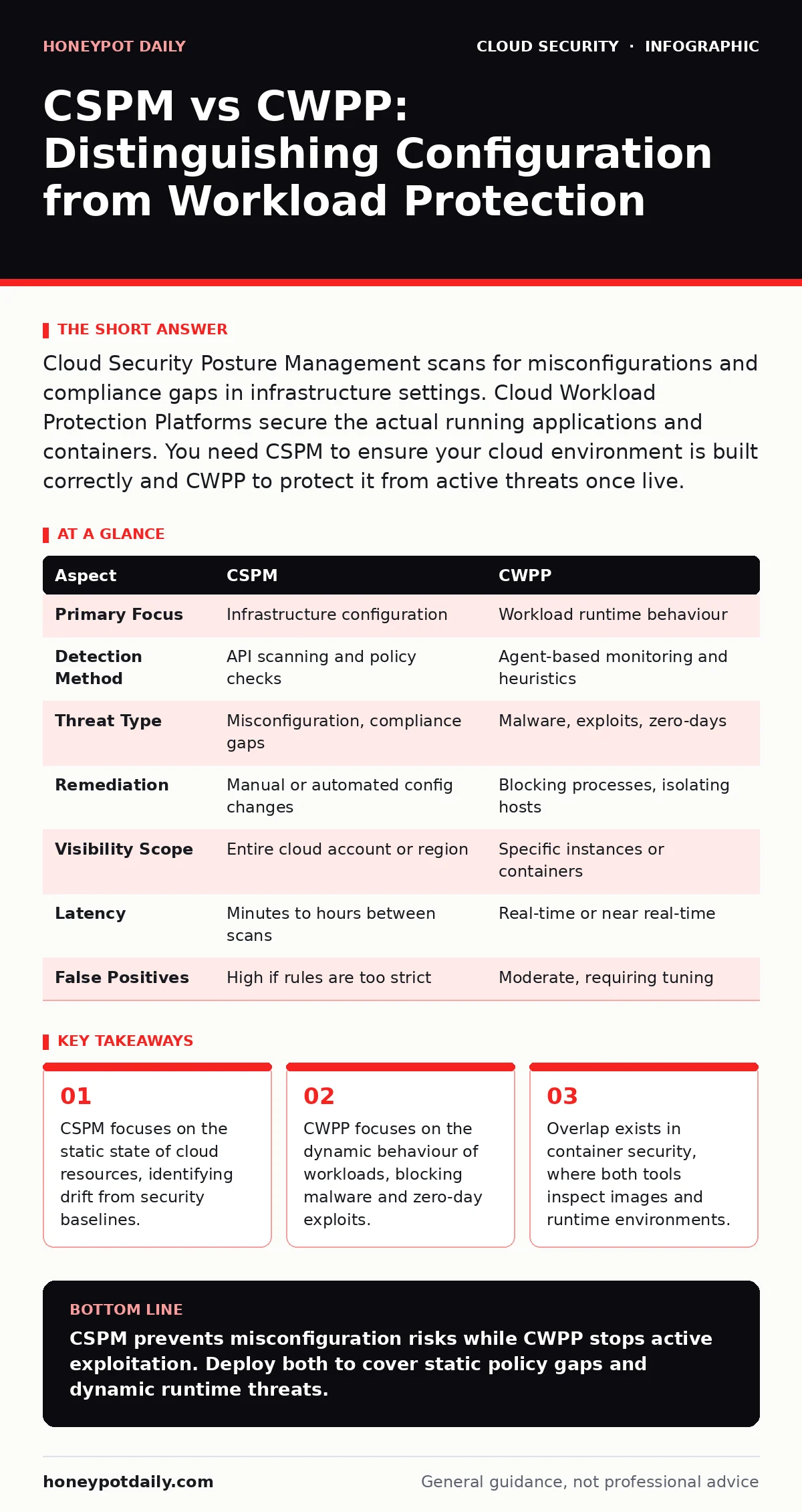
Cloud Security Posture Management scans for misconfigurations and compliance gaps in infrastructure settings. Cloud Workload Protection Platforms secure the actual running applications and containers. You need CSPM to ensure your cloud environment is built correctly and CWPP to protect it from active threats once live.
The Fundamental Distinction
The core difference lies in what is being observed. CSPM examines the infrastructure configuration, checking whether storage buckets are public or whether logging is disabled. CWPP examines the workload itself, monitoring processes, memory, and network calls for malicious activity. One looks at the house structure; the other looks at the people inside.
Imagine you build a secure house with locked doors. CSPM verifies that the locks are installed correctly. CWPP watches for someone picking the lock or hiding in the attic. If you only have CSPM, you know the locks are good, but you do not know if an intruder has already entered. If you only have CWPP, you might detect an intruder, but you will not know that the back door was left open due to a configuration error.
What CSPM Actually Does
CSPM tools connect to cloud provider APIs to read the state of every resource. They compare this state against a set of rules, often derived from frameworks like CIS Benchmarks or internal policy. The output is a list of findings, such as "this database is exposed to the internet" or "this user has excessive permissions".
The value of CSPM is in visibility and remediation guidance. It tells you what is wrong and how to fix it. However, it is a point-in-time assessment. If an attacker changes a setting after the scan, CSPM will not see it until the next cycle. It does not block attacks; it highlights risks that could lead to attacks.
What CWPP Actually Does
CWPP agents run inside the virtual machines, containers, or serverless functions. They monitor system calls, file integrity, and process execution. If a process tries to execute a known exploit or connect to a command-and-control server, the CWPP can block it. This is runtime protection, active and continuous.
CWPP protects against threats that bypass perimeter controls. Even if your network is perfectly configured, a compromised application can still be exploited. CWPP stops the exploitation from succeeding. It handles malware, ransomware, and lateral movement within the workload. The trade-off is performance overhead, as the agent must inspect every action.
Point-by-Point Comparison
| Aspect | CSPM | CWPP |
|---|---|---|
| Primary Focus | Infrastructure configuration | Workload runtime behaviour |
| Detection Method | API scanning and policy checks | Agent-based monitoring and heuristics |
| Threat Type | Misconfiguration, compliance gaps | Malware, exploits, zero-days |
| Remediation | Manual or automated config changes | Blocking processes, isolating hosts |
| Visibility Scope | Entire cloud account or region | Specific instances or containers |
| Latency | Minutes to hours between scans | Real-time or near real-time |
| False Positives | High if rules are too strict | Moderate, requiring tuning |
Where They Overlap
The boundary blurs around containers and serverless functions. CSPM can scan container images for vulnerabilities before they are deployed. CWPP can monitor the running container for anomalous behaviour. Both tools may report on the same resource, but from different angles.
Consider Kubernetes misconfigurations. CSPM identifies that a pod is running as root. CWPP detects that the root process is executing a suspicious binary. You need both to understand the full risk. Similarly, Kubernetes network policies are configured at the infrastructure level, checked by CSPM, but enforced at the runtime level, monitored by CWPP.
See also: Shift Left Security Meaning: Move Checks to Code Before Build · Difference Between Virtual Private Cloud and Private Cloud
Choosing the Right Tool
Choose CSPM when:
- You are building new cloud environments and need to enforce cloud guardrails.
- You must demonstrate compliance with regulatory standards.
- Your primary risk is human error in configuration.
- You need to audit permissions and access controls across multiple accounts.
- You are planning cloud migration security and need a baseline.
Choose CWPP when:
- You run critical applications that are frequent targets for attackers.
- You need protection against zero-day exploits and malware.
- Your workloads are dynamic, such as serverless functions or ephemeral containers.
- You suspect insider threats or compromised credentials.
- You want to prevent lateral movement within your infrastructure.
Integrating for Full Coverage
The most secure posture uses both tools in tandem. CSPM ensures the environment is secure by design. CWPP ensures it remains secure in operation. When CSPM detects a misconfiguration, it can trigger a remediation script. When CWPP detects an attack, it can alert the security team and provide context from the CSPM data.
This integration reduces noise. If CWPP alerts on a suspicious process, you can check the CSPM data to see if the host was properly configured. If it was, the alert is likely a true positive. If it was not, the issue may be a known risk. This context speeds up incident response and reduces fatigue.
Consider how private endpoints reduce the attack surface. CSPM verifies that public access is disabled. CWPP monitors the private traffic for anomalies. Similarly, denial-of-wallet attacks target serverless functions. CSPM ensures cost limits are set. CWPP detects abnormal execution patterns that signal abuse.
For hybrid cloud security, both tools must cover on-premises and cloud workloads. CSPM extends to virtual machines on-premises. CWPP agents run on physical servers. Consistency is key. Finally, single sign-on reduces credential risk. CSPM checks SSO configuration. CWPP monitors for token theft.
Key takeaways
- CSPM focuses on the static state of cloud resources, identifying drift from security baselines.
- CWPP focuses on the dynamic behaviour of workloads, blocking malware and zero-day exploits.
- Overlap exists in container security, where both tools inspect images and runtime environments.
CSPM prevents misconfiguration risks while CWPP stops active exploitation. Deploy both to cover static policy gaps and dynamic runtime threats.
Frequently asked questions
Can CSPM replace CWPP?
No, CSPM only checks configuration settings and cannot detect or block active malware or exploits running inside workloads.
Does CWPP fix misconfigurations?
No, CWPP focuses on runtime protection and does not audit or remediate infrastructure configuration errors like open ports or weak permissions.
Which tool is better for compliance?
CSPM is better for compliance as it maps directly to standards and frameworks, providing audit trails for configuration settings.
Do I need agents for CSPM?
Typically no, CSPM uses cloud provider APIs to scan resources, whereas CWPP usually requires agents installed on workloads for deep inspection.
How this guide was produced: written by the Honeypot Daily editorial team with AI assistance, checked against the public references listed below, and reviewed when the facts change. See our editorial policy or report an error.