Exposure Management: Define and Reduce Your Attack Surface
Most organisations defend assets they believe exist, leaving invisible cloud resources and shadow IT wide open to automated scanning and exploitation.
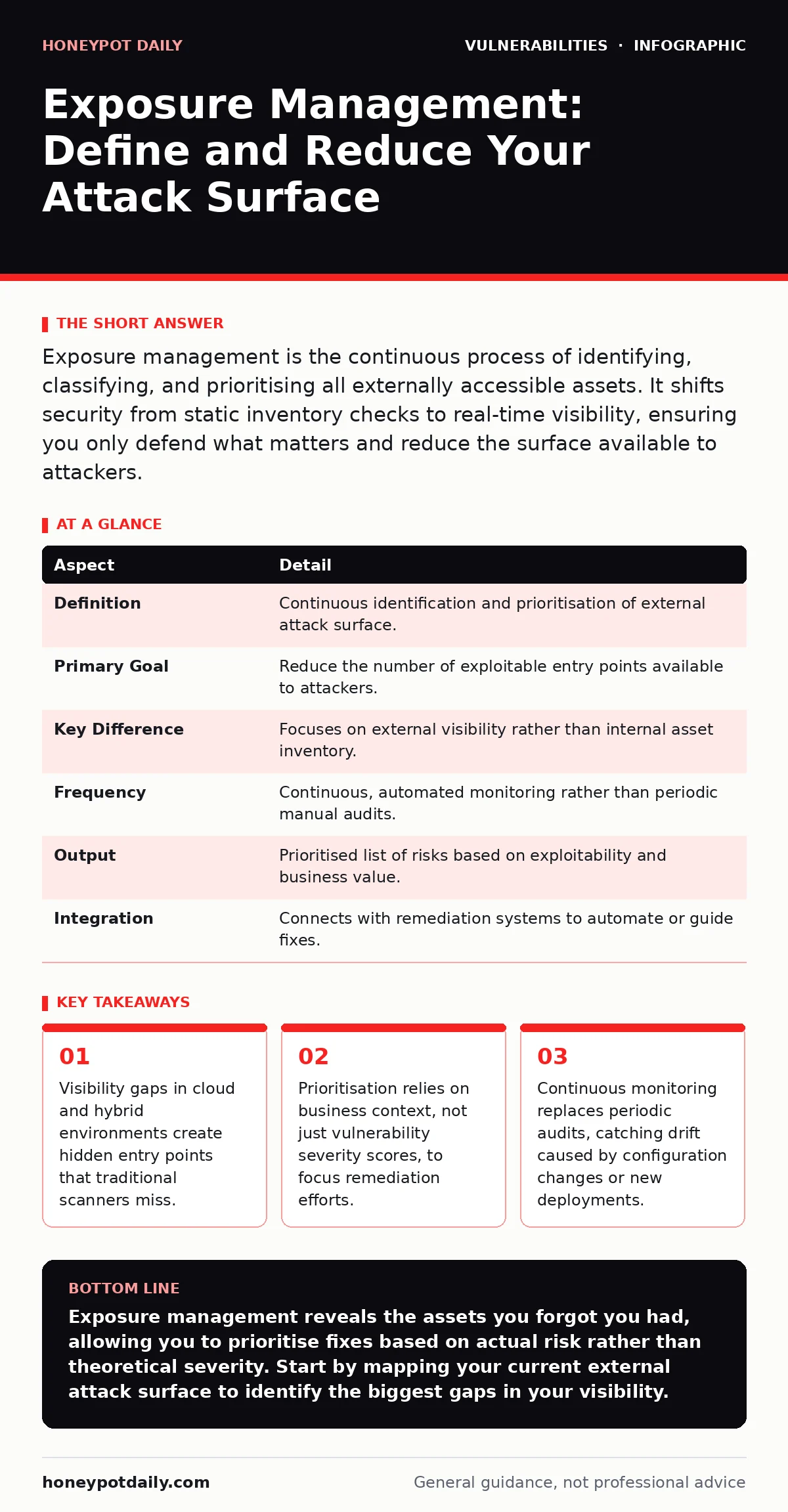
Exposure management is the continuous process of identifying, classifying, and prioritising all externally accessible assets. It shifts security from static inventory checks to real-time visibility, ensuring you only defend what matters and reduce the surface available to attackers.
The House With Invisible Doors
Imagine you own a large estate. You install high-quality locks on every door you know about. You check them weekly. You feel secure. However, the gardener built a shed last month. It has no lock. The window is open. An intruder does not need to pick your master lock; they simply walk through the shed.
This is the core failure of traditional security. You defend the perimeter you designed, not the perimeter that exists. Exposure management addresses this by mapping every entry point, known and unknown, and assessing its risk in real time.
| Aspect | Detail |
|---|---|
| Definition | Continuous identification and prioritisation of external attack surface. |
| Primary Goal | Reduce the number of exploitable entry points available to attackers. |
| Key Difference | Focuses on external visibility rather than internal asset inventory. |
| Frequency | Continuous, automated monitoring rather than periodic manual audits. |
| Output | Prioritised list of risks based on exploitability and business value. |
| Integration | Connects with remediation systems to automate or guide fixes. |
Why Traditional Defences Fall Short
Traditional vulnerability scanning assumes you know what you are protecting. You point a scanner at a list of IP addresses or domain names. The scanner checks for known weaknesses. If an asset is not on the list, the scanner ignores it.
This approach fails in dynamic environments. Cloud services spin up and down. Developers deploy new endpoints without notifying security teams. Third-party vendors gain temporary access. These changes create "shadow IT" assets that are fully exposed to the internet but invisible to your security tools.
Exposure management flips the model. Instead of asking "what do we own?", it asks "what can the internet see?". It scans the entire external surface from the attacker’s perspective. This ensures that even unauthorised or forgotten assets are identified and assessed.
The Three Pillars of Visibility
Effective exposure management rests on three interconnected pillars. Without all three, your view of the risk landscape remains fragmented.
First, asset discovery. This involves continuously scanning the internet for any resource associated with your organisation. This includes domain names, IP addresses, certificates, and open ports. It also identifies assets that may have been decommissioned but not properly removed from public DNS records.
Second, context enrichment. Finding an asset is not enough. You must understand what it is. Is it a critical database? A public-facing web server? A test environment? Context enrichment links discovered assets to internal data. It determines the business value and the sensitivity of the data stored or processed.
Third, risk prioritisation. Not all vulnerabilities are equal. A critical flaw on an internal printer poses less risk than a medium flaw on a public-facing authentication server. Prioritisation combines technical severity with business context. It tells you which issues to fix first based on actual exploitability and impact.
Prioritisation Over Severity Scores
Most security teams rely on Common Vulnerability Scoring System (CVSS) scores to prioritise fixes. These scores are generic. They describe the theoretical severity of a vulnerability in a vacuum. They do not account for your specific environment.
Exposure management introduces exploitability and business context. A vulnerability with a low CVSS score might be trivial to exploit if it is on a public-facing system with no authentication. Conversely, a high-score vulnerability on an isolated internal system may pose negligible immediate risk.
You must assess whether the vulnerability is actually reachable. Is it exposed to the internet? Is there a patch available? How easy is it to exploit? This practical assessment prevents teams from wasting time on low-impact issues while critical exposures remain open.
Integration With Other Defences
Exposure management does not replace existing security tools. It enhances them by providing better data. It fits into the broader security stack as a visibility and prioritisation layer.
It works closely with penetration testing. While pentests provide a deep, manual assessment of specific systems, exposure management provides continuous, broad visibility. Together, they offer both depth and breadth.
It informs mitigations and workarounds. When a zero-day vulnerability emerges, exposure management quickly identifies which assets are affected. This allows you to apply temporary controls, such as virtual patching, before a permanent fix is available.
It supports change management for security patches. By continuously monitoring for new assets and configurations, it detects when a patch has failed or when a new vulnerable component has been introduced. This ensures that remediation efforts remain effective.
Common Misconceptions
Many organisations misunderstand what exposure management actually does. These misconceptions lead to poor implementation and wasted resources.
One common error is treating it as a one-time project. Exposure is dynamic. Assets change daily. A single scan provides a snapshot that is outdated the moment it is taken. Continuous monitoring is required to maintain accurate visibility.
Another mistake is assuming it replaces vulnerability management. It does not. It complements it. Vulnerability management focuses on fixing known weaknesses in known assets. Exposure management focuses on finding unknown assets and prioritising risks across the entire external surface.
Some teams believe exposure management only applies to cloud environments. This is incorrect. On-premises assets, hybrid environments, and third-party integrations all contribute to the external attack surface. Every externally reachable component must be accounted for.
Operationalising the Process
To get value from exposure management, you must integrate it into your daily operations. It should not be a separate, siloed function.
Start by defining your external attack surface. What assets are acceptable to be public? What should never be exposed? This baseline helps you identify anomalies quickly.
Automate the workflow. When a new high-risk exposure is detected, automatically create a ticket in your incident management system. Assign it to the relevant team based on asset ownership. Track the remediation progress.
Review the data regularly. Look for trends. Are certain teams consistently deploying insecure configurations? Are specific cloud services more prone to misconfiguration? Use these insights to improve security policies and training.
Remember, the goal is not just to find problems. It is to reduce the overall risk posture. By continuously identifying and prioritising exposures, you stay ahead of attackers who rely on your blind spots.
Key takeaways
- Visibility gaps in cloud and hybrid environments create hidden entry points that traditional scanners miss.
- Prioritisation relies on business context, not just vulnerability severity scores, to focus remediation efforts.
- Continuous monitoring replaces periodic audits, catching drift caused by configuration changes or new deployments.
- Integration with remediation tools closes the loop between finding a risk and fixing it, reducing mean time to resolve.
Exposure management reveals the assets you forgot you had, allowing you to prioritise fixes based on actual risk rather than theoretical severity. Start by mapping your current external attack surface to identify the biggest gaps in your visibility.
Frequently asked questions
How is exposure management different from vulnerability scanning?
Vulnerability scanning checks known assets for known weaknesses. Exposure management discovers all externally visible assets, including unknown ones, and prioritises them based on exploitability and business context.
Does exposure management replace penetration testing?
No. Penetration testing provides deep, manual assessment of specific systems. Exposure management provides continuous, broad visibility of the entire external surface. They complement each other.
Can exposure management detect insider threats?
No. It focuses on the external attack surface visible from the internet. Insider threats typically originate from within the network and require different detection mechanisms.
How often should exposure scans run?
They should run continuously or at least daily. Assets change frequently, especially in cloud environments. Infrequent scans leave windows of opportunity for attackers to exploit newly exposed assets.
How this guide was produced: written by the Honeypot Daily editorial team with AI assistance, checked against the public references listed below, and reviewed when the facts change. See our editorial policy or report an error.