
Whaling Attack Response: Containment, Recovery and Prevention Steps
Executives face targeted deception that bypasses standard security controls, requiring specific isolation and forensic steps to prevent lasting organisational damage.
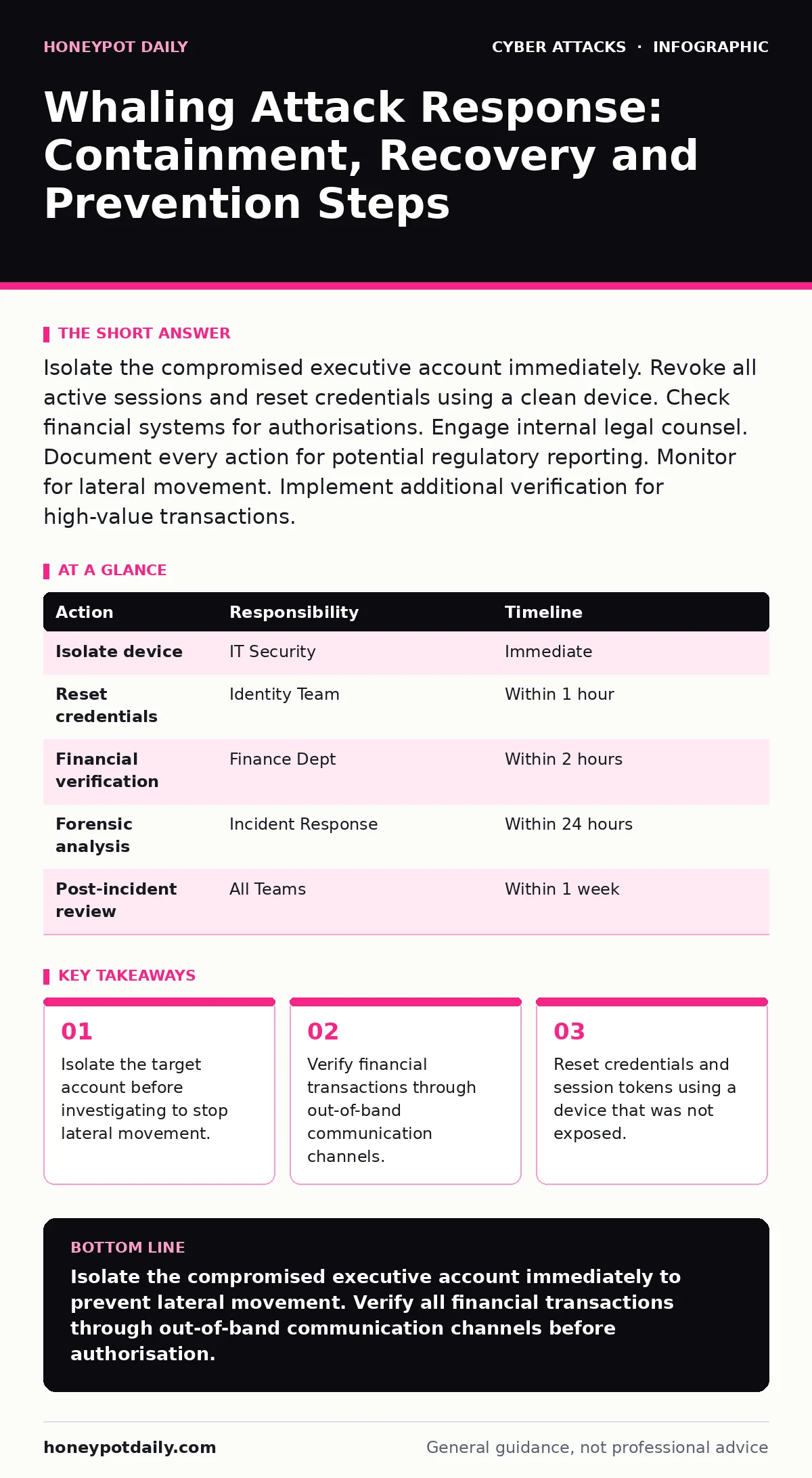
Isolate the compromised executive account immediately. Revoke all active sessions and reset credentials using a clean device. Check financial systems for authorisations. Engage internal legal counsel. Document every action for potential regulatory reporting. Monitor for lateral movement. Implement additional verification for high-value transactions.
First hour
Whaling attacks target senior executives to gain access to sensitive data or authorise fraudulent transfers. The attacker relies on the target’s authority to bypass normal scrutiny. You must act quickly to limit the blast radius. Speed matters more than perfect forensics in the initial phase. Assume the attacker has already moved laterally within the network.
- Isolate the executive’s device from the network immediately.
- Disable the executive’s email and identity provider accounts.
- Revoke all active session tokens and API keys associated with the account.
- Notify the incident response team and legal counsel.
- Preserve the device’s memory and disk state for forensic analysis.
- Check financial systems for any recent authorisations or changes.
The goal is to freeze the environment. Do not attempt to recover data yet. Focus on stopping the bleed. The attacker may have installed persistence mechanisms that survive a simple reboot. You need to ensure the account cannot be used to escalate privileges further.
First day
Once the immediate threat is contained, you begin the investigation. You need to determine the scope of the compromise. Did the attacker access other systems? Did they exfiltrate data? You must review logs from the identity provider, email servers and endpoint detection systems. Look for unusual login times, locations or device types.
Check for any new administrative privileges granted to the compromised account. Attackers often try to elevate their access to maintain control even after the initial account is locked. Review any recent changes to group policies or security settings. These changes can indicate that the attacker has established a foothold in the underlying infrastructure.
Imagine an attacker uses a cloned email interface to send requests to the finance department. This technique, known as browser-in-the-browser attacks, tricks users into believing they are interacting with a legitimate service. You must verify if any such requests were honoured. Contact finance directly using a known phone number, not the email address.
Review the executive’s calendar and contacts. Attackers often scan these for high-value targets or upcoming meetings. They may use this information to craft more convincing follow-up messages. Check for any new contacts added to the executive’s address book. These could be decoy accounts used to spread the attack further.
First week
Recovery involves restoring access securely and ensuring the attacker has no remaining foothold. You must reset all credentials for the compromised executive. Use a clean device to perform this action. Do not use the infected device. Generate new passwords and enable multi-factor authentication. Consider using hardware security keys for added protection.
Check for any persistent backdoors or malicious scripts. These may have been installed to regain access even after credentials are changed. Run full endpoint scans on all devices the executive uses. Review network traffic logs for any unusual outbound connections. Look for connections to known command and control servers.
Engage with external partners if necessary. If the attacker accessed third-party services, you may need to notify those providers. They can help secure the associated accounts and provide additional forensic data. Document all steps taken during the response. This documentation is vital for post-incident reviews and potential legal proceedings.
Who to tell
Communication during a whaling attack must be controlled and precise. You need to inform specific stakeholders without causing panic or alerting the attacker. Internal communication should be limited to the incident response team and executive leadership. Use secure channels that are not linked to the compromised account.
External communication depends on the severity of the breach. If customer data was accessed, you may need to notify regulatory bodies. Legal counsel should guide this process. Do not make public statements until you have a clear understanding of the impact. Misinformation can damage trust and complicate recovery efforts.
Consider the implications for your partners and vendors. If the attacker used your executive’s credentials to access shared systems, those partners need to be alerted. They should review their own logs for any suspicious activity. Coordinate with them to ensure a unified response.
How to stop a repeat
Prevention requires a multi-layered approach. Technical controls alone are not enough. You must combine technology with process and training. Implement strict verification procedures for high-value transactions. Require dual approval for any financial transfers above a certain threshold. Use out-of-band communication for verification.
Review your account lockout policies to ensure they balance security and usability. Too strict policies can lead to denial of service, while too lenient policies allow brute force attacks. Consider implementing adaptive authentication that challenges users based on risk factors. This reduces friction for legitimate users while increasing security for suspicious activity.
Train executives and their assistants to recognise social engineering tactics. Whaling attacks often involve detailed research and personalised messages. Training should focus on identifying subtle cues and verifying requests through trusted channels. Regular phishing simulations can help reinforce these skills. However, ensure these simulations are realistic and do not cause unnecessary stress.
See also: How security operations centers detect and respond to threats · What Is Threat Actors: Definitions, Tactics and Detection Strategies
Technical hardening
Strengthen your identity management infrastructure. Implement password managers to ensure strong, unique passwords for all accounts. This reduces the risk of credential stuffing and password spraying attacks. Ensure that multi-factor authentication is enforced for all privileged accounts. Use phishing-resistant methods such as FIDO2 security keys.
Review your email security settings. Implement DMARC, DKIM and SPF records to prevent email spoofing. These standards help verify that emails are sent from authorised sources. Monitor for any attempts to bypass these controls. Attackers often use look-alike domains to evade detection.
Consider the risks of baiting attacks where malicious files are sent to executives. Ensure that endpoint detection and response solutions are configured to block these files. Regularly update your software and patch vulnerabilities. Unpatched systems provide easy entry points for attackers.
Organisational resilience
Whaling attacks exploit trust and authority. You must build a culture of security that questions authority when necessary. Encourage employees to verify requests, even if they come from senior leaders. This does not mean undermining authority, but ensuring that processes are followed.
Regularly review and update your incident response plan. Test it through tabletop exercises. Identify gaps and address them proactively. Ensure that all staff know their role during an incident. Clear roles and responsibilities reduce confusion and speed up response times.
| Action | Responsibility | Timeline |
|---|---|---|
| Isolate device | IT Security | Immediate |
| Reset credentials | Identity Team | Within 1 hour |
| Financial verification | Finance Dept | Within 2 hours |
| Forensic analysis | Incident Response | Within 24 hours |
| Post-incident review | All Teams | Within 1 week |
Long-term monitoring
Continued monitoring is essential to detect any residual threats. Set up alerts for unusual activity on the executive’s account. Monitor for any attempts to access sensitive data or make changes to system settings. Use behavioural analytics to detect anomalies that may indicate a compromised account.
Regularly audit access rights. Ensure that executives only have the permissions they need. Remove unnecessary privileges. This reduces the impact of a potential compromise. Review third-party access regularly. Ensure that vendors have only the access required for their role.
Key takeaways
- Isolate the target account before investigating to stop lateral movement.
- Verify financial transactions through out-of-band communication channels.
- Reset credentials and session tokens using a device that was not exposed.
Isolate the compromised executive account immediately to prevent lateral movement. Verify all financial transactions through out-of-band communication channels before authorisation.
Frequently asked questions
How do I know if an executive has been targeted by a whaling attack?
Look for unusual login activity, unexpected email requests for financial transfers, or changes to account settings. Verify any such requests through a trusted channel.
Should I reset all passwords in the organisation after a whaling attack?
No, reset passwords only for accounts that were accessed or could have been accessed by the attacker. Resetting all passwords is disruptive and rarely necessary.
What is the role of multi-factor authentication in preventing whaling attacks?
Multi-factor authentication adds an extra layer of security, making it harder for attackers to access accounts even if they have the password. Use phishing-resistant methods for best results.
How long should I monitor for signs of a breach after a whaling attack?
Monitor for at least 30 days, as attackers may remain dormant for weeks before exfiltrating data or making changes. Continue to review logs and behaviour analytics regularly.
How this guide was produced: written by the Honeypot Daily editorial team with AI assistance, checked against the public references listed below, and reviewed when the facts change. See our editorial policy or report an error.