
Industrial Control System Vulnerabilities: Hidden Risks and Fixes
Legacy protocols lack inherent security, meaning network segmentation alone fails when maintenance tools bypass logical boundaries without cryptographic verification.
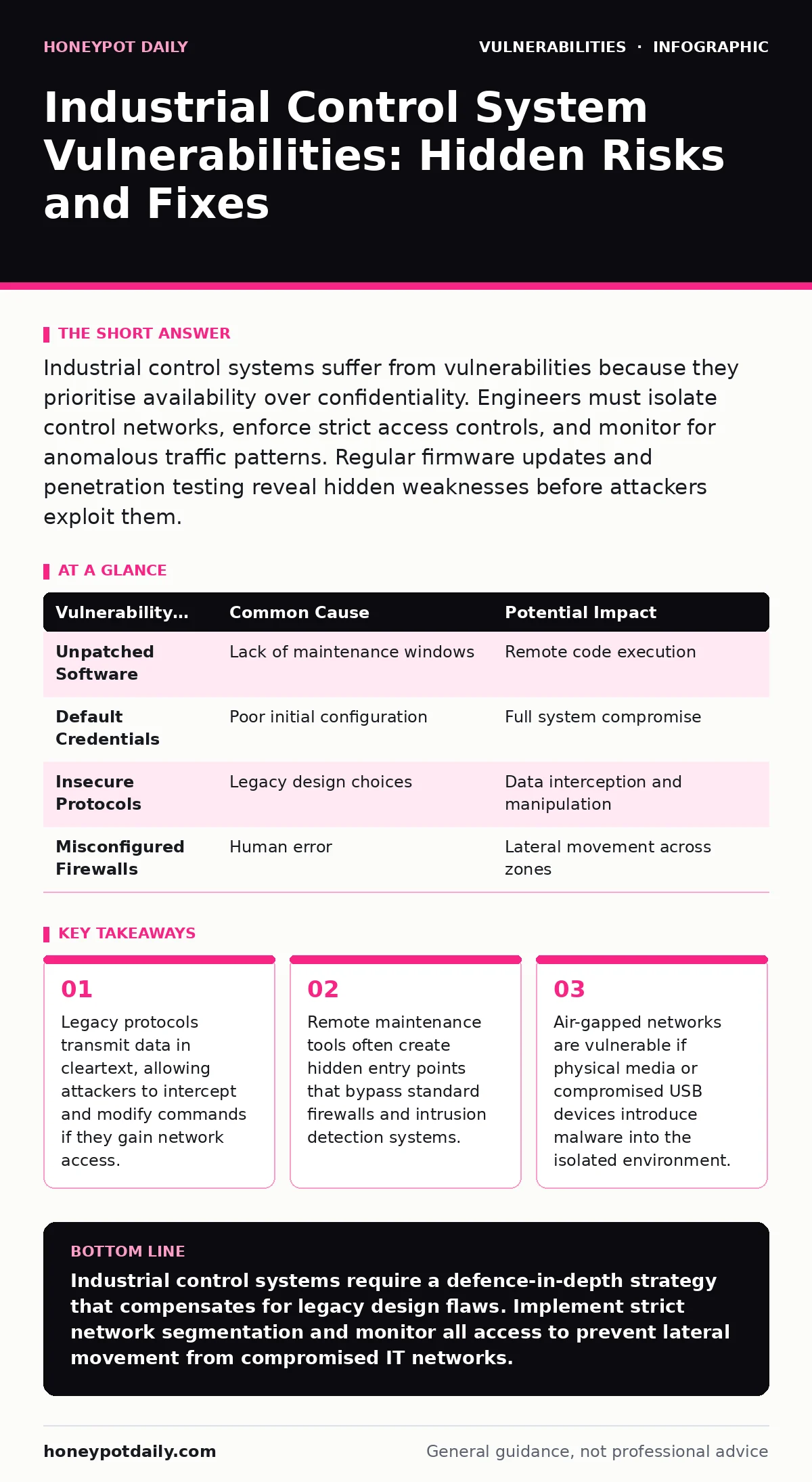
Industrial control systems suffer from vulnerabilities because they prioritise availability over confidentiality. Engineers must isolate control networks, enforce strict access controls, and monitor for anomalous traffic patterns. Regular firmware updates and penetration testing reveal hidden weaknesses before attackers exploit them.
Why do industrial control systems have more vulnerabilities than IT systems?
Industrial control systems prioritise real-time reliability and uptime over data confidentiality, leading to fewer built-in security controls. Many legacy protocols were designed in an era where networks were physically isolated, so they lack encryption or authentication mechanisms. This design choice leaves them exposed to modern network threats. Engineers often cannot apply standard patches because system downtime is costly and risky. The result is a persistent accumulation of unpatched flaws that attackers can exploit over many years.
How do attackers enter an isolated control network?
Attackers rarely breach the control network directly from the internet. They typically compromise the corporate IT network first, then move laterally to the operational technology environment. They use legitimate maintenance tools or stolen credentials to traverse the boundary. Imagine a technician using a USB drive to transfer files; if that drive contains malware, it bypasses all network defences. This method exploits the trust placed in authorised personnel and physical access, making it difficult to detect without strict media controls.
What is the danger of unencrypted industrial protocols?
Unencrypted protocols transmit data in plain text, allowing anyone with network access to read or modify commands. Protocols like Modbus or DNP3 do not verify the sender’s identity or ensure data integrity. An attacker can inject false sensor readings or change valve positions without triggering alarms. This lack of cryptographic protection means that internal network segmentation is insufficient if an attacker gains a foothold inside the zone. You must assume that any traffic on these networks is potentially hostile.
Can firmware updates introduce new vulnerabilities?
Firmware updates can introduce new vulnerabilities if the update process lacks integrity checks or if the new code contains bugs. Some manufacturers push updates that disable security features for compatibility, creating fresh attack surfaces. You must verify the digital signature of every update before installation. Testing updates in a isolated staging environment prevents catastrophic failures in production. Refer to our guide on firmware updates for detailed procedures on validating and deploying patches safely in critical environments.
How do weak password policies affect control systems?
Weak password policies allow attackers to guess or brute-force credentials for engineering workstations and HMI interfaces. Many systems use default passwords that are publicly documented or never changed after installation. This simplicity enables rapid lateral movement once an attacker breaches the perimeter. You should enforce complex passwords and multi-factor authentication where the system architecture permits. Our guide on weak password policies explains how to balance security requirements with operational constraints in legacy environments.
See also: CVSS 4.0 Misreadings: What Security Teams Get Wrong · How to Read CSAF Advisories Without Misinterpreting Scope
What role does penetration testing play in finding hidden flaws?
Penetration testing reveals hidden flaws by simulating real-world attacks in a controlled manner. Automated scanners often miss logic errors or configuration weaknesses that a human tester would identify. Ethical hackers attempt to exploit known vulnerabilities and discover zero-day issues through manual analysis. This process helps you understand the true attack surface and prioritise remediation efforts. See our guide on penetration testing for best practices on conducting safe and effective tests without disrupting critical operations.
| Vulnerability Type | Common Cause | Potential Impact |
|---|---|---|
| Unpatched Software | Lack of maintenance windows | Remote code execution |
| Default Credentials | Poor initial configuration | Full system compromise |
| Insecure Protocols | Legacy design choices | Data interception and manipulation |
| Misconfigured Firewalls | Human error | Lateral movement across zones |
How can authorization bypass vulnerabilities be exploited?
Authorization bypass vulnerabilities allow attackers to access resources without proper credentials by manipulating API calls or URL parameters. In control systems, this can mean changing setpoints or disabling safety interlocks. These flaws often arise from improper validation of user inputs on web-based management interfaces. You must enforce strict role-based access controls and validate every request server-side. Our guide on authorization bypass vulnerabilities details how to structure permissions to prevent privilege escalation in complex systems.
What are the risks of remote maintenance tools?
Remote maintenance tools provide vendors with access to diagnose and fix issues from afar. However, these connections often bypass standard security controls, creating a direct path into the control network. If the vendor’s account is compromised, attackers gain immediate access. You should restrict remote access to dedicated, monitored channels and disable it when not in use. Consider the risks similar to those found in Citrix NetScaler vulnerabilities, where remote access infrastructure becomes a primary attack vector.
How do format string vulnerabilities impact embedded controllers?
Format string vulnerabilities occur when user input is incorrectly processed by functions that format strings, leading to memory corruption. In embedded controllers, this can crash the system or allow code execution. These flaws are common in older C-based firmware. You must validate all input data and use safe string handling functions. Our guide on format string vulnerabilities explains how to identify and fix these issues in legacy codebases. Similarly, Apache Struts vulnerabilities show how web frameworks can expose backend systems to remote attacks.
What mitigations work when patches are unavailable?
When patches are unavailable, you must rely on compensating controls such as network segmentation, strict access controls, and continuous monitoring. Virtual patching via intrusion prevention systems can block exploit attempts before they reach the vulnerable system. You should also limit the functionality of exposed services to reduce the attack surface. Our guide on mitigations and workarounds provides strategies for protecting legacy systems that cannot be updated. Regular audits ensure these controls remain effective over time.
Key takeaways
- Legacy protocols transmit data in cleartext, allowing attackers to intercept and modify commands if they gain network access.
- Remote maintenance tools often create hidden entry points that bypass standard firewalls and intrusion detection systems.
- Air-gapped networks are vulnerable if physical media or compromised USB devices introduce malware into the isolated environment.
Industrial control systems require a defence-in-depth strategy that compensates for legacy design flaws. Implement strict network segmentation and monitor all access to prevent lateral movement from compromised IT networks.
Frequently asked questions
Can antivirus software protect industrial control systems?
Antivirus software provides limited protection on resource-constrained control systems and may interfere with real-time operations. You should rely on network-based detection and behavioural analysis instead.
How often should I review access controls?
Review access controls quarterly and immediately after any personnel changes. Regular audits ensure that only authorised users have access to critical systems and that privileges are appropriately assigned.
Is it safe to use cloud services for SCADA data?
Cloud services can be safe if data is encrypted in transit and at rest, and access is strictly controlled. You must ensure compliance with industry standards and isolate sensitive control data from general cloud resources.
What is the first step in securing a legacy system?
The first step is to inventory all assets and map the network traffic. Understanding what devices exist and how they communicate allows you to identify unnecessary connections and implement targeted security measures.
How this guide was produced: written by the Honeypot Daily editorial team with AI assistance, checked against the public references listed below, and reviewed when the facts change. See our editorial policy or report an error.