Detect Format String Vulnerabilities: Signals, Tools and Blind Spots
Format string flaws hide in plain sight by turning log messages into memory corruption vectors, bypassing traditional input checks through interpreter logic errors.
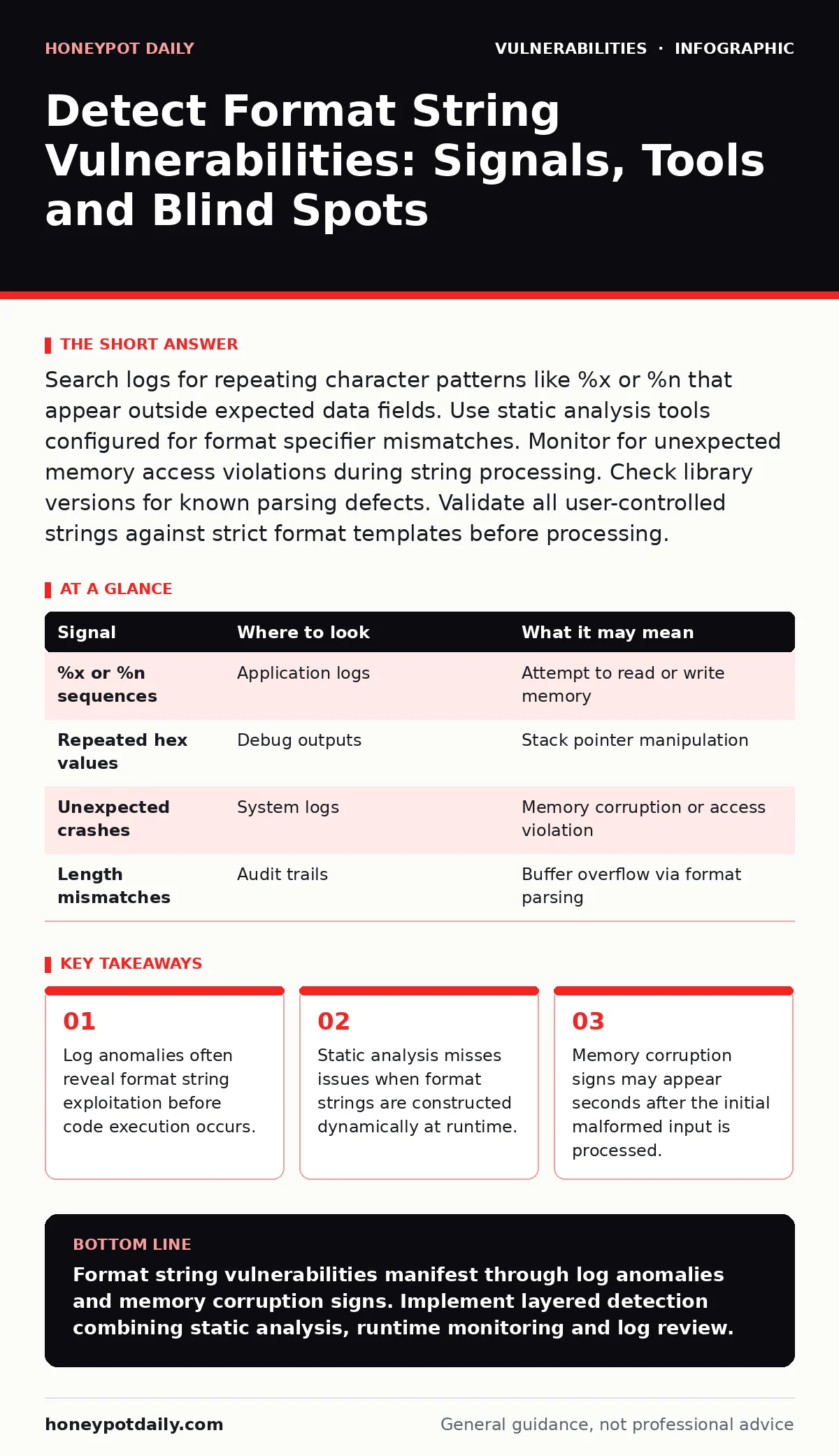
Search logs for repeating character patterns like %x or %n that appear outside expected data fields. Use static analysis tools configured for format specifier mismatches. Monitor for unexpected memory access violations during string processing. Check library versions for known parsing defects. Validate all user-controlled strings against strict format templates before processing.
Log Anomalies Reveal Early Exploitation Attempts
Format string vulnerabilities allow attackers to manipulate how a program interprets data. You will see evidence in application logs when input contains special sequences. Look for repeating patterns of hexadecimal values or unexpected null bytes. These artefacts indicate the parser is reading beyond the intended buffer boundary. The system attempts to interpret user input as formatting instructions rather than plain text.
This misinterpretation causes the application to read or write to arbitrary memory locations. You must distinguish between legitimate hexadecimal data and malicious format specifiers. Legitimate data rarely contains consecutive format directives without surrounding context. Malicious inputs often strip surrounding text to maximise parser confusion.
| Signal | Where to look | What it may mean |
|---|---|---|
| %x or %n sequences | Application logs | Attempt to read or write memory |
| Repeated hex values | Debug outputs | Stack pointer manipulation |
| Unexpected crashes | System logs | Memory corruption or access violation |
| Length mismatches | Audit trails | Buffer overflow via format parsing |
Static Analysis Catches Code-Level Flaws
Static application security testing tools scan source code for dangerous patterns. You configure these tools to flag function calls that accept user input as format strings. The scanner looks for missing format specifiers or mismatched argument counts. It identifies places where a variable is passed directly to a formatting function.
This approach catches vulnerabilities before deployment. It fails when format strings are constructed dynamically from multiple sources. The tool cannot trace complex logic paths that assemble the final string at runtime. You must combine static analysis with manual review for complex applications. Manual review ensures the context of string assembly is understood.
Runtime Monitoring Detects Active Abuse
Dynamic analysis observes the application while it processes input. You deploy instrumentation to monitor memory access patterns during string processing. The monitor alerts when the application reads from uninitialised memory regions. It flags writes to protected memory segments. These events often precede a crash or code execution. Runtime monitoring catches issues that static analysis misses. It detects logic flaws that only manifest with specific input combinations. The overhead of monitoring can impact application performance. You must balance detection sensitivity with system stability. High-sensitivity settings generate more false positives.
Memory Corruption Signs Point to Exploitation
When a format string vulnerability is exploited, memory state changes unpredictably. You observe these changes through core dumps or crash reports. The stack pointer may deviate from its expected value. Return addresses on the stack contain garbage data or attacker-controlled values. Heap metadata may show corruption signs. These symptoms confirm that the format parser accessed memory incorrectly. They do not prove remote code execution occurred. They indicate the application’s memory integrity was compromised. You must correlate these memory signs with log anomalies. Correlation confirms the attack vector and scope.
Library Defects Compound the Risk
Applications often rely on third-party libraries for string handling. These libraries may contain their own format string vulnerabilities. You must track updates for all dependencies. A vulnerability in a logging library can expose the entire application. The application code may be secure, but the library parses input unsafely. This creates a hidden attack surface. You cannot patch the library by fixing the application code. You must update the library itself or replace it. This dependency chain extends the detection window. You must monitor for advisories related to all included components.
Refer to our guide on logging library vulnerabilities for details on managing these specific risks. Proper library management reduces the chance of inherited flaws.
Common Blind Spots in Detection
Many detection efforts focus on web-facing inputs. They miss internal APIs and command-line interfaces. These interfaces often bypass standard input validation layers. Attackers exploit these trust assumptions. Another blind spot is dynamic format string construction. When code builds format strings from multiple variables, static tools fail to flag the risk. The final string looks benign until runtime. A third blind spot is insufficient log retention. Attackers may probe slowly over weeks. Short retention periods delete evidence before analysis begins. You must extend log retention for critical systems.
Tooling Strategy for Comprehensive Coverage
No single tool detects all format string vulnerabilities. You need a layered approach. Static analysis finds code-level flaws. Runtime monitoring catches active exploitation. Log analysis reveals historical abuse patterns. Combine these tools into a unified monitoring pipeline. Correlate alerts across different data sources. This reduces false positives and highlights true threats. Automate the correlation process where possible. Manual correlation scales poorly with large datasets. You must prioritise alerts based on severity and context. High-severity memory corruption signs require immediate attention.
Mitigation Requires Input Validation
Detection is only part of the solution. You must prevent exploitation through strict input validation. Reject any input containing format specifiers unless explicitly allowed. Use allowlists for permitted characters. Sanitise all user-controlled strings before processing. This prevents the parser from interpreting input as instructions. It forces the application to treat input as data. This approach aligns with secure coding practices. It reduces the attack surface significantly. You must apply this validation consistently across all interfaces. Inconsistent validation creates gaps attackers can exploit.
See our input validation guide for detailed implementation strategies. Proper validation prevents many format string issues. It complements detection efforts by reducing the number of exploitable flaws.
Key takeaways
- Log anomalies often reveal format string exploitation before code execution occurs.
- Static analysis misses issues when format strings are constructed dynamically at runtime.
- Memory corruption signs may appear seconds after the initial malformed input is processed.
Format string vulnerabilities manifest through log anomalies and memory corruption signs. Implement layered detection combining static analysis, runtime monitoring and log review.
Frequently asked questions
How do I distinguish between benign hex data and format string attacks?
Benign hex data appears in structured fields with consistent formatting. Attack inputs often contain consecutive format specifiers like %x%x%x without surrounding context. Look for patterns that attempt to manipulate memory addresses rather than represent values.
Can format string vulnerabilities exist in compiled binaries without source code?
Yes. Binary analysis tools can identify dangerous function calls and memory access patterns. You can detect runtime behaviour indicative of format string exploitation even without source code access.
What is the difference between a format string bug and a buffer overflow?
A buffer overflow writes beyond a buffer boundary. A format string bug tricks the parser into reading or writing arbitrary memory locations using format specifiers. Both cause memory corruption but through different mechanisms.
How often should I update static analysis rules for format strings?
Update rules whenever new parsing libraries are introduced or existing ones are updated. Review rules after major application refactoring. Regular updates ensure the scanner catches evolving code patterns and library changes.
How this guide was produced: written by the Honeypot Daily editorial team with AI assistance, checked against the public references listed below, and reviewed when the facts change. See our editorial policy or report an error.