
Threat Modeling for Small Teams: Practical Steps and Costs
Formal threat modeling reveals hidden data flows that standard audits miss, allowing small teams to prioritise fixes based on actual risk rather than fear.
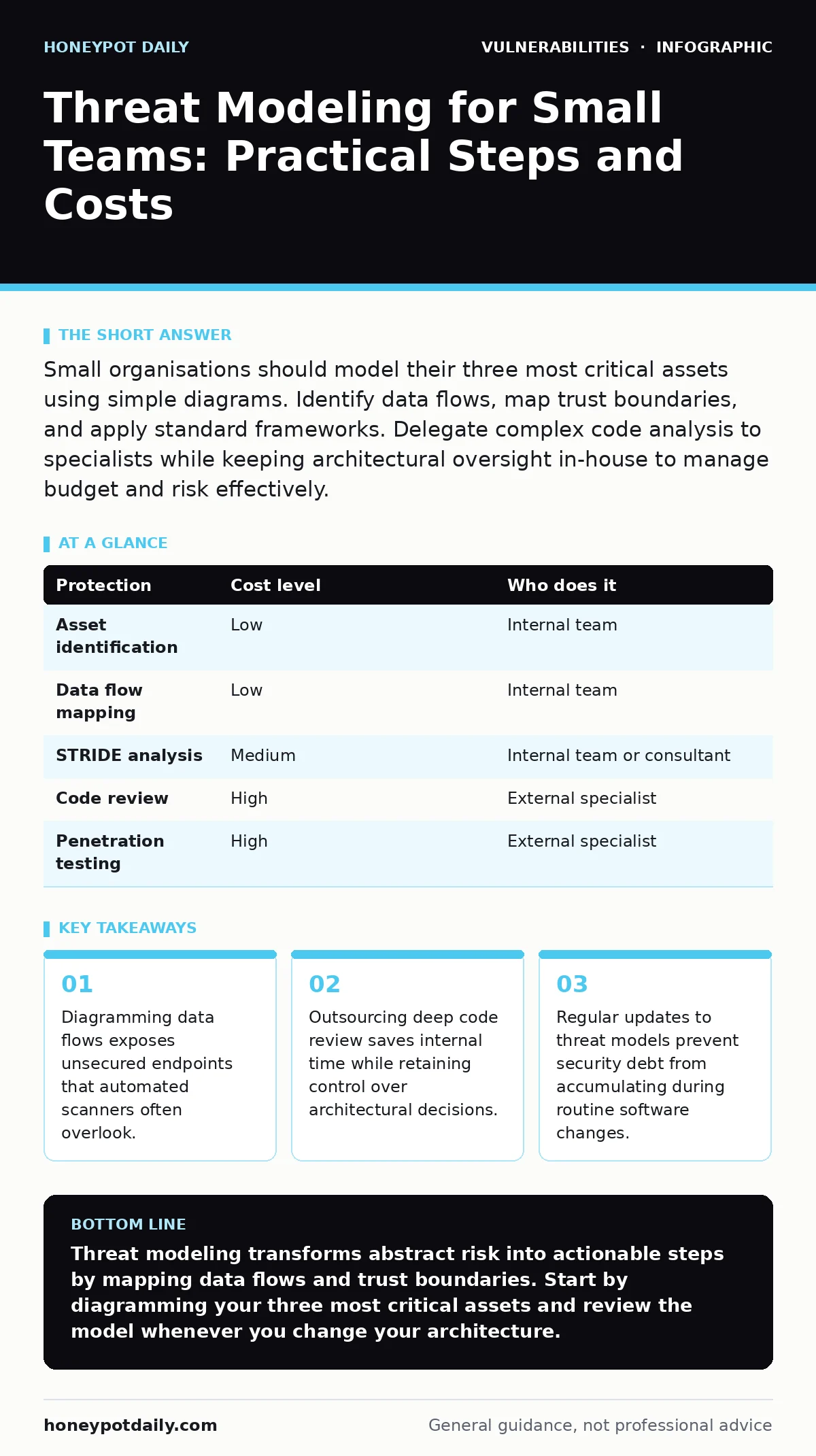
Small organisations should model their three most critical assets using simple diagrams. Identify data flows, map trust boundaries, and apply standard frameworks. Delegate complex code analysis to specialists while keeping architectural oversight in-house to manage budget and risk effectively.
This assumption fails when an employee shares a link with incorrect permissions. The data flows from the internal network to the cloud, then to the client. Threat modeling maps this journey. It identifies the exact point where permissions can be misconfigured. Without this map, the team reacts to breaches rather than preventing them. Small teams lack the resources for constant monitoring. They need a targeted approach that focuses on the highest value assets. Modeling forces you to define what you are protecting before you buy tools.
Why Threat Modeling Matters at Small Scale
Small organisations often skip threat modeling because they view it as a luxury for large enterprises. This view ignores the specific vulnerabilities of limited resources. A small team cannot afford to patch every vulnerability. They must choose where to invest their limited time and money. Threat modeling provides the logic for these choices. It moves the discussion from "we need more security" to "we need to protect this specific data flow".
Imagine a small e-commerce shop. They use a standard shopping cart plugin. The team assumes the plugin is secure because it is popular. Threat modeling asks how customer data moves from the browser to the database. It reveals that the plugin logs sensitive information in plain text. This insight changes the priority list. The team stops worrying about minor display issues and focuses on encrypting the logs. This process saves money by avoiding unnecessary tools. It also reduces risk by addressing real weaknesses.
Small teams face a higher impact from breaches. They lack the legal and financial buffer of larger corporations. A single incident can threaten business continuity. Threat modeling acts as an insurance policy for architecture. It identifies single points of failure before they are exploited. This proactive stance is cheaper than reactive recovery. It also helps in communicating risk to stakeholders who may not understand technical details.
Affordable Ways to Conduct Threat Modeling
You do not need expensive software to perform effective threat modeling. Paper and whiteboards are often the best tools for the initial phase. They encourage collaboration and prevent getting stuck in tool configuration. Start by listing your critical assets. These are the items that would cause significant harm if compromised. For a small business, this might include customer databases, intellectual property, or payment credentials.
Next, draw the data flow. Use simple boxes for systems and arrows for data movement. Label each arrow with the protocol used, such as HTTPS or SMTP. Identify where the data crosses trust boundaries. A trust boundary is a point where data moves from a trusted environment to an untrusted one, or vice versa. These boundaries are common attack surfaces. Mark them clearly on your diagram. This visualisation helps you see gaps in your defences.
Consider using open standards like STRIDE. STRIDE is a framework that categorises threats into Spoofing, Tampering, Repudiation, Information Disclosure, Denial of Service, and Elevation of Privilege. Apply each category to your data flow diagram. Ask if an attacker could spoof an identity at that point. Ask if they could tamper with the data in transit. This structured approach ensures you do not overlook common threat vectors. It provides a consistent method for reviewing different parts of your system.
| Protection | Cost level | Who does it |
|---|---|---|
| Asset identification | Low | Internal team |
| Data flow mapping | Low | Internal team |
| STRIDE analysis | Medium | Internal team or consultant |
| Code review | High | External specialist |
| Penetration testing | High | External specialist |
What to Delegate to External Experts
Small teams should keep architectural oversight in-house. You understand your business logic better than any outsider. However, deep technical analysis often requires specialised skills. Delegate tasks that require specific expertise or objective eyes. Code review is a prime candidate for delegation. Internal developers may miss biases in their own logic. An external specialist can identify subtle flaws in input validation or memory management.
Penetration testing is another area where external help is valuable. It simulates real-world attacks against your live systems. This testing reveals issues that static analysis might miss. Ensure the tester follows a standard methodology. Ask for a report that prioritises findings by risk. This allows you to address the most critical issues first. Do not delegate the decision of which risks to accept. That decision requires business context that only you possess.
Imagine you delegate the review of your authentication system. They recommend a fix. You must decide if the fix is feasible. You must also decide if the risk is acceptable. This decision involves balancing security with user experience. An external provider cannot make this trade-off for you. They can only provide the technical facts.
Questions to Ask Your IT Provider
When engaging an external provider, clarity is key. Define the scope of the engagement before work begins. Ask specific questions to ensure they understand your environment. Do not rely on vague promises of security.
- What specific assets will you assess during the engagement?
- How do you report findings, and what is the format of the output?
- Do you provide remediation guidance for each identified vulnerability?
- How do you handle sensitive data during the assessment process?
- What is your experience with our specific technology stack?
These questions help you evaluate the provider's competence. They also set clear expectations for the deliverables. A good provider will answer these questions confidently. They will also ask you questions about your business goals. This two-way dialogue ensures the assessment is relevant to your needs.
Integrating Threat Modeling into Development
Threat modeling is not a one-time activity. It must evolve with your systems. Integrate it into your development lifecycle. Review the model whenever you add new features or change architecture. This practice prevents security debt from accumulating. It ensures that new components fit securely into the existing ecosystem.
Use change management for security patches to track updates to your threat model. When a patch changes a component's behaviour, update the diagram. Check if new trust boundaries have been created. Assess if existing controls are still effective. This continuous process keeps your security posture aligned with your current reality. It also helps you spot trends in vulnerabilities.
Small teams often struggle with documentation. Keep the threat model simple and accessible. Store it in a shared location where all team members can view it. Use comments to explain complex decisions. This transparency helps new team members understand the security rationale. It also ensures that knowledge is not lost when staff leave.
Common Pitfalls to Avoid
Many teams fail at threat modeling by focusing on tools rather than thinking. Do not let software dictate your process. The value comes from the discussion, not the diagram. Another pitfall is ignoring the human element. Social engineering attacks often bypass technical controls. Include user behaviour in your model. Consider how employees handle passwords and phishing attempts.
Finally, avoid over-engineering. Do not try to model every minor component. Focus on the critical paths. A simple model that is updated regularly is better than a complex model that is ignored. Prioritise based on risk. This approach ensures you get the most value from your limited resources.
Leveraging Related Security Practices
Threat modeling works best when combined with other security practices. It complements exposure management by identifying what needs to be protected. It informs mitigations and workarounds by highlighting the most critical risks. It also guides the implementation of HTTP security headers by showing where data is exposed to the web.
Use threat modeling to justify security investments. It provides a clear link between technical controls and business risk. This link helps you secure budget for necessary tools and staff. It also helps you explain security decisions to non-technical stakeholders. By showing the potential impact of a breach, you make the case for proactive security.
Remember that threat modeling is a mindset. It encourages you to think like an attacker. It forces you to question assumptions. This habit improves the overall security culture of your organisation. It makes security a shared responsibility rather than a siloed function.
Key takeaways
- Diagramming data flows exposes unsecured endpoints that automated scanners often overlook.
- Outsourcing deep code review saves internal time while retaining control over architectural decisions.
- Regular updates to threat models prevent security debt from accumulating during routine software changes.
Threat modeling transforms abstract risk into actionable steps by mapping data flows and trust boundaries. Start by diagramming your three most critical assets and review the model whenever you change your architecture.
Frequently asked questions
How often should we update our threat model?
Update the model whenever you make significant changes to your architecture or add new features. Review it at least once a year to ensure it reflects your current environment.
Can we use threat modeling for cloud services?
Yes, threat modeling is essential for cloud environments. It helps you understand shared responsibility and identify misconfigurations in your cloud setup.
Do we need a dedicated security team to perform threat modeling?
No, small teams can perform threat modeling themselves. Focus on simple diagrams and standard frameworks. Delegate complex technical analysis if needed.
How do we measure the success of threat modeling?
Success is measured by the number of high-risk vulnerabilities identified and mitigated before deployment. Track the reduction in security incidents over time.
How this guide was produced: written by the Honeypot Daily editorial team with AI assistance, checked against the public references listed below, and reviewed when the facts change. See our editorial policy or report an error.