Next-Generation Antivirus: Practical Protection for Small Teams
Traditional signature matching misses novel attacks, requiring behavioural analysis and endpoint isolation to stop ransomware before encryption begins.
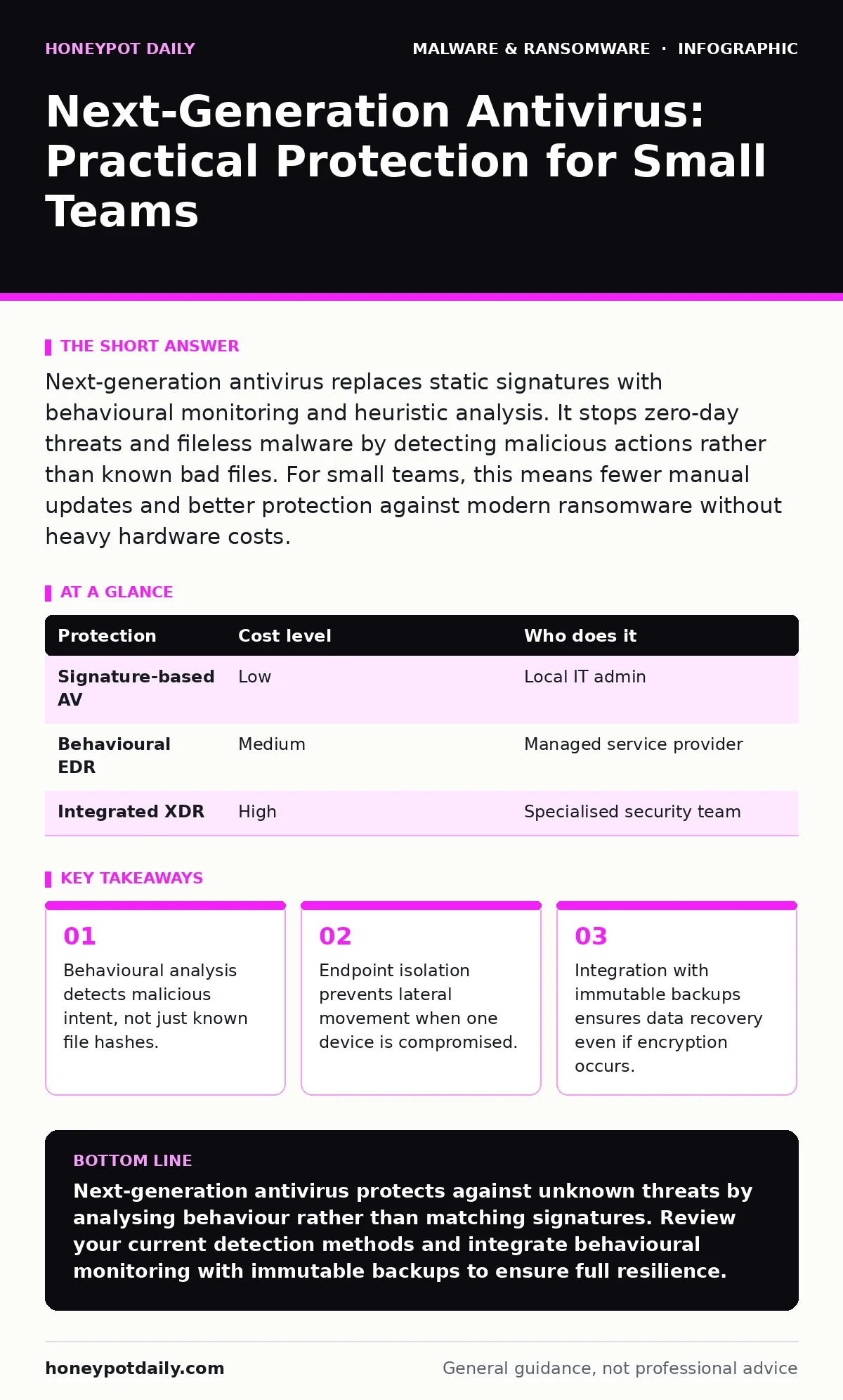
Next-generation antivirus replaces static signatures with behavioural monitoring and heuristic analysis. It stops zero-day threats and fileless malware by detecting malicious actions rather than known bad files. For small teams, this means fewer manual updates and better protection against modern ransomware without heavy hardware costs.
The Shift From Signatures to Behaviour
Traditional antivirus software relies on a database of known malicious file signatures. It compares every file on your system against this list. If the hash matches, the file is quarantined. This method fails against new threats that have never been seen before. These are called zero-day exploits because zero days of public knowledge exist about them.
Next-generation antivirus moves beyond static matching. It uses behavioural analysis to monitor what programs do, not just what they are. If a legitimate utility like a text editor suddenly tries to access the registry keys associated with encryption, the system flags this as suspicious. This approach catches fileless malware, which lives in memory rather than on disk.
For smaller organisations, this shift reduces the maintenance burden. You no longer need to wait for vendor updates after every new outbreak. The system learns the baseline of normal activity for your environment. Deviations from this baseline trigger alerts or automatic containment. This proactive stance is necessary because attackers automate their campaigns, outpacing manual signature updates.
Why Scale Changes the Risk Profile
Large enterprises have dedicated security operations centres to monitor alerts. Small teams often rely on a single IT generalist or an external provider. This difference in resources changes how you must deploy protection. You cannot afford false positives that lock users out of critical work. You also cannot afford false negatives that lead to data loss.
The cost of downtime is proportionally higher for smaller entities. A ransomware attack can halt operations entirely if backups are compromised or inaccessible. Traditional antivirus often lacks the context to distinguish between a user running a legitimate script and an attacker deploying ransomware. Next-generation tools provide this context through machine learning models trained on vast amounts of telemetry.
Imagine a scenario where an attacker uses a legitimate system tool to move laterally across the network. This technique is known as living off the land. Traditional scanners ignore these tools because they are signed by the operating system vendor. Behavioural engines detect the unusual frequency or destination of these commands. This capability is vital for preventing a single infected laptop from compromising the entire server infrastructure.
Affordable Implementation Strategies
You do not need enterprise-grade budgets to achieve enterprise-grade protection. Many cloud-based security platforms offer tiered pricing suitable for small teams. These solutions run as lightweight agents on endpoints. They send telemetry to the cloud for analysis, reducing the need for local server infrastructure.
Consider the total cost of ownership, not just the license fee. A cheap tool that generates hundreds of false alerts costs more in staff time than a more accurate, slightly pricier alternative. Look for platforms that include automated remediation. If a threat is detected, the tool should isolate the endpoint from the network automatically. This reduces the window of exposure while you investigate.
| Protection | Cost level | Who does it |
|---|---|---|
| Signature-based AV | Low | Local IT admin |
| Behavioural EDR | Medium | Managed service provider |
| Integrated XDR | High | Specialised security team |
Integrated platforms that combine firewall, endpoint protection, and email filtering often provide better value than disjointed tools. They share threat intelligence across components. A phishing attempt blocked by the email filter can update the endpoint rules to watch for related payloads. This synergy improves detection rates without requiring additional staff.
What to Delegate and What to Keep
You should delegate the initial alert triage to your provider or the platform’s automation. This includes isolating infected hosts and killing malicious processes. However, you must retain control over policy decisions and investigation workflows.
Do not delegate the definition of critical assets. The security tool needs to know which servers hold sensitive data and which workstations are high-risk. If you outsource this configuration, you risk having the wrong priorities enforced. A misconfigured rule might allow an attacker to bypass protections on the database server while over-protecting a test machine.
Refer to our guide on immutable backups for how to protect your data stores. Even the best detection fails occasionally. Immutable backups prevent attackers from deleting or encrypting your recovery copies. This combination of detection and recovery creates a resilient security posture. You can tolerate a breach if you can restore operations quickly and completely.
Questions for Your IT Provider
When selecting a partner to manage your next-generation security, ask specific technical questions. Vague promises of "best-in-class" protection are insufficient. You need to understand their detection methodology and response capabilities.
- How do you distinguish between benign automation scripts and malicious fileless attacks?
- What is your mean time to detect and mean time to respond for ransomware?
- Do you provide visibility into memory-resident threats, as described in memory forensics?
- How do you handle false positives to avoid business disruption?
- What is your process for investigating potential firmware malware infections?
These questions reveal whether the provider understands modern attack vectors. A competent provider will explain their use of behavioural analytics and threat hunting. They will also discuss their integration with your backup systems. Avoid providers who rely solely on signature-based scanning or who cannot explain their investigation process.
See also: Endpoint telemetry checklist: capture what attackers hide · Memory Forensics for Small Teams: Detect What Disk Tools Miss
Integrating With Existing Defences
Next-generation antivirus is not a standalone solution. It works best when integrated with email security and network monitoring. Phishing remains the primary entry point for most attacks. If your email filter blocks the initial malicious attachment, the endpoint never sees the threat. This layered approach is known as defence in depth.
Regularly review your software update policies. Fake software updates are a common vector for distributing malware. Ensure that your systems only accept updates from verified, official sources. This reduces the attack surface available to adversaries. Combine this with user training to identify suspicious prompts.
Be aware of the ransomware payment debate. Paying ransoms does not guarantee data recovery and funds further criminal activity. Relying on detection and recovery is the sustainable path. By focusing on prevention through behavioural analysis and recovery through immutable backups, you eliminate the need to engage with attackers. This strategy protects your reputation and your financial stability.
Maintenance and Continuous Improvement
Security is not a one-time purchase. It requires ongoing tuning and review. Start by establishing a baseline of normal network activity. As your business grows and changes, so will this baseline. Regularly update your exclusion lists to prevent critical business applications from triggering false alarms.
Conduct periodic tabletop exercises to test your response plan. Imagine a scenario where an endpoint is infected and isolated. Can your team communicate effectively? Do they know how to restore data from immutable backups? These drills reveal gaps in your procedures before a real attack occurs.
Review logs and reports monthly. Look for patterns that might indicate a sophisticated campaign. Even if the tool blocks the attack, understanding the method helps you strengthen other defences. This continuous improvement cycle ensures your protection evolves alongside emerging threats.
Key takeaways
- Behavioural analysis detects malicious intent, not just known file hashes.
- Endpoint isolation prevents lateral movement when one device is compromised.
- Integration with immutable backups ensures data recovery even if encryption occurs.
Next-generation antivirus protects against unknown threats by analysing behaviour rather than matching signatures. Review your current detection methods and integrate behavioural monitoring with immutable backups to ensure full resilience.
Frequently asked questions
Does next-generation antivirus replace the need for firewalls?
No, it complements firewalls. Firewalls control network traffic, while next-generation antivirus monitors endpoint behaviour. Both are necessary for defence in depth.
How do I handle false positives from behavioural analysis?
Configure the tool to isolate suspicious processes rather than deleting them immediately. Review the isolated actions to confirm they are benign, then add the application to an allowlist if safe.
Is cloud-based next-generation antivirus secure?
Yes, provided the vendor uses strong encryption for telemetry data. Cloud platforms often have better threat intelligence because they analyse data from millions of endpoints globally.
Can next-generation antivirus detect insider threats?
It can detect anomalous behaviour that may indicate an insider threat, such as unusual data access patterns. However, it works best alongside user activity monitoring for comprehensive coverage.
How this guide was produced: written by the Honeypot Daily editorial team with AI assistance, checked against the public references listed below, and reviewed when the facts change. See our editorial policy or report an error.