How Dark Web Monitoring Works: The Hidden Mechanics and Limits
Dark web monitoring relies on crawling hidden forums and marketplaces, but it often misses real-time leaks and struggles with encrypted communication channels that bypass traditional indexing.
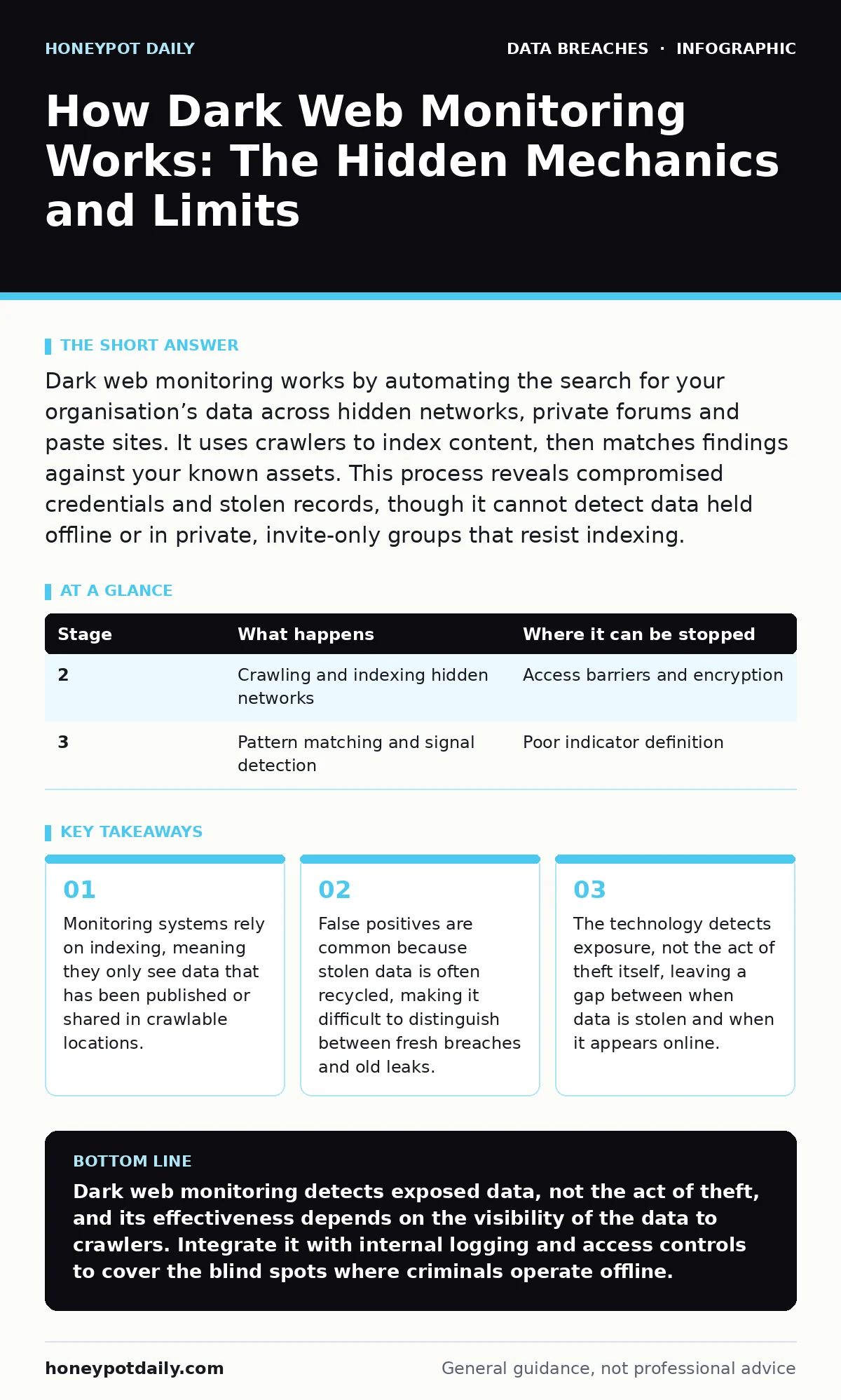
Dark web monitoring works by automating the search for your organisation’s data across hidden networks, private forums and paste sites. It uses crawlers to index content, then matches findings against your known assets. This process reveals compromised credentials and stolen records, though it cannot detect data held offline or in private, invite-only groups that resist indexing.
The Illusion of Total Visibility
Dark web monitoring is often marketed as a surveillance tool that watches every corner of the internet for your data. In reality, it is a targeted search engine for hidden networks. These systems do not watch the dark web in real time like a camera feed. Instead, they periodically crawl specific locations where stolen data tends to accumulate.
This distinction matters because it defines what you can and cannot see. You are not watching a live heist. You are finding the aftermath. The mechanism depends entirely on the willingness of data brokers and criminals to publish or share your information in places that automated tools can reach.
Stage 1: Asset Definition and Baseline Creation
Before any scanning occurs, the monitoring system needs to know what to look for. This stage involves compiling a list of indicators that belong to your organisation. These indicators include domain names, email formats, IP address ranges and employee name patterns.
The system builds a baseline of your digital footprint. It separates your legitimate public data from sensitive internal data. If you do not define these indicators clearly, the tool will return irrelevant results or miss critical exposures.
This stage connects directly to data inventory and mapping. Without a clear map of what data exists and where it resides, you cannot effectively identify when that data appears elsewhere. A vague definition leads to noise, while an overly narrow definition creates blind spots.
Stage 2: Crawling and Indexing Hidden Networks
The core engine of dark web monitoring is a crawler. Unlike standard web crawlers that index public sites, these tools are designed to access hidden services. They use protocols like Tor to navigate onion sites and access private forums that require authentication.
The crawler visits known marketplaces, paste sites and discussion boards. It downloads text, images and files, then stores them in an internal index. This process is slow and resource-intensive. The crawler must constantly adapt to new forums and changing URLs to remain effective.
Imagine a library where the books are hidden in locked rooms. The crawler is the librarian who has managed to pick the locks of some rooms. It can only read the books it can find. It cannot read the books kept in rooms it has not yet discovered or cannot access.
Stage 3: Pattern Matching and Signal Detection
Once the crawler has indexed content, the system applies pattern matching. It scans the stored data for the indicators defined in Stage 1. This is not a simple keyword search. It uses regular expressions and fuzzy matching to identify variations of email addresses or partial credit card numbers.
The system flags any match as a potential signal. It then attempts to verify the context. Is the email address appearing in a list of breached credentials? Is it part of a larger dataset? This step separates relevant signals from background noise.
This stage is where the limits of password hashing and salting become apparent. If your passwords are properly hashed and salted, the monitoring tool cannot reverse them. It can only flag that a hash has been found, not what the password is. This reduces the immediate risk but still indicates a compromise.
| Stage | What happens | Where it can be stopped |
|---|---|---|
| 2 | Crawling and indexing hidden networks | Access barriers and encryption |
| 3 | Pattern matching and signal detection | Poor indicator definition |
Stage 4: Contextual Analysis and Risk Scoring
Not all matches are equal. Finding an old password from a decade ago is less urgent than finding current login credentials. The system assigns a risk score based on context. It considers the sensitivity of the data, the recency of the post and the reputation of the source.
This analysis helps prioritise alerts. It filters out low-risk findings that would overwhelm security teams. However, this scoring is imperfect. It relies on historical data and assumptions about criminal behaviour.
A high-risk score does not mean an attack is happening. It means your data is exposed. The difference is subtle but critical. Exposure is a condition; attack is an action. Monitoring detects the condition, not the action.
See also: How Digital Forensics Works: The Chain of Evidence Explained · How Social Media Oversharing Enables Targeted Attacks
Stage 5: Alert Generation and Reporting
The final stage is the delivery of intelligence. The system generates alerts for security teams. These alerts contain the matched data, the source location and the risk score. They may also include recommendations for remediation, such as forcing a password reset.
The effectiveness of this stage depends on integration. If the alerts are sent to an inbox that no one reads, the monitoring is useless. Integration with security operations platforms allows for automated responses and faster triage.
This process highlights the risk of insider data theft. Monitoring tools look for external exposures. They do not typically monitor internal channels. An insider can leak data through private messaging apps or email, bypassing dark web monitors entirely.
| Stage | What happens | Where it can be stopped |
|---|---|---|
| 4 | Contextual analysis and risk scoring | Biased risk models |
| 5 | Alert generation and reporting | Alert fatigue and poor integration |
The Hidden Costs of Monitoring
Dark web monitoring is not a passive service. It requires ongoing maintenance. Indicators must be updated as employees leave and new domains are acquired. The cost is not just financial. It is the cognitive load of managing false positives.
Many alerts are stale. Data from old breaches circulates indefinitely. Treating every alert as a fresh crisis leads to burnout. You must develop a process for validating and closing alerts efficiently.
There is also the risk of over-reliance. Teams may assume that if the monitoring tool does not alert, they are safe. This is false. Data can be stolen and held offline for months before being published. This is the basis of data extortion, where criminals threaten to release data unless paid. Monitoring cannot detect data that has not been published.
Limits and Blind Spots
The most significant limit of dark web monitoring is its dependence on visibility. It cannot see what is not indexed. Private Telegram groups, encrypted email lists and offline hard drives are invisible to crawlers.
It also cannot detect SIM swap fraud in real time. If a criminal swaps a SIM card to intercept a one-time password, the monitoring tool will not see the interception. It may only see the resulting account takeover if credentials are later posted online.
Similarly, it offers little protection against child identity theft. This crime often involves long-term exploitation of personal data that may never appear on public dark web forums. The data is used slowly and quietly, avoiding the attention of automated crawlers.
Integrating with Broader Security
Dark web monitoring is one layer of defence. It should not stand alone. It works best when combined with full disk encryption and strong access controls. These measures protect data at rest, reducing the impact if a breach occurs.
It also complements strategies for managing third-party data breaches. Your vendors may be compromised, and their data may include your customers’ information. Monitoring can help detect when this external data appears online, allowing you to respond before your own systems are targeted.
The goal is not to catch every leak. It is to reduce the time between exposure and detection. This window is where the most damage occurs. By understanding the mechanics and limits of monitoring, you can use it effectively without relying on it as a silver bullet.
Key takeaways
- Monitoring systems rely on indexing, meaning they only see data that has been published or shared in crawlable locations.
- False positives are common because stolen data is often recycled, making it difficult to distinguish between fresh breaches and old leaks.
- The technology detects exposure, not the act of theft itself, leaving a gap between when data is stolen and when it appears online.
Dark web monitoring detects exposed data, not the act of theft, and its effectiveness depends on the visibility of the data to crawlers. Integrate it with internal logging and access controls to cover the blind spots where criminals operate offline.
Frequently asked questions
Can dark web monitoring stop a data breach?
No, it cannot stop a breach. It only detects data after it has been stolen and published online. Prevention requires strong access controls and encryption.
How often should I review dark web monitoring alerts?
Review them regularly, ideally daily. Stale data circulates for years, so you must distinguish between old leaks and new exposures to prioritise your response.
Does monitoring cover social media?
Standard dark web monitoring focuses on hidden networks and forums. Social media is part of the surface web and requires different tools for monitoring.
Can it detect stolen intellectual property?
It can detect IP if it is posted in a crawlable format. However, most IP is shared via private channels or offline, making it difficult to detect.
How this guide was produced: written by the Honeypot Daily editorial team with AI assistance, checked against the public references listed below, and reviewed when the facts change. See our editorial policy or report an error.