
How Child Identity Theft Works: The Silent Build-Up
Attackers wait for a child to reach adulthood before cashing in stolen data, allowing fraud to compound silently for over a decade without detection.
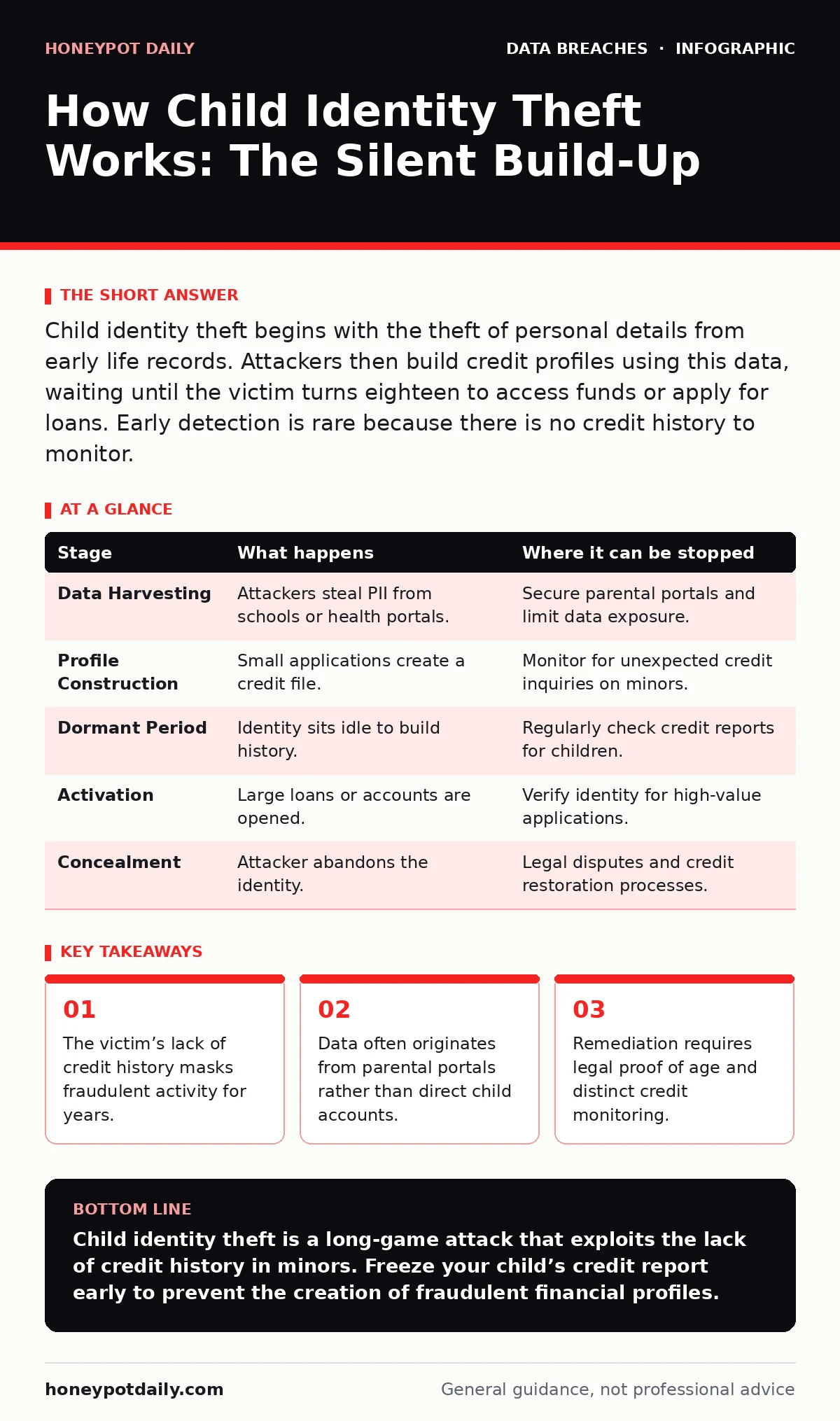
Child identity theft begins with the theft of personal details from early life records. Attackers then build credit profiles using this data, waiting until the victim turns eighteen to access funds or apply for loans. Early detection is rare because there is no credit history to monitor.
The Foundation of Silent Fraud
Child identity theft differs from adult fraud in its timeline and patience. An attacker does not seek immediate gain. Instead, they harvest identifying information to construct a synthetic identity. This identity remains dormant until the child reaches legal adulthood. By then, the stolen persona has a long, clean credit history.
The value lies in the time gap. Credit bureaus do not flag activity for minors in the same way they do for adults. A child has no legitimate reason to apply for credit. Therefore, any application using their details stands out as anomalous to automated systems, but often goes unnoticed by human reviewers until damage is done.
### Stage 1: Data Harvesting
The process begins with the acquisition of personal identifiers. Attackers target sources where parental and child data intersect. These include school registration portals, healthcare provider databases, and parental banking applications. A single breach in a school’s administrative system can yield names, dates of birth, and home addresses.
This stage relies on the assumption that minor data is low-value. Security teams often prioritise protecting financial transactions over educational records. This creates a blind spot. Attackers exploit this by scraping data from less secure entry points. They may also use social engineering to extract details from parents who are less wary of sharing their child’s information.
### Stage 2: Profile Construction
With basic identifiers in hand, the attacker builds a credit profile. They apply for small services, such as mobile phone contracts or streaming subscriptions, in the child’s name. These applications are often processed manually or through loopholes in automated verification systems. The goal is to generate a credit file.
This step is critical. Without a credit file, the stolen identity has no financial weight. The attacker ensures payments are made on time to build a positive history. This creates a veneer of legitimacy. When the child turns eighteen, the credit score appears strong and established. The fraud is hidden within the normal noise of credit reporting.
### Stage 3: The Dormant Period
For years, the stolen identity sits idle. The attacker monitors the profile but avoids large transactions. This patience allows the credit history to mature. It also allows the attacker to observe when the child approaches adulthood. They may apply for additional services to deepen the profile, such as utility accounts or minor loans.
During this phase, the victim is unaware. Parents rarely monitor their child’s credit report. Credit bureaus do not send alerts for minor activity linked to a non-existent credit file. The fraud relies on inertia. The longer the period, the more entrenched the identity becomes. Disentangling the fake history from the real person later becomes legally complex.
### Stage 4: Activation and Exploitation
Once the child reaches the age of majority, the attacker activates the profile. They apply for significant credit products, such as mortgages, car loans, or high-limit credit cards. The established credit history supports these applications. Automated systems approve them based on the fabricated track record.
This is the point of maximum damage. The attacker may drain accounts or default on loans. The victim suddenly discovers a poor credit score or unpaid debts. The attacker may also use the identity to open bank accounts, further complicating the financial trail. The sudden shift from dormancy to heavy usage triggers alerts, but only after the fraud is complete.
See also: SIM Swap Fraud: How Attackers Steal Your Identity and Money
### Stage 5: Concealment and Disappearance
After extracting value, the attacker discards the identity. They may move to a new victim or simply vanish. The damage remains with the victim. The victim must now prove that they did not authorise these actions.
This stage highlights the asymmetry of the attack. The attacker loses nothing but time. The victim loses years of financial standing. Rebuilding a credit history from scratch is difficult. It requires consistent, on-time payments over several years. The stolen years cannot be recovered, only mitigated.
| Stage | What happens | Where it can be stopped |
|---|---|---|
| Data Harvesting | Attackers steal PII from schools or health portals. | Secure parental portals and limit data exposure. |
| Profile Construction | Small applications create a credit file. | Monitor for unexpected credit inquiries on minors. |
| Dormant Period | Identity sits idle to build history. | Regularly check credit reports for children. |
| Activation | Large loans or accounts are opened. | Verify identity for high-value applications. |
| Concealment | Attacker abandons the identity. | Legal disputes and credit restoration processes. |
Interrupting the Chain
Stopping child identity theft requires proactive measures. You must treat a child’s data as sensitive as your own. This means securing parental accounts with strong authentication. It also means monitoring for unusual activity.
One effective method is placing a freeze on the child’s credit file. This prevents any new accounts from being opened. It does not stop the initial theft of data, but it blocks the construction of the credit profile. Without a credit file, the stolen identity has no financial utility.
This approach has limitations. It requires you to manage the freeze until the child is ready to seek credit. Forgetting to lift the freeze can cause delays in legitimate applications. You must balance security with future convenience.
The Hidden Costs of Remediation
When fraud is discovered, the remediation process is arduous. You must contact credit bureaus, lenders, and law enforcement. You need to provide proof of identity and evidence of fraud. This can take months or years.
The financial cost is not just the stolen money. It is the damage to the credit score. A poor score affects loan rates, insurance premiums, and even employment opportunities. The psychological toll is also significant. The victim loses trust in financial systems.
Preventing Future Exposure
Prevention starts with data hygiene. Limit the amount of personal information you share online. Be cautious with third-party services that request detailed family information. Many breaches occur through these less secure channels.
Consider how third-party data breaches impact your family. A breach in a school or healthcare provider can expose your child’s data. You cannot control these entities, but you can mitigate the risk. Use unique passwords for each parental account. Enable multi-factor authentication wherever possible.
This aligns with the principles of data inventory and mapping. Knowing where your family’s data resides helps you prioritise security efforts. It allows you to identify weak points in your digital footprint. By understanding the flow of information, you can better protect against exploitation.
Key takeaways
- The victim’s lack of credit history masks fraudulent activity for years.
- Data often originates from parental portals rather than direct child accounts.
- Remediation requires legal proof of age and distinct credit monitoring.
Child identity theft is a long-game attack that exploits the lack of credit history in minors. Freeze your child’s credit report early to prevent the creation of fraudulent financial profiles.
Frequently asked questions
Does a credit freeze protect against all types of identity theft?
No, it only prevents new credit accounts from being opened. It does not stop tax fraud or medical identity theft.
How long does it take to remove fraudulent accounts?
It varies, but typically takes several months. Disputes must be filed with each bureau and lender involved.
Is it safe to use my child’s data for parental apps?
Minimise the data shared. Use generic information where possible and avoid providing full dates of birth or SSNs unless absolutely necessary.
How this guide was produced: written by the Honeypot Daily editorial team with AI assistance, checked against the public references listed below, and reviewed when the facts change. See our editorial policy or report an error.