SIM Swap Fraud: How Attackers Steal Your Identity and Money
Attackers bypass your phone's security by convincing the carrier to move your number to a new device, rendering two-factor authentication useless.
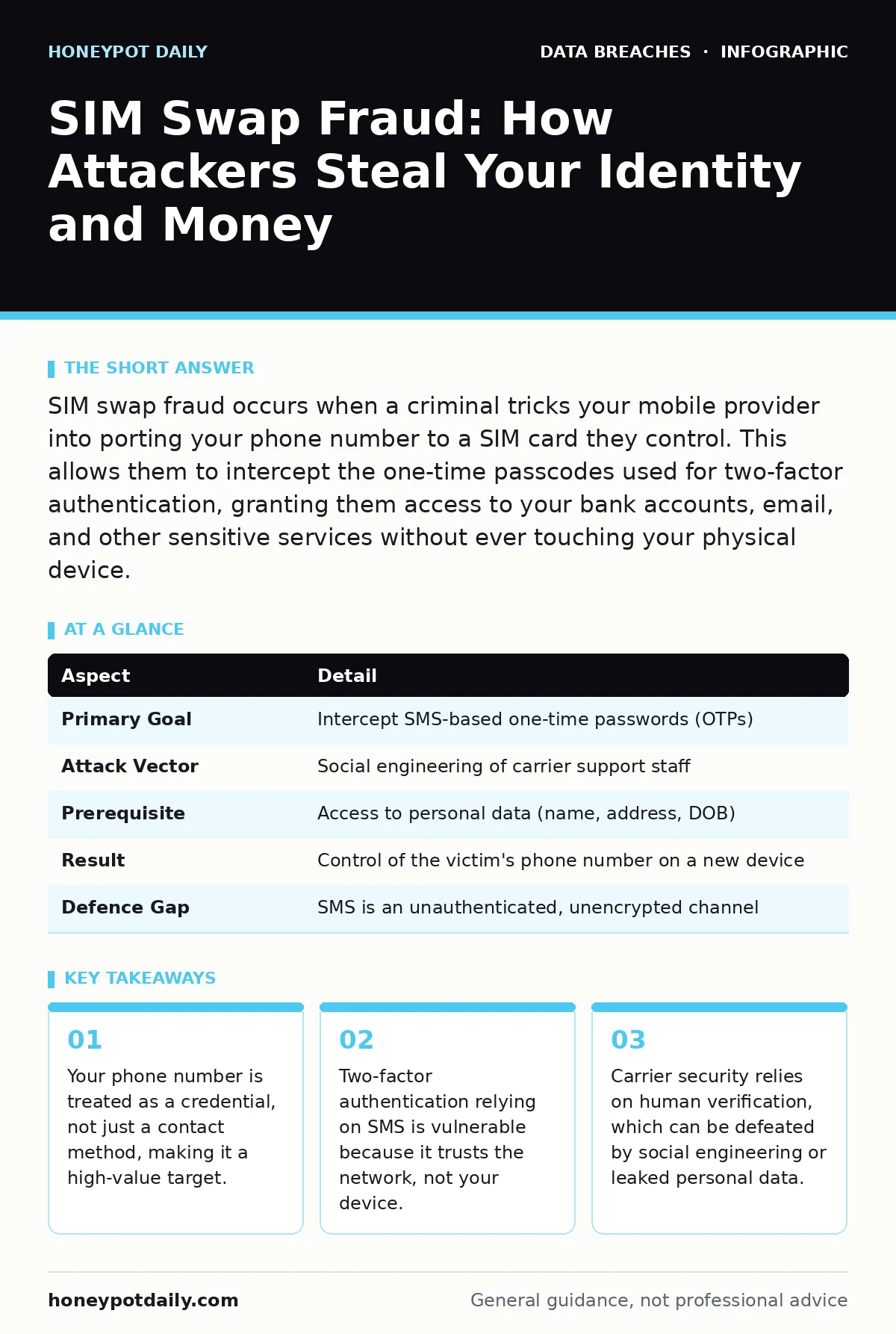
SIM swap fraud occurs when a criminal tricks your mobile provider into porting your phone number to a SIM card they control. This allows them to intercept the one-time passcodes used for two-factor authentication, granting them access to your bank accounts, email, and other sensitive services without ever touching your physical device.
The Analogy: Renting Your Identity
Imagine your home address is your phone number. You lock your front door, but the key to that lock is not a physical metal object. It is a piece of paper held by the local post office. If a stranger convinces the post office that they are you, they receive all your mail. They do not need to break into your house. They simply redirect the flow of information. Your house remains secure, but your identity has been hijacked in the transit layer.
This is the mechanism behind SIM swap fraud. The attacker does not hack your phone. They hack the relationship between your phone and the network provider.
At a Glance: The Mechanics of SIM Swapping
| Aspect | Detail |
|---|---|
| Primary Goal | Intercept SMS-based one-time passwords (OTPs) |
| Attack Vector | Social engineering of carrier support staff |
| Prerequisite | Access to personal data (name, address, DOB) |
| Result | Control of the victim's phone number on a new device |
| Defence Gap | SMS is an unauthenticated, unencrypted channel |
How the Attack Executes
The process begins with data gathering. The attacker needs enough personal information to pass the carrier's identity checks. This data often comes from third-party data breaches where names, addresses, and birth dates were leaked. With this dossier, the attacker contacts your mobile provider.
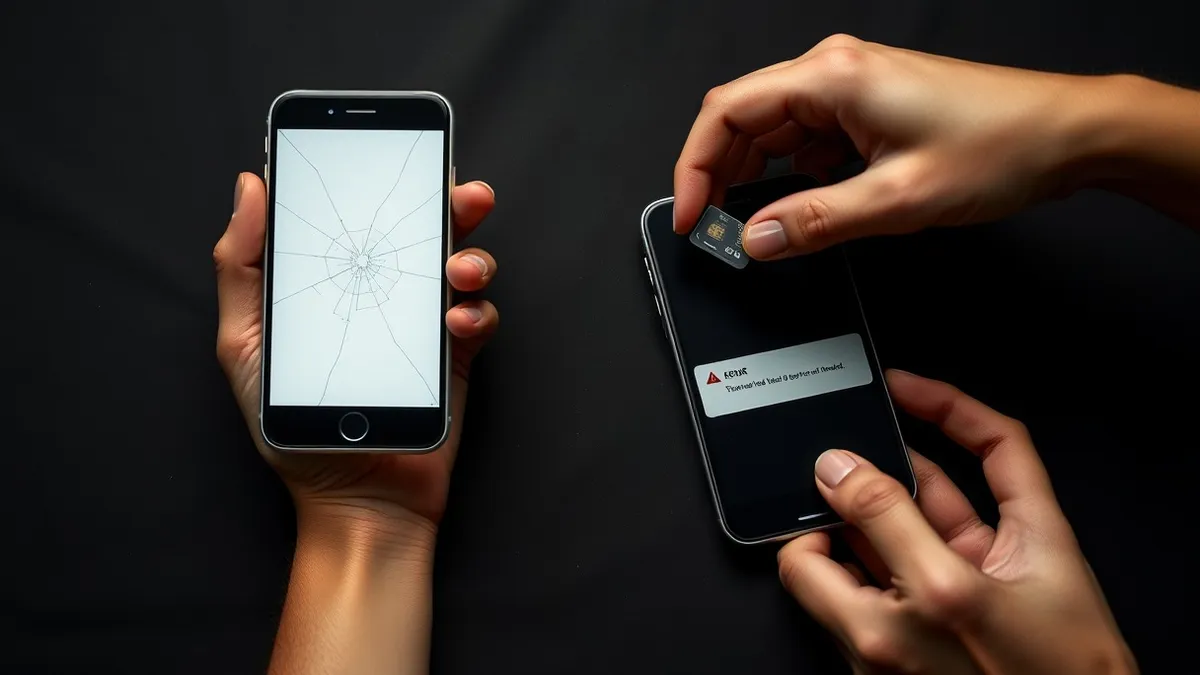
They claim their SIM card is lost or damaged. They request a replacement to be sent to a new address or activated on a device they hold. The carrier representative, following standard procedure, asks verification questions. If the attacker’s answers match the records, the representative ports your number to the attacker’s SIM.
Your phone loses signal. You see "No Service" or "Emergency Calls Only." The attacker’s device now rings when someone calls you. More critically, it receives your text messages.
The SMS Authentication Trap
The danger lies in how we use phone numbers for security. Many services use SMS as a second factor for login. This is known as two-factor authentication. The system assumes that only you can receive the text message sent to your number. This assumption fails during a SIM swap.
Because the attacker now controls the number, they receive the login codes. They can reset passwords for your email, banking, and social media accounts. You are locked out of your digital life. The attacker does not need to guess your password; they simply reset it using the code delivered to their device.
Who Is Targeted and Why
You might assume only wealthy individuals are at risk. While high-net-worth individuals are frequent targets due to the potential payout, the threat is broader. Anyone with valuable accounts is a candidate. This includes individuals with significant cryptocurrency holdings, active online banking, or professional email accounts.
Even those without wealth can be affected. Attackers may target accounts not for immediate cash, but for lateral movement. They use your account to contact your contacts, spreading malware or phishing links. This turns you into an unwitting accomplice. The financial impact on you may be secondary to the damage done to your network.
See also: How Child Identity Theft Works: The Silent Build-Up
Common Forms of SIM Swap Fraud
The fraud manifests in several ways, depending on the attacker’s end goal.
- Direct Financial Theft: The attacker resets banking passwords and transfers funds. This is the most direct form.
- Crypto Wallet Draining: Many cryptocurrency exchanges use SMS for withdrawal confirmations. Once the attacker controls the number, they can move assets to a wallet they control.
- Account Takeover: The attacker resets email passwords. Email is the master key to the internet. With access to your inbox, they can reset passwords for every other service you use.
- Social Engineering Amplification: The attacker uses your social media to request money from friends or colleagues, leveraging your trust.
What People Usually Get Wrong
There is a persistent myth that SIM swapping is a technical hack. It is not. It is a process failure. The mobile network infrastructure is not broken; the human verification step is.
Another misconception is that changing your password stops the attack. It does not. If the attacker can reset the password via SMS, your current password is irrelevant. The vulnerability is in the recovery method, not the login credential.
Finally, many believe that being careful with passwords is enough. While good hygiene helps, it does not mitigate the risk of identity theft at the carrier level. You cannot password-protect the relationship between your name and your phone number.
How to Reduce the Risk
Mitigation requires layers of defence. You must harden your identity and remove the attacker’s leverage.
- Add a SIM PIN: Set a PIN code on your SIM card. This prevents the SIM from working in another device unless the PIN is entered. If the attacker ports your number, they still cannot use the SIM without this code. Note that this does not stop the porting process itself, but it complicates usage.
- Use Authenticator Apps: Replace SMS two-factor authentication with time-based one-time password (TOTP) apps. These generate codes on your device, independent of the mobile network. The attacker cannot intercept these codes because they are not sent over the air.
- Set a Carrier PIN: Contact your mobile provider and set a specific passcode for account changes. This is separate from your mobile PIN. Require this code for any SIM replacement or porting request.
- Limit Public Data: Reduce the personal information available online. The easier it is for attackers to answer verification questions, the higher your risk. Regularly check if your data has been exposed in data breaches and consider services like dark web monitoring to alert you to new exposures.
- Use Hardware Keys: For high-value accounts, use physical security keys. These devices require a physical tap to approve a login. They are immune to SIM swapping because the attacker cannot replicate the physical device.
The Hidden Cost of Recovery
Recovering from a SIM swap is time-consuming. You must contact your carrier to reverse the port. You must then reset passwords for every service that used SMS verification. This can take days or weeks.
During this window, attackers may have already drained accounts or damaged your reputation. Even after recovery, the psychological toll is significant. You lose trust in your own devices and communication channels.
The best defence is prevention. By removing SMS from your security stack, you remove the attacker’s primary weapon. Your phone number should be for calling and texting, not for logging in.
Key takeaways
- Your phone number is treated as a credential, not just a contact method, making it a high-value target.
- Two-factor authentication relying on SMS is vulnerable because it trusts the network, not your device.
- Carrier security relies on human verification, which can be defeated by social engineering or leaked personal data.
Frequently asked questions
Can I tell if my SIM has been swapped?
Yes. If your phone suddenly loses all signal and cannot make emergency calls, your SIM may have been swapped. You will also miss incoming calls and texts.
Is switching to an authenticator app enough?
It significantly reduces risk. However, you should also set a carrier PIN and a SIM PIN to add layers of protection against account takeover and SIM reuse.
How long does it take to reverse a SIM swap?
It varies by carrier. Some resolve it within hours, while others may take several days. Contact your provider immediately upon noticing signal loss.
Are prepaid phones safer from SIM swaps?
Not necessarily. While verification may be simpler, the fundamental vulnerability remains. If the attacker can impersonate you to the carrier, they can port the number regardless of the plan type.
How this guide was produced: written by the Honeypot Daily editorial team with AI assistance, checked against the public references listed below, and reviewed when the facts change. See our editorial policy or report an error.