What a Digital Forensics Analyst Actually Does in a Breach
A digital forensics analyst reconstructs events from binary residues, proving that silence in logs is often louder than noise.
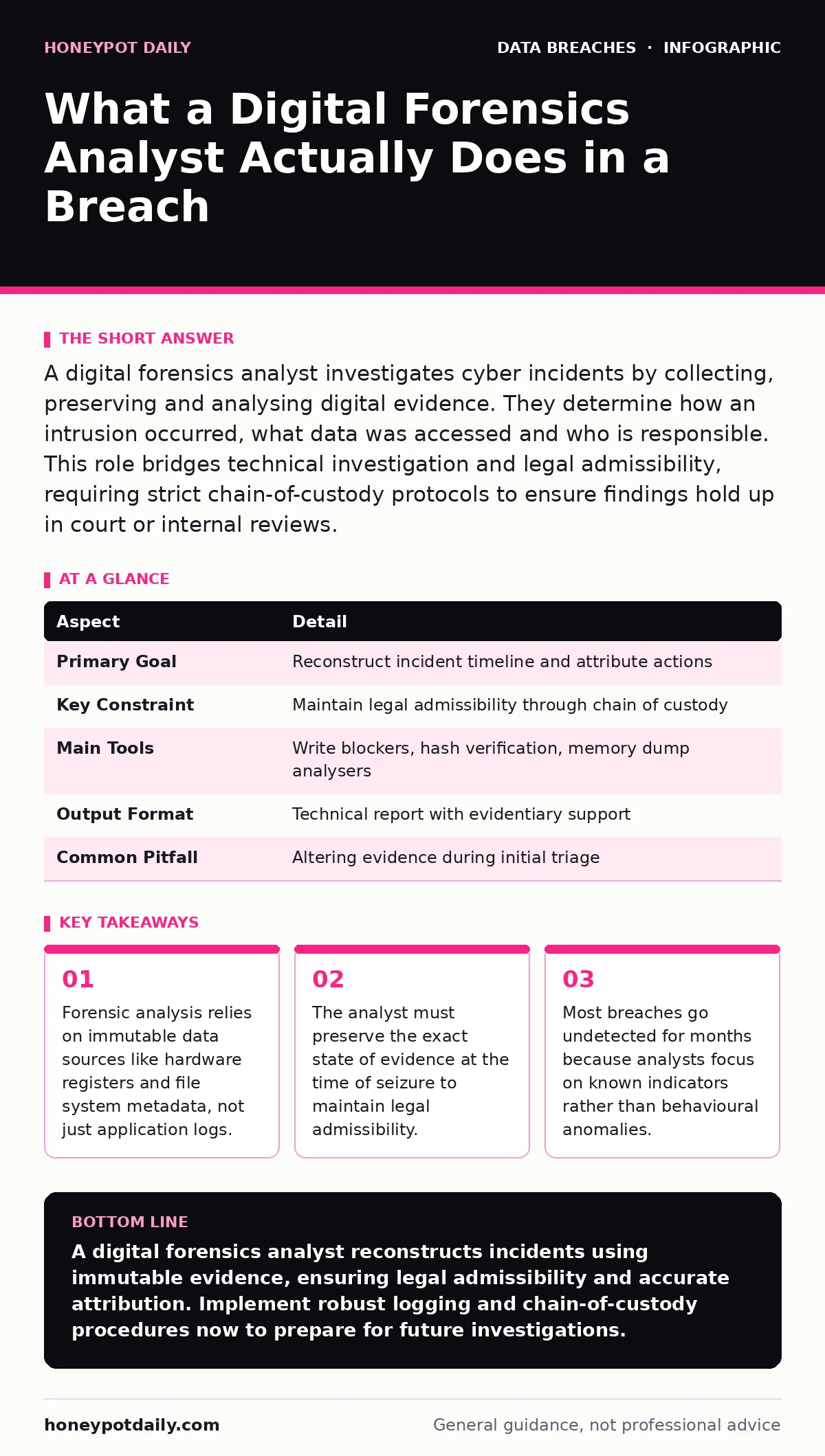
A digital forensics analyst investigates cyber incidents by collecting, preserving and analysing digital evidence. They determine how an intrusion occurred, what data was accessed and who is responsible. This role bridges technical investigation and legal admissibility, requiring strict chain-of-custody protocols to ensure findings hold up in court or internal reviews.
The Core Function of a Digital Forensics Analyst
Imagine a crime scene where every footprint dissolves in rain. A digital forensics analyst works in this environment. They examine electronic devices and network traffic to reconstruct past events. Their primary goal is to establish a factual timeline of an incident. This role differs from general IT support because the outcome must withstand legal or disciplinary scrutiny. The analyst does not merely fix the problem; they document how it happened.
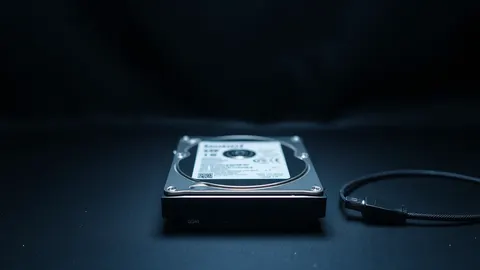
The work begins with preservation. Any action taken on a compromised system alters its state. Writing to a hard drive changes file timestamps and metadata. Therefore, the analyst creates a bit-for-bit copy of the storage medium. This image is the only source used for analysis. The original device remains untouched. This process ensures that the evidence remains admissible in court. If the chain of custody breaks, the entire investigation may be dismissed.
| Aspect | Detail |
|---|---|
| Primary Goal | Reconstruct incident timeline and attribute actions |
| Key Constraint | Maintain legal admissibility through chain of custody |
| Main Tools | Write blockers, hash verification, memory dump analysers |
| Output Format | Technical report with evidentiary support |
| Common Pitfall | Altering evidence during initial triage |
How Forensic Analysis Works in Practice
The analyst starts by verifying the integrity of the evidence. They calculate a cryptographic hash of the disk image. This hash acts as a digital fingerprint. If the hash changes, the evidence has been tampered with. The analyst then examines volatile data first. Random access memory contains processes, network connections and decrypted keys. This data disappears when power is cut. Static data on hard drives persists but lacks context.
Next, the analyst correlates logs from different sources. Operating system logs, application logs and network flow data must align. Discrepancies often reveal the attack vector. For instance, a login event in the server log might not match the authentication server records. This gap indicates credential theft or pass-the-hash attacks. The analyst maps these events to a timeline. They identify the initial compromise, lateral movement and data exfiltration points.
What People Usually Get Wrong
Many organisations believe that deleting malicious files removes the threat. This is incorrect. Malware often installs persistence mechanisms in the registry or scheduled tasks. These mechanisms survive deletion. The analyst must identify all persistence points. Otherwise, the attacker regains access. Another common error is relying solely on antivirus software. Modern threats use fileless techniques. They operate entirely in memory. Traditional signature-based tools miss these attacks.
Organisations also underestimate the value of passive data. Network traffic metadata can reveal command-and-control communications. Even if the payload is encrypted, the timing and volume of traffic are visible. The analyst looks for anomalies in these patterns. A sudden burst of outbound traffic to an unknown IP address is suspicious. This approach complements active scanning. It provides a broader view of the incident.
The Hidden Costs of Poor Forensics
When an investigation is rushed, critical evidence is lost. This leads to incomplete remediation. The attacker retains access. The breach continues silently. The cost of a prolonged breach far exceeds the cost of a thorough investigation. Legal liabilities also increase. If the analyst cannot prove the scope of data loss, regulatory fines may be higher. Accurate attribution is difficult but necessary. It determines whether the incident was external or insider-driven.
Insider threats are harder to detect. They have legitimate access. Their actions blend with normal activity. The analyst must establish a baseline of normal behaviour. Deviations from this baseline indicate compromise. This requires historical data. Without logs from before the incident, attribution is nearly impossible. This highlights the importance of proactive logging strategies. Reactive measures are often insufficient.
Who Is Affected by Forensic Findings
The findings impact multiple stakeholders. Legal teams need accurate timelines for litigation. Compliance officers require proof of data handling. Management needs risk assessments. The analyst’s report translates technical details into business impact. It answers who, what, when and how. This clarity is vital for decision-making. However, the report must be precise. Ambiguity leads to misinterpretation. Misinterpretation can lead to wrongful accusations or inadequate remediation.
Employees may also be affected. If an insider is implicated, their career ends. The analyst must ensure fairness. Bias in analysis can ruin lives. Objectivity is paramount. The analyst follows standard procedures. They document every step. This transparency protects both the organisation and the individual. It ensures that conclusions are based on evidence, not assumption.
See also: How security operations centers detect and respond to threats · Whaling Attack Response: Containment, Recovery and Prevention Steps
Integrating Forensics with Broader Security
Forensics does not exist in isolation. It informs future prevention. The analyst identifies gaps in monitoring. These gaps are then closed. For example, if logs were missing, logging is enhanced. This feedback loop strengthens security posture. It turns a breach into a learning opportunity. The organisation becomes more resilient. This continuous improvement is key to long-term security.
Consider the role of full disk encryption. It protects data at rest. However, it does not prevent live analysis of memory. If an attacker gains access, they can bypass encryption. The analyst must still examine memory dumps. Encryption is a layer, not a silver bullet. Similarly, data inventory and mapping helps identify what was stolen. Without knowing what data exists, scoping the breach is guesswork. Accurate inventories reduce uncertainty.
The Future of the Digital Forensics Analyst
As technology evolves, so do threats. Cloud environments complicate forensics. Data is distributed across regions. Jurisdictional issues arise. The analyst must adapt. They need skills in cloud architecture and API integration. Traditional disk imaging is less relevant. Containerised environments require new techniques. The analyst must stay current. Continuous learning is not optional. It is a requirement.
The rise of artificial intelligence changes the landscape. Automated tools can process vast amounts of data. However, they require human oversight. False positives are common. The analyst validates findings. They provide context that machines cannot. This human element remains critical. Technology assists, but does not replace, the analyst. The skill set shifts from manual searching to strategic oversight.
Practical Steps for Preparation
You can prepare for forensic needs today. Start by enabling detailed logging. Store logs securely. Ensure they are tamper-proof. Define retention policies. Keep logs long enough for investigations. Train staff on incident response. Practice with simulations. Identify your digital forensics analyst contacts. Establish relationships before a crisis. This preparation reduces response time. It improves outcomes.
Consider password hashing and salting. It protects credentials. If passwords are stolen, hashes make them unusable. This limits the damage. However, it does not prevent the theft. The analyst must still investigate the breach. Strong authentication reduces the attack surface. It is a preventive measure. Forensics is a reactive measure. Both are necessary.
Also, review personally identifiable information handling. Know where sensitive data resides. This knowledge speeds up scoping. It reduces liability. If you know what is at risk, you can protect it better. Forensics confirms what happened. Preparation prevents what could happen. The combination is powerful.
Key takeaways
- Forensic analysis relies on immutable data sources like hardware registers and file system metadata, not just application logs.
- The analyst must preserve the exact state of evidence at the time of seizure to maintain legal admissibility.
- Most breaches go undetected for months because analysts focus on known indicators rather than behavioural anomalies.
A digital forensics analyst reconstructs incidents using immutable evidence, ensuring legal admissibility and accurate attribution. Implement robust logging and chain-of-custody procedures now to prepare for future investigations.
Frequently asked questions
What tools does a digital forensics analyst use?
Analysts use write blockers to prevent evidence alteration, hash verification tools for integrity, and memory dump analysers for volatile data. They also employ network packet analysers and log correlation software.
How long does a forensic investigation take?
Duration varies by complexity. Simple incidents may take days. Complex breaches involving multiple systems and jurisdictions can take months. The key is preserving evidence immediately.
Can a digital forensics analyst prove who did it?
They can attribute actions to specific accounts or IP addresses. However, proving the identity of the individual behind those accounts requires additional intelligence and often law enforcement cooperation.
What is the difference between forensics and incident response?
Incident response focuses on containment and recovery. Forensics focuses on evidence collection and analysis. They often overlap, but forensics prioritises legal admissibility and detailed reconstruction.
How this guide was produced: written by the Honeypot Daily editorial team with AI assistance, checked against the public references listed below, and reviewed when the facts change. See our editorial policy or report an error.