
Log Tampering Detection: How Attackers Erase Their Digital Footprints
Attackers routinely overwrite log records to match expected sequences, rendering simple checksums and file integrity monitoring ineffective against determined adversaries.
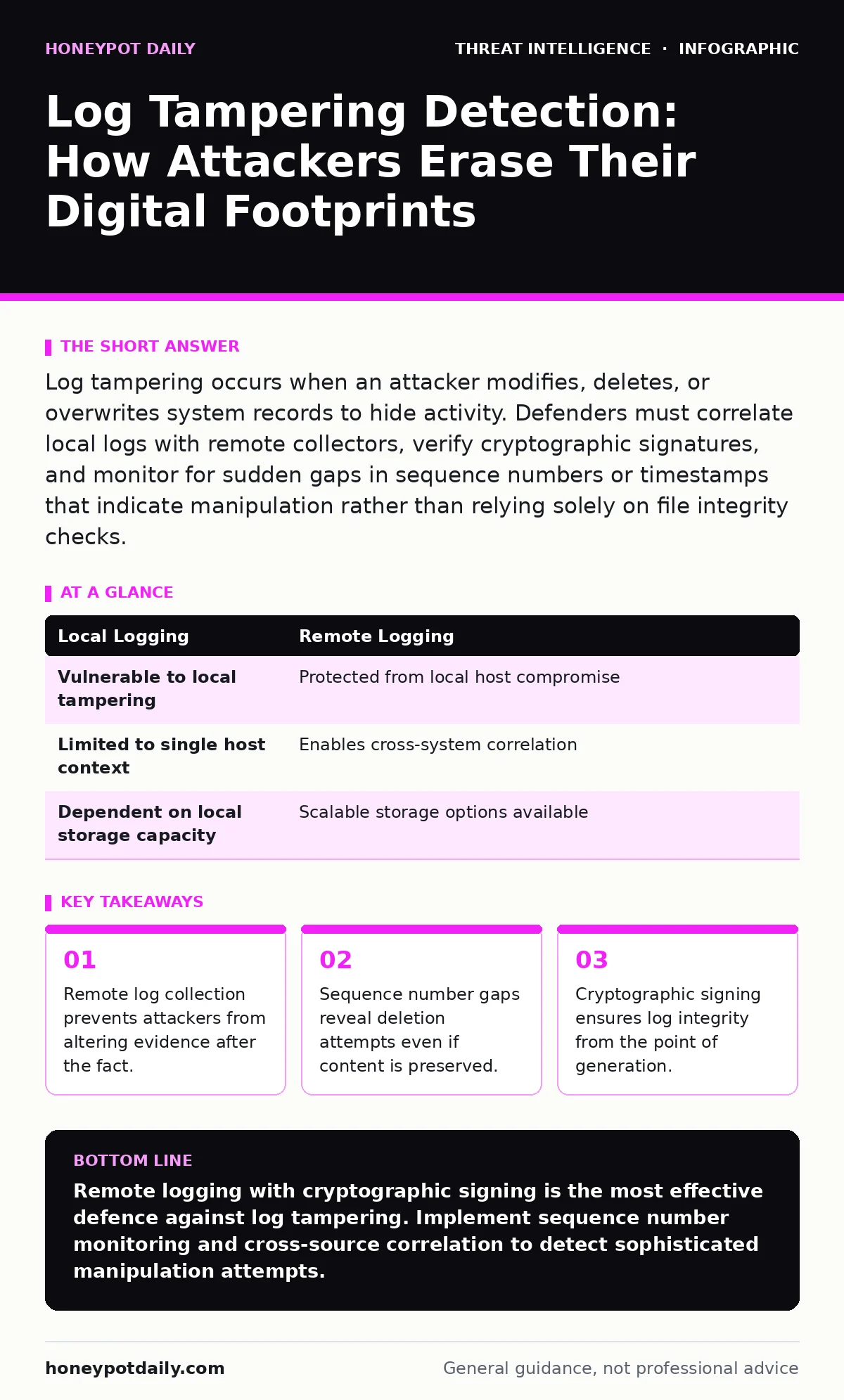
Log tampering occurs when an attacker modifies, deletes, or overwrites system records to hide activity. Defenders must correlate local logs with remote collectors, verify cryptographic signatures, and monitor for sudden gaps in sequence numbers or timestamps that indicate manipulation rather than relying solely on file integrity checks.
What constitutes log tampering in security operations
Log tampering involves any unauthorised modification, deletion, or insertion of data within system, application, or security logs. Attackers perform this action to erase their digital footprint after gaining access. They may overwrite specific entries, clear entire log files, or inject false records to create confusion. This activity directly undermines the ability of defenders to reconstruct an incident timeline. Understanding this behaviour is fundamental to maintaining reliable audit trails.
Why do attackers target log files first
Attackers target log files because they provide the primary evidence of intrusion steps. Without logs, defenders cannot determine how an entry point was exploited or what data was accessed. Early log suppression allows attackers to operate with reduced visibility. This tactic buys time for lateral movement and privilege escalation. It also complicates forensic investigations by removing the initial indicators of compromise. Refer to our guide on alert triage for methods to prioritise these early signals.
How can remote logging prevent evidence destruction
Remote logging sends log data to a centralised server immediately upon generation. This separation ensures that even if an attacker compromises the local host, the remote records remain intact. The attacker cannot delete or modify logs that reside on a different system. This architecture creates a reliable backup of activity records. It also allows for correlation across multiple hosts to identify patterns.
| Local Logging | Remote Logging |
|---|---|
| Vulnerable to local tampering | Protected from local host compromise |
| Limited to single host context | Enables cross-system correlation |
| Dependent on local storage capacity | Scalable storage options available |
What reveals gaps in log sequences
Sequence numbers assigned to log entries reveal gaps when an attacker deletes records. If logs jump from entry 100 to entry 105, the missing entries indicate tampering. Attackers often struggle to maintain consistent sequencing when injecting false records. Monitoring for non-sequential jumps provides a strong indicator of manipulation. This method works even if the attacker preserves the file structure but removes specific lines.
Do file integrity monitors detect log changes
File integrity monitors detect changes to log file sizes or timestamps. They alert when a log file is modified, deleted, or replaced. However, they do not verify the content of the changes. An attacker who overwrites a log entry with plausible data may not trigger a significant alert. The file size remains similar, and the structure stays intact. Therefore, integrity monitors alone are insufficient for detecting sophisticated tampering.
See also: How security operations centers detect and respond to threats · Whaling Attack Response: Containment, Recovery and Prevention Steps
How does cryptographic signing verify log authenticity
Cryptographic signing involves digitally signing each log entry at the moment of creation. This process uses a private key known only to the logging service. Verifiers use the corresponding public key to confirm that the entry has not been altered. Any modification to the signed data invalidates the signature. This method provides strong evidence of tampering, as attackers cannot forge valid signatures without the private key.
What role do timestamps play in detection
Timestamps help identify anomalies in log generation patterns. Attackers may backdate logs to blend with legitimate activity or rush entries to fill gaps. Inconsistent timestamp intervals can reveal automated injection attempts. Sudden bursts of logs followed by silence may indicate a cover-up attempt. Comparing timestamps against known system behaviour helps identify these irregularities. See our article on network enumeration for context on normal baseline activity.
Can attackers forge realistic log entries
Attackers can forge realistic log entries by studying existing patterns. They replicate standard formats, user IDs, and event codes. This makes forged entries difficult to distinguish from legitimate ones. However, forged entries often lack contextual consistency with other system events. For example, a login log may not match corresponding network connection records. Cross-referencing multiple data sources exposes these inconsistencies.
How does process injection affect log integrity
Process injection allows attackers to execute code within legitimate processes. This technique can bypass logging mechanisms by hiding actions from standard auditors. Injected code may suppress log generation for specific actions. It can also redirect log output to null devices. Defenders must monitor for unusual process behaviour and memory anomalies. Read our guide on process injection to understand these evasion techniques.
What advanced techniques detect sophisticated tampering
Advanced detection combines multiple signals to identify tampering. Machine learning models analyse log patterns to detect subtle anomalies. These models learn normal behaviour and flag deviations. Statistical analysis of log volume, frequency, and content helps identify outliers. Integrating threat intelligence feeds provides context for suspicious activities. This multi-layered approach reduces false positives and improves detection accuracy.
Key takeaways
- Remote log collection prevents attackers from altering evidence after the fact.
- Sequence number gaps reveal deletion attempts even if content is preserved.
- Cryptographic signing ensures log integrity from the point of generation.
Remote logging with cryptographic signing is the most effective defence against log tampering. Implement sequence number monitoring and cross-source correlation to detect sophisticated manipulation attempts.
Frequently asked questions
How do I verify if my logs have been tampered with?
Check for sequence number gaps, verify cryptographic signatures, and compare local logs with remote copies. Look for inconsistent timestamps and unusual log volume patterns.
Can attackers bypass remote logging?
Attackers can attempt to disrupt the network connection between the host and the log server. However, they cannot alter logs already stored on the remote server.
What is the difference between log suppression and log tampering?
Log suppression prevents logs from being created, while log tampering modifies or deletes existing logs. Both aim to hide activity but use different methods.
Should I delete old logs to free up space?
Delete old logs only after archiving them securely. Ensure archived logs are cryptographically signed and stored on immutable media. Refer to our guide on **cybercrime forums** for insights on data retention risks.
How this guide was produced: written by the Honeypot Daily editorial team with AI assistance, checked against the public references listed below, and reviewed when the facts change. See our editorial policy or report an error.