
Password Spraying vs Dictionary Attack: Mechanics, Risks and Detection
Password spraying avoids lockouts by trying one weak credential against thousands of accounts, while dictionary attacks hammer one account with many guesses.
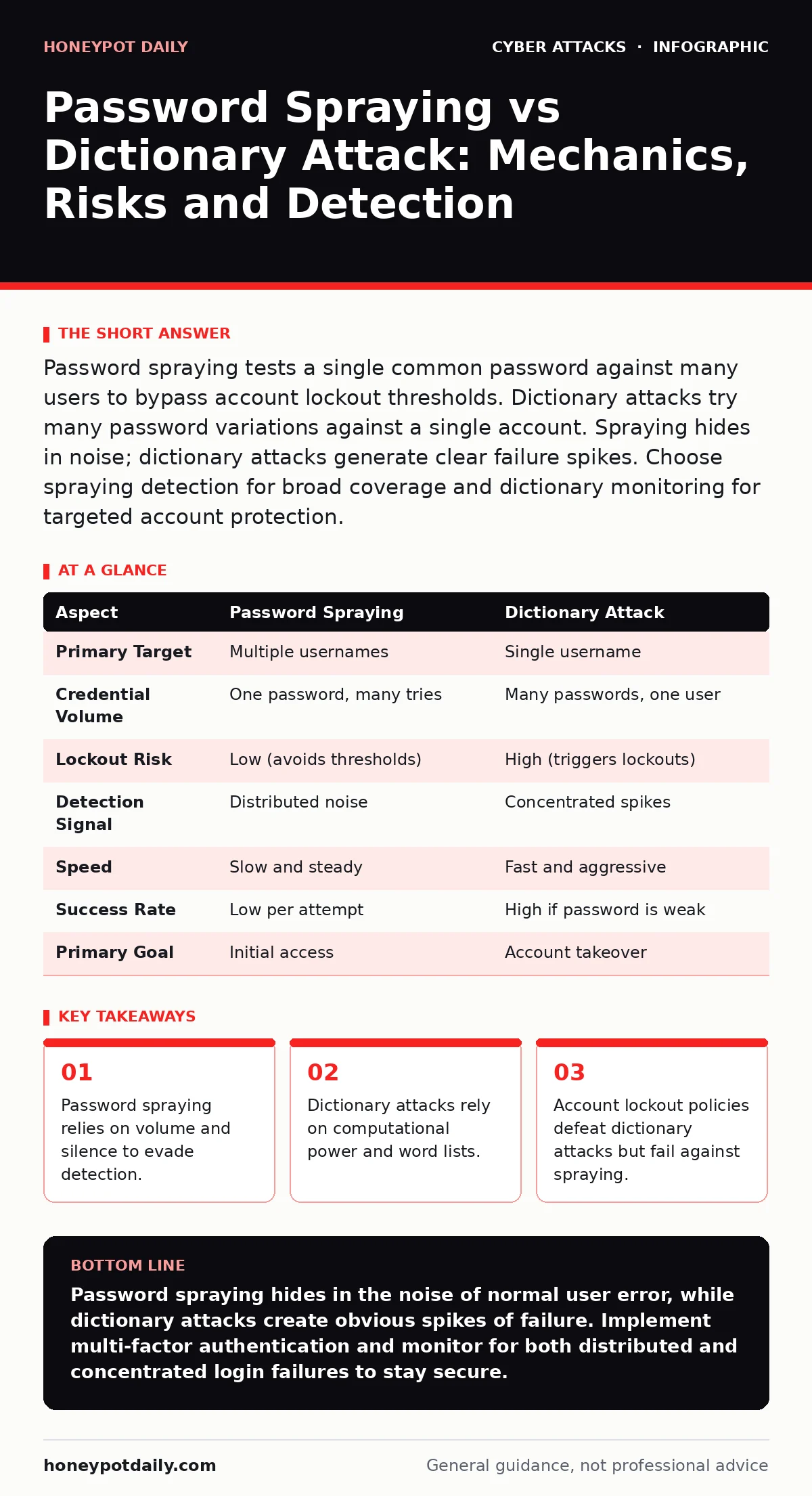
Password spraying tests a single common password against many users to bypass account lockout thresholds. Dictionary attacks try many password variations against a single account. Spraying hides in noise; dictionary attacks generate clear failure spikes. Choose spraying detection for broad coverage and dictionary monitoring for targeted account protection.
The Core Difference Between Password Spraying and Dictionary Attacks
The fundamental difference between password spraying and dictionary attacks lies in the direction of the brute force effort. Password spraying involves an attacker selecting a single, high-probability password and attempting to authenticate it against a vast number of usernames within an organisation. This method prioritises breadth over depth, aiming to find any account that happens to use that specific weak credential.
Dictionary attacks, by contrast, focus on depth. The attacker targets a single specific username and cycles through a large list of potential passwords, derived from common words, patterns or leaked databases. This approach seeks to crack one specific account rather than surveying the entire user base.
What Is Password Spraying?
Password spraying is a low-and-slow credential stuffing technique. The attacker chooses a password that is statistically likely to be used by many people, such as a season name, a sports team or a simple numeric sequence. They then attempt to log in with this password against hundreds or thousands of accounts. The critical mechanism here is the avoidance of account lockout. Most security systems lock an account after a certain number of failed login attempts.
By only trying one password per account, the attacker stays under this threshold. The resulting failed login attempts appear as normal user error rather than a coordinated attack. This technique exploits the human tendency to reuse simple, memorable passwords across multiple services. It is particularly effective against organisations that enforce weak password complexity requirements or lack multi-factor authentication.
What Is a Dictionary Attack?
A dictionary attack is a targeted brute force method. The attacker possesses a "dictionary" file containing millions of potential passwords. This list might include common passwords, variations of the target username, or entries from previous data breaches. The attacker selects a specific target account and submits these passwords one by one. Modern dictionary attacks often use "masks" to add complexity, such as appending numbers or symbols to dictionary words.
This method assumes the target account holds valuable data or privileges. The attacker is willing to trigger account lockouts because they are focused on a single high-value target. If the system locks the account after five failures, the attacker simply waits for the lockout period to expire or moves to a different account if they have a list of high-value targets. This approach is computationally intensive but highly effective against users who choose predictable passwords.
Comparison: Password Spraying vs Dictionary Attack
| Aspect | Password Spraying | Dictionary Attack |
|---|---|---|
| Primary Target | Multiple usernames | Single username |
| Credential Volume | One password, many tries | Many passwords, one user |
| Lockout Risk | Low (avoids thresholds) | High (triggers lockouts) |
| Detection Signal | Distributed noise | Concentrated spikes |
| Speed | Slow and steady | Fast and aggressive |
| Success Rate | Low per attempt | High if password is weak |
| Primary Goal | Initial access | Account takeover |
When to Choose Password Spraying Defences
Choose to prioritise password spraying detection when your environment has a large user base with diverse password habits. This approach is necessary if you cannot enforce strict multi-factor authentication across all accounts. You should implement this when your logging infrastructure can correlate low-frequency failures across many users. Look for patterns where the same password fails for dozens of accounts in a short window.
This method is also vital if you observe increased authentication traffic from unfamiliar geographic locations. Suppose your security operations center sees a slight uptick in failed logins that does not trigger standard alerts. This could indicate a slow spray. Implementing rate limiting per IP address helps mitigate this. You must also monitor for successful logins immediately following a series of failures, as this indicates a successful compromise.
When to Choose Dictionary Attack Defences
Choose to prioritise dictionary attack mitigation when protecting high-privilege accounts or service accounts. These accounts are specific targets for attackers seeking deep access. You should implement this when your accounts use predictable passwords based on usernames or common words. This is critical if you lack account lockout policies or if those policies have long cooldown periods.
You must ensure your authentication system can detect rapid-fire attempts against a single identity. Implementing progressive delays between login attempts slows down automated dictionary tools. You should also enforce complex password requirements to increase the size of the dictionary an attacker must try. Suppose an attacker targets your administrative console. A dictionary attack is likely. Strong passwords and multi-factor authentication render this attack ineffective.
Overlapping Defences and Shared Risks
Both attacks rely on weak user passwords. No amount of detection will stop an attacker if users choose "Password123". You must enforce strong password policies and encourage the use of passphrases. Multi-factor authentication is the single most effective defence against both methods. Even if an attacker guesses the password, they cannot access the account without the second factor.
This applies to both spraying and dictionary attacks. You should also monitor for impossible travel, where a user logs in from two distant locations in a short time. This indicates credential theft. Regularly audit your logs for anomalies. Consider phishing simulations to ensure users do not hand over credentials directly, which bypasses all technical defences. Remember that session hijacking remains a risk even with strong passwords.
Advanced Detection Strategies
Detection requires behavioural analytics rather than simple threshold counting. For password spraying, look for the "same password, many users" pattern. For dictionary attacks, look for "many passwords, one user". Combine these signals with context. Is the login attempt from a known good IP? Is the device trusted?
Implementing DKIM helps verify email authenticity, reducing the success of phishing that leads to credential theft. Monitor for baiting attacks that trick users into revealing credentials. Your security operations centers must be tuned to these specific patterns. Do not rely on generic intrusion detection systems. Custom rules are necessary. Regularly update your blocklists and allowlists. Test your detection rules with controlled simulations.
Key takeaways
- Password spraying relies on volume and silence to evade detection.
- Dictionary attacks rely on computational power and word lists.
- Account lockout policies defeat dictionary attacks but fail against spraying.
Password spraying hides in the noise of normal user error, while dictionary attacks create obvious spikes of failure. Implement multi-factor authentication and monitor for both distributed and concentrated login failures to stay secure.
Frequently asked questions
Does multi-factor authentication stop password spraying?
Yes, multi-factor authentication stops password spraying because the attacker only has the password. They cannot provide the second factor, such as a code from an authenticator app, rendering the guessed credential useless.
Can a dictionary attack bypass account lockouts?
A standard dictionary attack will trigger account lockouts. Attackers may use distributed networks to spread attempts or wait for lockout periods to expire. They may also target accounts that do not have lockout policies enabled.
How do I distinguish spraying from normal user error?
Normal user error is random and sporadic. Password spraying shows a pattern where the same password fails for many different accounts within a short timeframe. Look for correlations in the failed credentials across the user base.
Are password spraying attacks slow?
Password spraying is intentionally slow to avoid detection. Attackers may take hours or days to spray a large organisation. This low-and-slow approach makes it difficult for automated systems to flag the activity as malicious.
How this guide was produced: written by the Honeypot Daily editorial team with AI assistance, checked against the public references listed below, and reviewed when the facts change. See our editorial policy or report an error.