Container runtime security: enforce policy after deployment
Runtime controls catch compromised containers that build-time scans miss, but they consume host resources and require careful tuning to avoid breaking services.
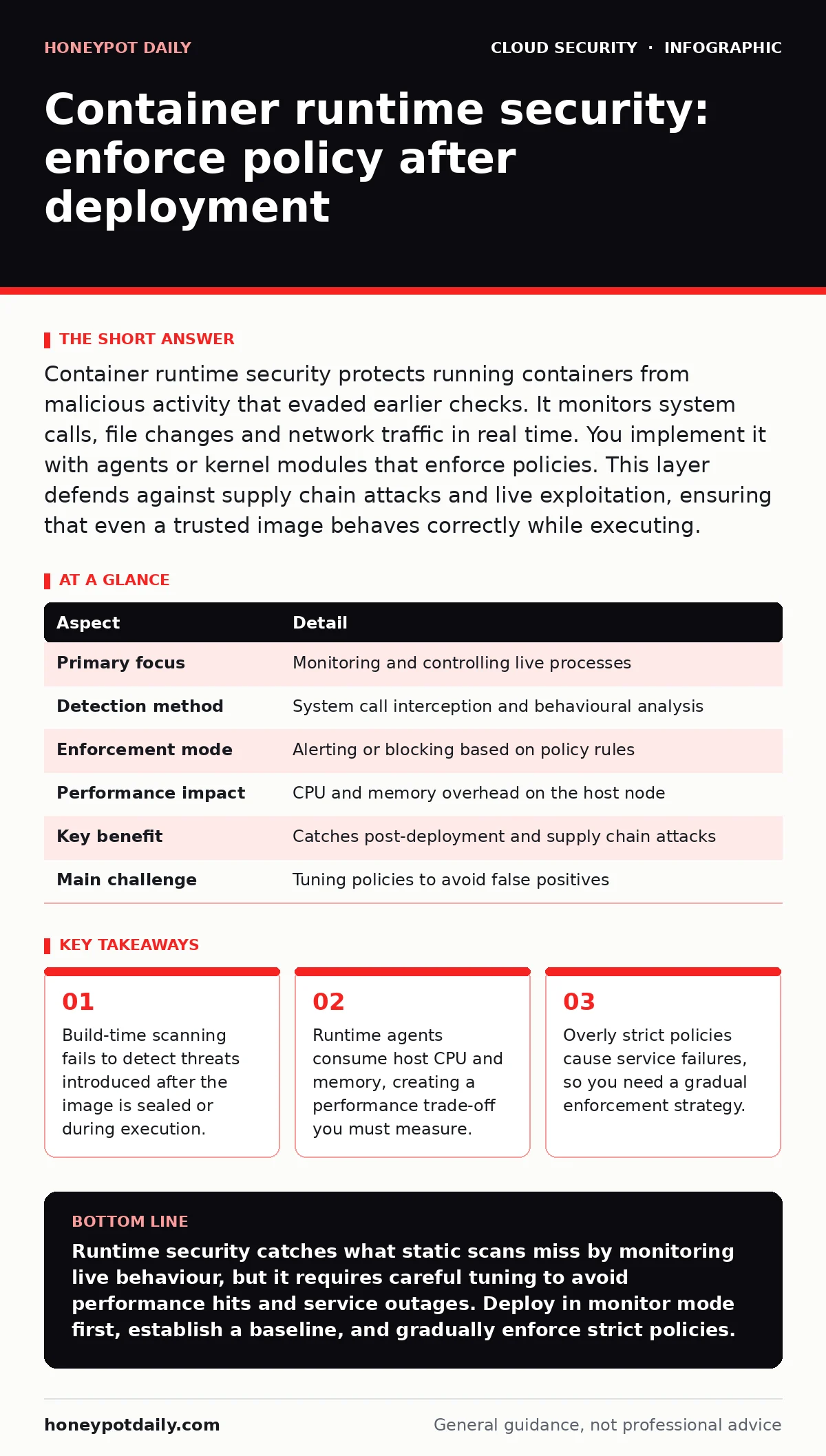
Container runtime security protects running containers from malicious activity that evaded earlier checks. It monitors system calls, file changes and network traffic in real time. You implement it with agents or kernel modules that enforce policies. This layer defends against supply chain attacks and live exploitation, ensuring that even a trusted image behaves correctly while executing.
The airport analogy for runtime protection
Imagine an airport security checkpoint. You screen every passenger before they board. This is your build-time scan. It checks for prohibited items in luggage. It verifies identity documents. It ensures the plane is loaded correctly. But what happens after the plane takes off? A passenger might pull a weapon from a hidden compartment.
Another might try to override the autopilot. The pre-flight scan cannot stop this. You need crew members monitoring the cabin. You need sensors in the cockpit. This is container runtime security. It watches the container after it has started. It detects behaviour that was not visible during the build. It stops actions that violate policy while the workload is live.
What is container runtime security?
Container runtime security is the set of controls that monitor and enforce policy on running containers. It operates at the operating system level. It uses kernel features like Linux Security Modules or eBPF. These tools intercept system calls before they reach the hardware. They allow or block actions based on rules you define. Unlike static analysis, which reads the image file, runtime security observes the process in action.
It sees which files are opened. It sees which ports are connected. It sees which commands are executed. This visibility catches threats that hide in the execution phase. It protects against supply chain compromises where the base image was clean but a dependency was tampered with later. It also stops lateral movement when an attacker uses a container as a pivot point.
| Aspect | Detail |
|---|---|
| Primary focus | Monitoring and controlling live processes |
| Detection method | System call interception and behavioural analysis |
| Enforcement mode | Alerting or blocking based on policy rules |
| Performance impact | CPU and memory overhead on the host node |
| Key benefit | Catches post-deployment and supply chain attacks |
| Main challenge | Tuning policies to avoid false positives |
How it works under the hood
The mechanism relies on deep kernel integration. When a process inside a container requests a resource, the kernel asks the security module for permission. The module checks the request against your policy. If the policy allows it, the request proceeds. If it denies it, the kernel blocks the action and logs the event. This happens in microseconds. You do not feel the delay. But the host CPU does the work. The security agent sits between the container and the kernel. It maintains a map of allowed behaviours for each container. For example, a web server should only read its configuration files. It should not execute shell commands. If the web server tries to run bash, the agent blocks it. This prevents command injection attacks. It also limits the blast radius of a breach. The attacker cannot escalate privileges or move laterally. The container remains isolated. This is different from network firewalls. Firewalls stop traffic at the edge. Runtime security stops actions inside the box.
Who it affects and why it matters
You care about this if you run stateful workloads. You care if you handle sensitive data. You care if you cannot trust every package in your supply chain. Attackers often bypass build-time scans. They use typosquatting to pull malicious packages. They exploit vulnerabilities in open-source libraries. They inject code during the CI/CD pipeline. These threats look normal until they run. Runtime security catches them. It also helps compliance teams. You need to prove that containers follow least privilege. You need to audit every access to sensitive files.
Runtime logs provide this evidence. They show who did what and when. This is vital for forensic analysis. If a breach occurs, you can trace the steps. You can see how the attacker moved. You can identify the root cause. This speeds up response times. It reduces the damage. It also affects developers. They must understand the policies. They must design applications that work within constraints. This shifts some security responsibility to the development phase. It encourages better coding practices. It reduces the need for runtime blocking.
What people usually get wrong
Many teams treat runtime security as a silver bullet. They install an agent and forget it. This fails. Policies need tuning. You start in monitor mode. You let the agent log everything. You review the logs. You identify legitimate traffic. You create allow-lists. You then switch to enforce mode. This takes time. Rushing it causes outages. Another mistake is ignoring performance. Agents consume resources. On crowded nodes, this adds latency. You must monitor host metrics. You must right-size your clusters. Do not put security on the critical path without testing.
A third error is relying solely on runtime controls. You still need strong build processes. You still need image signing. You still need secret management. Runtime security is a layer. It is not the only layer. It catches what others miss. It does not replace them. Think of it as a safety net. It catches the falls. It does not prevent the climb. You need guardrails too. This aligns with cloud guardrails principles. You define boundaries. You enforce them consistently. You reduce risk across the platform.
See also: Orphaned Cloud Resources: Definition, Risks, and Cleanup Strategy · Shift Left Security Meaning: Move Checks to Code Before Build
Implementing a practical strategy
Start with visibility. Deploy the agent in monitor mode. Collect data for a week. Identify the baseline. Look for anomalies. Check for unexpected file writes. Check for new processes. Check for network connections to unknown IPs. Use this data to build policies. Be specific. Do not allow all outbound traffic. Allow only to known services. Do not allow all file reads. Allow only configuration directories. Test policies in a staging environment. Verify that applications work. Check for errors. Adjust rules. Then move to production. Use a gradual rollout. Start with low-risk workloads.
Monitor closely. Expand to critical services. Keep a rollback plan. If a policy breaks a service, revert quickly. Automate the feedback loop. Integrate alerts with your incident response. Define clear playbooks. Who responds? How? What tools do they use? Practice the response. Run tabletop exercises. Simulate an attack. Test your detection. Test your blocking. Refine your policies. This is an iterative process. Security is not a one-time setup. It is continuous improvement. You must adapt to new threats. You must adapt to application changes. You must stay vigilant.
The trade-offs you must accept
There is no free lunch. Runtime security costs CPU cycles. It adds complexity. It requires expertise. You need engineers who understand kernels. You need engineers who understand applications. You need engineers who understand threat models. This is a skills gap in many teams. You must invest in training. You must hire the right people. Or you must buy tools that abstract the complexity. But even then, you need someone to tune them. Another cost is the risk of false positives. A blocked request might be legitimate. It might break a feature.
You must have a fast unblock process. You must document every change. You must communicate with development teams. Explain why the block happened. Help them fix it. This builds trust. It encourages collaboration. It improves security culture. It also requires storage. Logs are large. You need a pipeline to ingest them. You need a database to query them. You need retention policies. This adds infrastructure cost. Plan for it. Budget for it. Do not underestimate the operational overhead. It is real. It is ongoing. It is part of the total cost of ownership.
Beyond the container boundary
Runtime security does not exist in a vacuum. It interacts with other controls. It complements shift-left security practices. You catch issues early. You reduce the load on runtime agents. It works with Kubernetes misconfigurations remediation. You fix the platform. You harden the nodes. It supports cloud migration security efforts. You extend protections to new environments. It integrates with single sign-on systems. You verify user identity. You enforce access controls. It helps prevent denial-of-wallet attacks.
You limit resource abuse. You set quotas. You monitor usage. It works with cloud access security brokers (CASB). You enforce data loss prevention. You monitor cloud apps. You create a defence in depth. No single tool stops all attacks. You need layers. You need overlap. You need redundancy. This is the reality of modern security. It is complex. It is hard. But it is necessary. You must accept the complexity. You must manage the trade-offs. You must stay focused on the goal. Protecting the workload. Protecting the data. Protecting the user.
Key takeaways
- Build-time scanning fails to detect threats introduced after the image is sealed or during execution.
- Runtime agents consume host CPU and memory, creating a performance trade-off you must measure.
- Overly strict policies cause service failures, so you need a gradual enforcement strategy.
Runtime security catches what static scans miss by monitoring live behaviour, but it requires careful tuning to avoid performance hits and service outages. Deploy in monitor mode first, establish a baseline, and gradually enforce strict policies.
Frequently asked questions
Does runtime security replace static analysis?
No, runtime security complements static analysis. Static scans check the image before deployment. Runtime security monitors the container after it starts. You need both layers to catch different types of threats.
Can runtime security stop zero-day attacks?
It can limit the impact of zero-day attacks. It cannot prevent the initial exploit if it uses allowed system calls. But it can block subsequent malicious actions like data exfiltration or lateral movement.
How do I handle false positives in runtime security?
Start in monitor mode to learn normal behaviour. Tune policies based on observed traffic. Implement a fast rollback process. Engage with development teams to adjust application behaviour or refine rules.
How this guide was produced: written by the Honeypot Daily editorial team with AI assistance, checked against the public references listed below, and reviewed when the facts change. See our editorial policy or report an error.