Null Pointer Dereference Bugs: Causes, Detection and Fix Strategies
Null pointer dereferences often mask deeper logic flaws that allow attackers to bypass security controls or cause service outages.
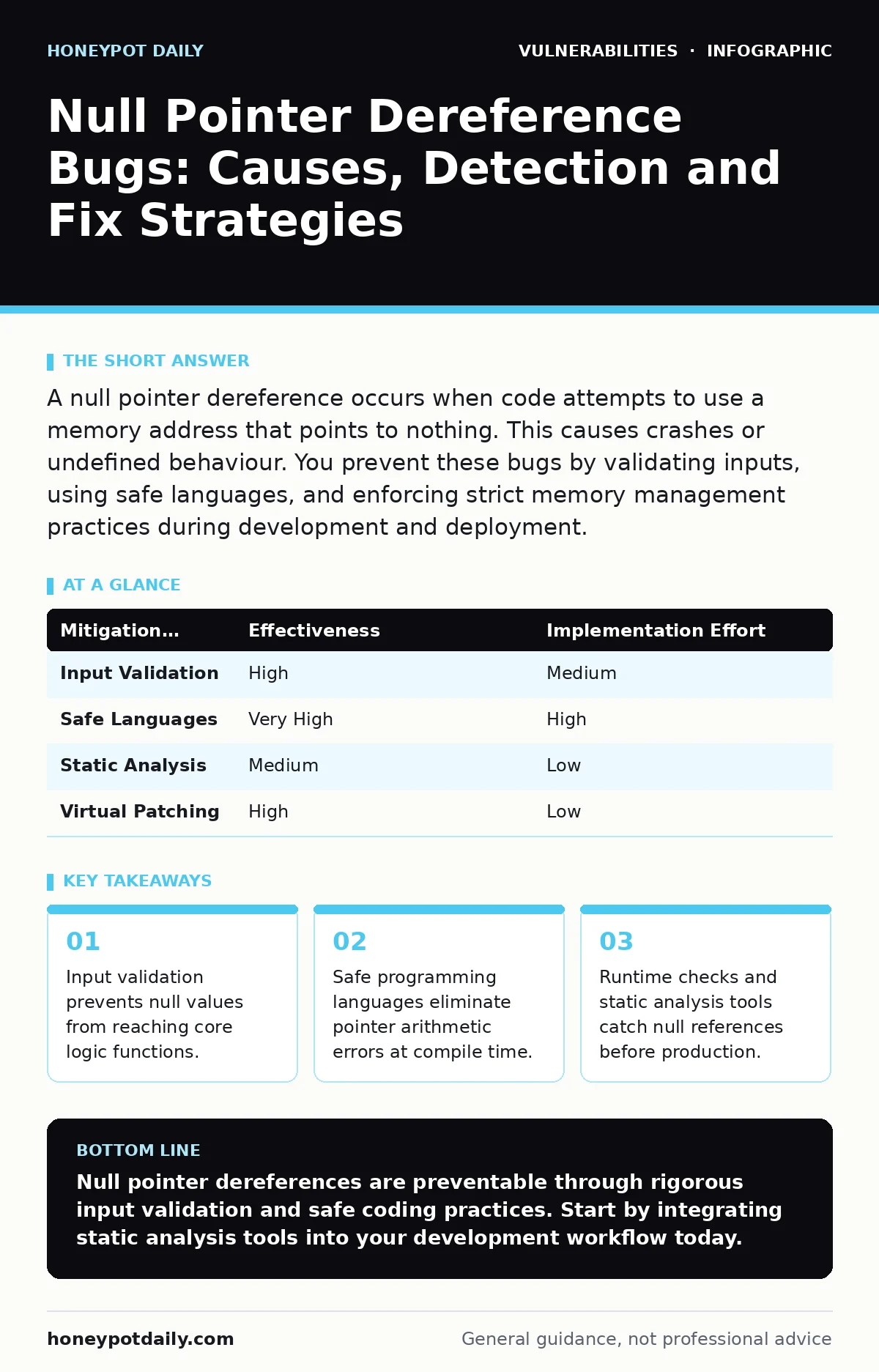
A null pointer dereference occurs when code attempts to use a memory address that points to nothing. This causes crashes or undefined behaviour. You prevent these bugs by validating inputs, using safe languages, and enforcing strict memory management practices during development and deployment.
What is a null pointer dereference?
A null pointer dereference happens when software tries to read from or write to a memory address that is null. Null represents an empty or non-existent object reference. The operating system typically terminates the program immediately to prevent further corruption. This behaviour creates a denial of service condition for users.
Why do null pointer dereferences occur in code?
Developers often assume that data structures always contain valid objects. Reality differs when network packets are malformed or databases return empty results. The code proceeds without checking if the object exists first. This assumption fails under edge cases or unexpected input.
How do attackers exploit null pointer dereferences?
Attackers craft specific inputs that trigger the null reference condition. They aim to crash the service for denial of service impact. In some cases, the crash bypasses authentication checks or leaves systems in an insecure state. This exploitation vector remains effective against poorly validated applications.
Can static analysis tools find these bugs?
Static analysis tools examine source code without executing it. They identify paths where a variable might be null when accessed. These tools reduce the number of bugs reaching production significantly. They do not catch every instance, especially in complex logic flows.
What is the difference between stack and heap null pointers?
Stack pointers relate to local variables within a function call. Heap pointers relate to dynamically allocated memory managed by the application. Both can be null, but heap issues often involve memory leaks or double frees. Stack issues usually stem from missing initialisation.
How do safe languages prevent null pointer issues?
Languages like Rust or Java enforce strict type systems. Rust uses ownership models that prevent dangling references at compile time. Java throws explicit exceptions when null references are accessed. These mechanisms shift error handling from runtime crashes to controlled code paths.
Does virtual patching help with null pointer bugs?
Virtual patching applies rules at the network or application layer. It blocks malicious inputs that trigger the vulnerability. This approach provides immediate protection without changing source code. It does not fix the underlying code defect permanently.
What is the hidden cost of ignoring null checks?
Ignoring null checks leads to unpredictable system behaviour beyond simple crashes. Attackers may chain this bug with authorization bypass vulnerabilities to gain access. The lack of validation often indicates broader quality issues in the codebase. These systemic weaknesses increase overall risk exposure.
| Mitigation Strategy | Effectiveness | Implementation Effort |
|---|---|---|
| Input Validation | High | Medium |
| Safe Languages | Very High | High |
| Static Analysis | Medium | Low |
| Virtual Patching | High | Low |
How do you test for null pointer dereferences?
Penetration testing includes fuzzing inputs to trigger unexpected states. Testers send malformed data to see if the application crashes. They also review code for missing null checks. Automated tools can simulate these attacks at scale.
What is the role of firmware updates in fixing these bugs?
Firmware updates often contain patches for deep system-level null pointer issues. These updates address vulnerabilities in embedded devices or hardware controllers. Delaying these updates leaves critical infrastructure exposed. Regular update schedules are necessary for long-term security.
How does exposure management relate to these bugs?
Exposure management identifies all assets that could be affected by the bug. It maps the attack surface to understand potential impact. This visibility helps prioritise which null pointer bugs to fix first. It ensures that critical services receive attention quickly.
What are common mitigations and workarounds?
Mitigations include adding null checks before every pointer access. Workarounds might involve restarting services after a crash. Permanent fixes require rewriting the affected code sections. Temporary measures buy time but do not eliminate the risk.
How do Kubernetes misconfigurations amplify this risk?
Kubernetes misconfigurations can allow containers to access host memory. If a container crashes due to a null pointer, it might affect the node. Proper isolation limits the blast radius of such crashes. Configuration audits prevent these amplification scenarios.
What is the impact on penetration testing reports?
Penetration testing reports highlight null pointer dereferences as high-risk findings. They detail the potential for denial of service or code execution. Recommendations include code review and testing. These reports drive remediation efforts in development teams.
How do weak password policies interact with these bugs?
Weak password policies do not directly cause null pointer bugs. However, they allow attackers to authenticate and trigger the bug. This combination increases the likelihood of successful exploitation. Strong authentication reduces the attack surface.
What is the long-term strategy for prevention?
Long-term prevention involves adopting safe programming practices. Teams must enforce code reviews and automated testing. Education on secure coding standards is necessary. Continuous monitoring ensures that new bugs are caught early.
Key takeaways
- Input validation prevents null values from reaching core logic functions.
- Safe programming languages eliminate pointer arithmetic errors at compile time.
- Runtime checks and static analysis tools catch null references before production.
Null pointer dereferences are preventable through rigorous input validation and safe coding practices. Start by integrating static analysis tools into your development workflow today.
Frequently asked questions
Is a null pointer dereference the same as a buffer overflow?
No, a null pointer dereference accesses an empty reference, while a buffer overflow writes beyond allocated memory. Both cause crashes but have different root causes.
Can a null pointer dereference lead to remote code execution?
Rarely, but it is possible if the attacker can control the memory layout. Most often, it results in a denial of service condition.
How often should I run static analysis for these bugs?
Run static analysis on every code commit. This ensures that new null pointer issues are caught before they reach production.
Do all programming languages suffer from null pointer issues?
No, languages like Rust and Go handle null safety differently. Traditional languages like C and C++ are more prone to these errors.
How this guide was produced: written by the Honeypot Daily editorial team with AI assistance, checked against the public references listed below, and reviewed when the facts change. See our editorial policy or report an error.