
Privileged Access Management: Definition, Purpose and Mechanics
Privileged access management breaks the link between identity and persistent power, ensuring that elevated rights exist only for the duration of a specific task.
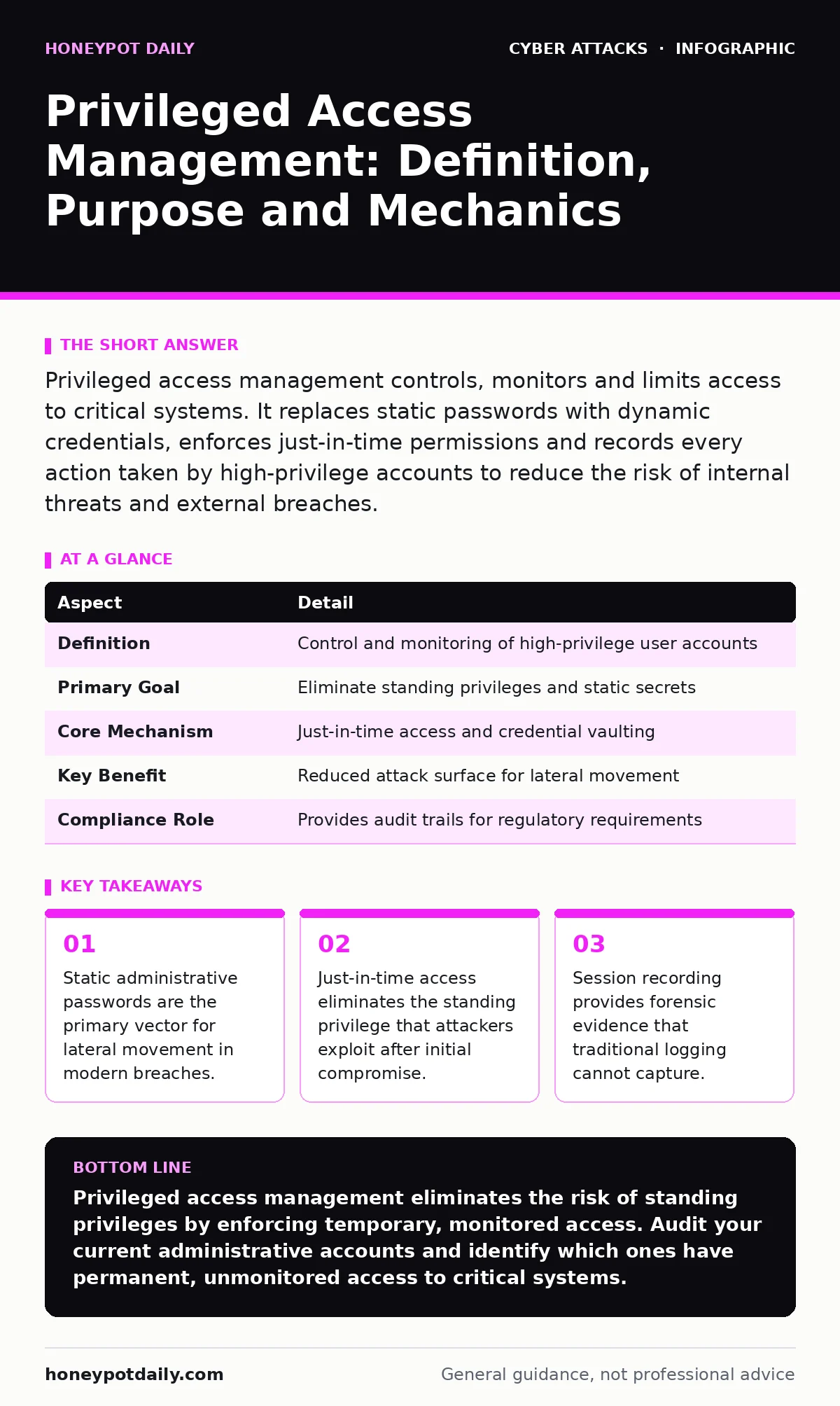
Privileged access management controls, monitors and limits access to critical systems. It replaces static passwords with dynamic credentials, enforces just-in-time permissions and records every action taken by high-privilege accounts to reduce the risk of internal threats and external breaches.
The Keys to the Kingdom
Imagine a hotel where the head housekeeper holds a master key that opens every room, the safe and the staff offices. If that key is stolen, the thief has unrestricted access to the entire property. Most organisations operate similarly. Administrators hold permanent, high-level credentials that grant unfettered access to servers, databases and cloud environments. This convenience creates a single point of failure.
Privileged access management addresses this structural weakness. It is a framework of policies, technologies and processes designed to restrict access to critical resources. The goal is not to stop administrators from doing their jobs. The goal is to ensure they can only do what is necessary, for as long as necessary, and with full visibility for auditors.
| Aspect | Detail |
|---|---|
| Definition | Control and monitoring of high-privilege user accounts |
| Primary Goal | Eliminate standing privileges and static secrets |
| Core Mechanism | Just-in-time access and credential vaulting |
| Key Benefit | Reduced attack surface for lateral movement |
| Compliance Role | Provides audit trails for regulatory requirements |
The Problem of Standing Privilege
The core issue is not that administrators need power. They do. The problem is that they keep it. Standing privilege means an account retains elevated rights even when no administrative task is being performed. This creates a persistent target. Attackers know that once they compromise a standard user account, the next step is to find a way to elevate privileges.
If administrative credentials are stored in plain text on a laptop or reused across multiple systems, a single breach grants wide-ranging access. This is known as lateral movement. The attacker moves from a low-privilege foothold to high-value assets. Traditional perimeter defences often fail here because the traffic appears legitimate. It comes from an authorised account that the system trusts implicitly.
Core Components of the Framework
A functional privileged access management solution relies on three interconnected mechanisms. First is the vault. This is a secure repository that stores privileged credentials. Administrators do not know the passwords. They request access through the vault, which injects the credentials directly into the session. This prevents credential theft via keyloggers or memory scraping.
Second is just-in-time access. Instead of permanent admin rights, users receive temporary elevation. The system grants access for a defined period, such as thirty minutes. Once the timer expires, the privilege is revoked automatically. This closes the window of opportunity for attackers who may have captured a session token but not the underlying credentials.
Third is session recording and monitoring. Every keystroke and command executed during a privileged session is recorded. This allows security teams to review actions after the fact. It also enables real-time interruption if dangerous commands, such as deleting system logs or disabling security controls, are detected.
Integration with Broader Defences
Privileged access management does not operate in isolation. It sits behind the perimeter and complements other security layers. For instance, phishing simulations train users to recognise social engineering attempts, but they cannot protect the admin accounts that are targeted via spear-phishing. PAM adds a second layer of defence for those high-value accounts.
It also interacts with identity verification methods. While password managers help users generate and store unique passwords for daily applications, they are not designed to handle the complex authentication workflows required for server administration. PAM systems often integrate with multi-factor authentication to ensure that even if a password is stolen, the attacker cannot authenticate without the second factor.
Consider network segmentation. If an attacker compromises a workstation, PAM limits what they can do from that machine. However, if the network is flat, they can still scan for other vulnerable services. PAM works best when combined with strict network policies that limit which devices can initiate administrative connections.
Common Misconceptions
Many organisations view privileged access management as a compliance checkbox. They implement a vault to satisfy auditors but allow users to bypass it for convenience. This defeats the purpose. If administrators can still use static passwords, the vault is merely a backup, not a control. The security benefit comes from enforcing the use of the vault for all privileged activities.
Another misconception is that PAM replaces the need for strong identity hygiene. It does not. If the underlying identity is compromised through a baiting attack or credential stuffing, the attacker may still gain access to the PAM portal. PAM assumes the identity is valid. It controls what that identity can do. It does not prove who the identity belongs to at the moment of access.
Some teams believe that monitoring alone is sufficient. Recording sessions is valuable, but it is reactive. You cannot undo damage after it has occurred. The proactive element lies in restricting the actions available during the session. Limiting command sets and enforcing approval workflows for high-risk operations is more effective than simply watching what happens.
See also: Account Lockout Policies: Implementation, Testing and Maintenance · Just-In-Time Access: Zero Standing Privileges for Cloud Security
The Hidden Cost of Visibility
There is a trade-off between security and operational efficiency. Strict PAM controls can slow down incident response. When a critical system fails, an administrator needs immediate access. Requiring multi-factor authentication and approval workflows can add minutes to the recovery process. These minutes matter during an outage.
Organisations must balance security with availability. Some PAM solutions offer emergency break-glass accounts. These are pre-authorized, high-privilege accounts that bypass standard controls in extreme emergencies. However, their use must be heavily monitored and reviewed. If break-glass accounts are used routinely, they become the new standing privileges, negating the security benefits of the PAM implementation.
What People Get Wrong
The most common error is focusing only on human users. Privileged access management often overlooks service accounts and API keys. These non-human identities run automated processes, backups and integrations. They rarely change passwords and often have broad permissions. Attackers increasingly target these accounts because they are easier to compromise than human users who have multi-factor authentication.
A comprehensive approach includes machine identities. These credentials must be stored in the vault, rotated regularly and monitored for unusual usage patterns. Ignoring non-human privileges leaves a significant blind spot. An attacker who compromises a service account can often move laterally to human-administered systems, bypassing the controls designed for people.
Key takeaways
- Static administrative passwords are the primary vector for lateral movement in modern breaches.
- Just-in-time access eliminates the standing privilege that attackers exploit after initial compromise.
- Session recording provides forensic evidence that traditional logging cannot capture.
Privileged access management eliminates the risk of standing privileges by enforcing temporary, monitored access. Audit your current administrative accounts and identify which ones have permanent, unmonitored access to critical systems.
Frequently asked questions
Does privileged access management replace multi-factor authentication?
No. MFA verifies identity, while PAM controls what that identity can do. They are complementary layers of defence that should be used together.
Can privileged access management prevent insider threats?
It mitigates them by limiting access and recording actions. It cannot stop a determined insider with legitimate access, but it makes their actions visible and reversible.
How does privileged access management handle emergency access?
It typically provides break-glass accounts or expedited approval workflows that allow immediate access during critical incidents, with mandatory post-incident review.
Is privileged access management only for large enterprises?
No. Any organisation with administrative accounts that access sensitive data or critical infrastructure benefits from controlling those privileges, regardless of size.
How this guide was produced: written by the Honeypot Daily editorial team with AI assistance, checked against the public references listed below, and reviewed when the facts change. See our editorial policy or report an error.