
Ransomware Payment Debate: Why Common Logic Fails Your Security Strategy
Paying ransomware operators often accelerates future attacks, while refusing payment shifts the burden to internal recovery capabilities and forensic investigation.
The ransomware payment debate is not about morality but economics and operational risk. Paying does not guarantee data return, funds criminal infrastructure, and may violate sanctions. Refusing payment requires verified immutable backups and rapid incident response. Misreading these dynamics leads to costly strategic errors during active breaches.
Misreading: Payment Guarantees Data Recovery
Many assume that transferring cryptocurrency ensures the return of encrypted files. This is a false equivalence. Operators are anonymous entities with no legal obligation to honour agreements. They frequently demand additional payments after the initial transfer. They may provide corrupted decryption keys or simply disappear. The mechanism of encryption is one-way; only the operator holds the private key. Without verification of their intent and capability, payment is a speculative transaction. It buys a chance, not a certainty.
Correct reading: Payment is a high-risk gamble with no contractual enforcement. You must assume that paying will not restore access. Your recovery plan should not rely on the operator’s honesty. Focus on technical recovery methods instead.
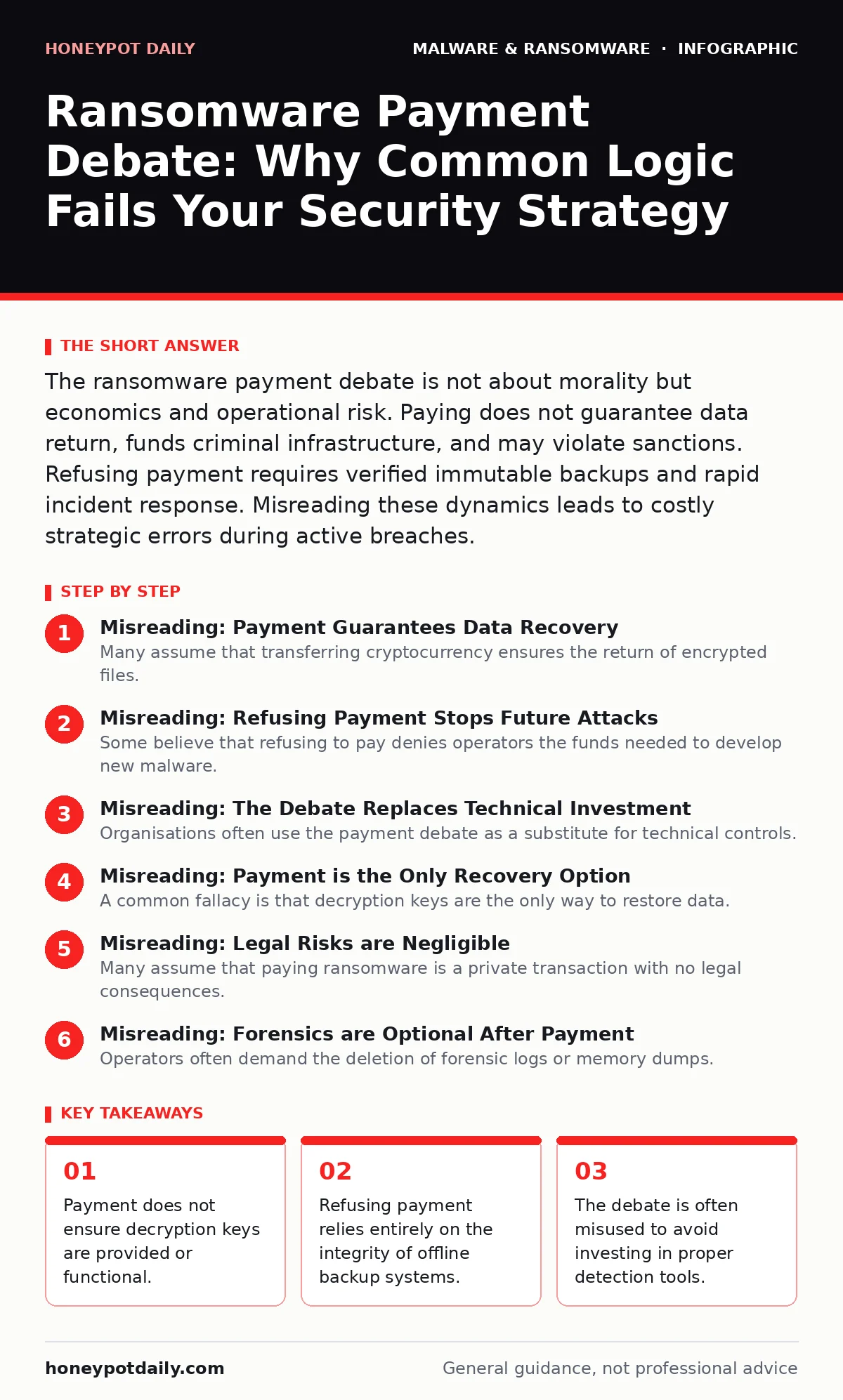
Misreading: Refusing Payment Stops Future Attacks
Some believe that refusing to pay denies operators the funds needed to develop new malware. This logic ignores the global scale of criminal infrastructure. Operators often have multiple revenue streams and backup funding. Denying one victim does not cripple their operations. Furthermore, successful non-payment can signal to other operators that your organisation is a difficult target. This may increase scrutiny and attack frequency. The economic model of ransomware is resilient to individual refusals.
Correct reading: Refusing payment is an operational stance, not a deterrent strategy. It does not stop the wider ecosystem. It forces you to rely on your own resilience. You must prepare for increased targeting if you become known as a non-payer.
Misreading: The Debate Replaces Technical Investment
Organisations often use the payment debate as a substitute for technical controls. They argue about ethics while neglecting detection capabilities. This misreading diverts attention from critical infrastructure weaknesses. If you cannot detect initial access, payment decisions are irrelevant. You need to know when an operator has entered your network. Without visibility, you cannot negotiate or contain the breach. Ethical arguments do not patch vulnerabilities.
Correct reading: Technical controls are the foundation of any ransomware strategy. Detection and response capabilities determine your options. You must invest in tools that identify malicious activity early. Refer to our guide on next-generation antivirus for baseline protection strategies.
Misreading: Payment is the Only Recovery Option
A common fallacy is that decryption keys are the only way to restore data. This ignores the value of offline backups. If your backups are isolated from the network, they remain usable. The debate often obscures the technical reality of data redundancy. Operators encrypt data on connected systems. They cannot reach air-gapped storage. Your ability to refuse payment depends on this isolation. Without it, you are forced into a corner.
Correct reading: Offline backups are the true alternative to payment. They provide leverage and operational continuity. Ensure your backup architecture prevents remote modification. See our guide on immutable backups for implementation details.
Misreading: Legal Risks are Negligible
Many assume that paying ransomware is a private transaction with no legal consequences. This is incorrect. Sanctions regimes restrict payments to certain entities and regions. Financial institutions may report large cryptocurrency transfers. Regulatory bodies may investigate the source of funds. Compliance failures can result in significant penalties. The legal framework is complex and evolving. Ignoring it exposes your organisation to secondary liabilities.
Correct reading: Legal compliance is a critical factor in payment decisions. Consult legal counsel before any transfer. Understand the jurisdiction of the operator and the funds. Failure to comply can exacerbate the incident.
Misreading: Forensics are Optional After Payment
Operators often demand the deletion of forensic logs or memory dumps. Some assume this is a reasonable condition for decryption. This is a dangerous misconception. Forensic data is vital for understanding the attack vector. It helps prevent recurrence and supports law enforcement. Deleting evidence hampers your ability to secure the environment. It also may violate legal obligations to preserve data. The cost of losing forensic insight is long-term vulnerability.
Correct reading: Preserve all forensic evidence regardless of payment status. Memory forensics can reveal hidden processes and credentials. Use this data to harden your defences. Refer to our guide on memory forensics for preservation techniques.
Misreading: All Ransomware is the Same
Treating all ransomware incidents as identical leads to poor decisions. Different malware families have different behaviours and capabilities. Some operators are more likely to honour agreements than others. Some use double extortion tactics, leaking data if unpaid. Understanding the specific variant changes the risk calculation. Generic advice fails in nuanced scenarios. You must analyse the specific threat actor.
Correct reading: Identify the specific ransomware variant before deciding. Research their history and tactics. This information informs your negotiation and recovery strategy. See our guide on malware families for classification details.
Key takeaways
- Payment does not ensure decryption keys are provided or functional.
- Refusing payment relies entirely on the integrity of offline backup systems.
- The debate is often misused to avoid investing in proper detection tools.
- Economic incentives for operators change based on payment trends.
Frequently asked questions
Does paying ransomware reduce the chance of future attacks?
No, paying often marks your organisation as a profitable target. It may increase the frequency and sophistication of future attempts.
Can I decrypt ransomware without paying?
Only if you have clean, offline backups or if a decryption tool has been released for that specific variant. Most modern ransomware requires the operator’s key.
What are the legal risks of paying ransomware?
Payments may violate international sanctions and financial regulations. They can lead to fines, investigations, and reputational
How this guide was produced: written by the Honeypot Daily editorial team with AI assistance, checked against the public references listed below, and reviewed when the facts change. See our editorial policy or report an error.